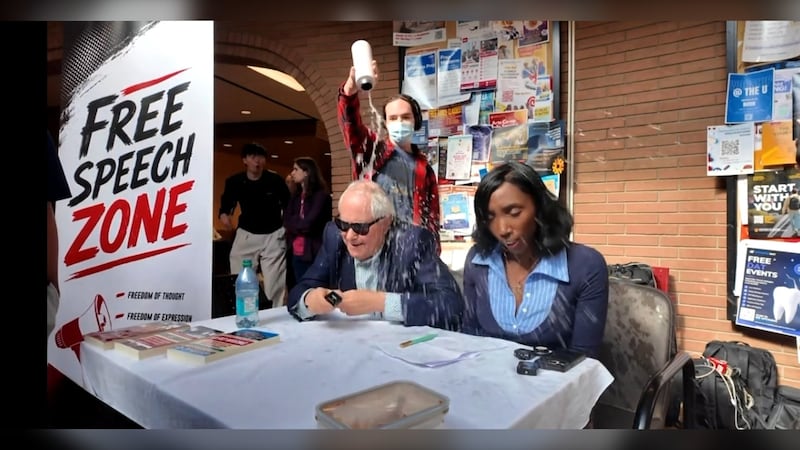
A debate at the University of Calgary over whether Canada’s residential school system should be considered genocide has drawn criticism from Indigenous students, while organizers say the event was intended to encourage discussion about a difficult part of Canadian history. The event was held Sept. 29 in the science theatres atrium, one day before the National Day for Truth and Reconciliation. University of Calgary professor emeritus Tom Flanagan and Rebel News reporter Drea Humphrey were invited to discuss the issue with students at an information table organized by a student free-speech group. Some students described the event as residential school denialism, while organizers rejected that characterization and said the purpose was to allow people with differing views to speak directly with one another. Hurtful event: Indigenous students Indigenous UCalgary student Mizze Walker said she was disappointed to see the discussion taking place outside a classroom in the Faculty of Arts and Social Sciences, where she is studying Indigenous studies. “Honestly, it was very disheartening. Aggravating and infuriating,” Walker said. Walker said the question of whether residential schools constituted genocide should not be treated as an academic exercise. “This is not a debatable topic. This is not free speech. This isn’t something that is debated,” she said. Walker is a member of a First Nation in New Brunswick and said her father, William Albert Walker, attended Shingwauk Residential School in Sault Ste. Marie, Ont. She said the event was particularly difficult because it was held immediately before the National Day for Truth and Reconciliation. “It’s devastating,” Walker said, adding that students had reached out to university offices seeking answers about how the event was allowed to take place. She said students were also frustrated that they had not received an explanation about the timing of the event. “There’s no accountability,” Walker said. Another Indigenous student, Jay Maudsley, also described the event as “sickening.” Maudsley said his own family was directly affected by residential schools and that the history continues to affect Indigenous families today. “My family was directly affected. So many people’s families were directly affected and continue to be affected to this day,” he said. Maudsley said students should be able to discuss difficult historical questions, but argued the event crossed a line. “Hate speech is not free speech,” he said. Free expression rules apply: U of C The University of Calgary said the event was organized by an external party and that it does not endorse the views expressed. However, the university said its free-expression rules require it to allow lawful expression on campus, including ideas that may be considered offensive or objectionable. Vice-provost of student and campus experience Verity Turpin said the university understands why students were upset by the event, particularly given its timing “We understand that the event was deeply harmful and hurtful,” Turpin said. She said the university is committed to supporting Indigenous students and will review its policies and procedures as it considers how to move forward. “From my heart, the University of Calgary stands firmly with our Indigenous students and our Indigenous community members,” she said. The university said it is guided by its Indigenous Strategy, ii’ taa’poh’to’p, and its commitment to Truth and Reconciliation. When asked about the handling of the event and an incident involving a student throwing water, Turpin said she would not comment on the specific incident. “What I can confirm is that we are an institution of learning, and so we’ll be looking at our policies and procedures and looking at those students to see how we can move forward in a good way,” she said. The University of Calgary Students’ Union also said it had also heard concerns from students. “Our top priority is student safety and wellbeing,” president Gabriela Dziegielewska said in a statement. “We’ve heard from students about the harm this event caused, particularly those whose loved ones went through the residential school system.” The students’ union said it was encouraging impacted students to seek support. “We think it’s important to remember this is not just an intellectual exercise, but something that affected real people,” the statement said. Organizers defend discussion William Diaz-Berthiaume, national campus coordinator for Canadian Students for Free Speech, said the event was intended to create an opportunity for students to debate the historical record. “No one is denying that residential schools were an atrocity, and that children were cruelly separated from their family, and many raped and abused,” Diaz-Berthiaume said. “That’s a horrible fact, and no one is denying this tragedy in our country’s history.” Diaz-Berthiaume said the group instead wanted students to have a conversation rather than simply hear competing views from a distance. “The goal was simple: have a conversation,” he said. He said conversations between Flanagan, Humphrey and students were respectful for roughly an hour and a half before the situation became disruptive. “When people stop talking, violence happens,” Diaz-Berthiaume said. “Where people don’t talk, and see the opposite side as the enemy, there is no reconciliation.” He said the group did not take a position on whether residential schools should be classified as genocide. “The question was whether or not it was genocide,” Diaz-Berthiaume said. Wanted students to challenge views: Flanagan Flanagan said the purpose of the event was to engage students in a discussion about residential schools and, specifically, the use of the term genocide. “The purpose was to engage students in discussion about Indian residential schools, and particularly about labeling of those schools as being genocidal,” he said. Flanagan said the first part of the event involved students approaching the table and asking questions. “Things were going pretty smoothly,” he said. He said the conversation later became more heated, with people shouting and swearing before water was poured on him and Humphrey. Flanagan said he did not organize the event or select the date. He said the timing provided an opportunity to discuss the issue because public attention was already focused on residential schools. “I think the days surrounding the National Day are a good chance for discussion because people’s attention is drawn to the issue,” he said. “I don’t think we should stop talking just because the government has declared a day a national day.” Flanagan also disputed several commonly cited descriptions of the residential school system, including claims surrounding the discovery of potential unmarked graves at the former Kamloops Indian Residential School. He argued that some accounts of the schools have overstated what is known about the deaths of children and the circumstances surrounding their attendance. Flanagan said children did die at residential schools, including from infectious diseases, but disputed what he described as broader claims about the number of deaths and the circumstances in which children were taken from their families. Those views have been strongly challenged by Indigenous students and others who argue the historical record documents widespread abuse, forced separation from families and lasting intergenerational harm. No charges will be laid: CPS The debate also led to a police investigation after a person threw water at someone at the table. Calgary police said officers were called to the university at about 1:30 p.m. on Sept. 29 for a disturbance involving an information table. Police said an individual threw water from a bottle, striking a person at the table. Campus security separated those involved and remained at the scene until officers arrived. No injuries were reported. Police said the person was taken into custody while officers investigated, but criminal charges would not be pursued and the individual was released. Walker said the water incident was not connected to the Indigenous students who were protesting the event. “That was not us,” she said. She said students wanted an opportunity to express their concerns rather than confront the people at the table. Students plan event Walker said Indigenous students are now organizing their own event on campus. The gathering is planned for Oct. 6 outside MacEwan Hall near the rainbow stairs from 11 a.m. to 2 p.m. She said the event will focus on Indigenous voices and culture and give students an opportunity to speak about their experiences and what they want to see from governments and institutions. Walker said the goal is to insure future generations of Indigenous students feel respected, honoured and safe on campus. “We want to raise our voices,” she said. She encouraged both Indigenous and non-Indigenous students to attend.