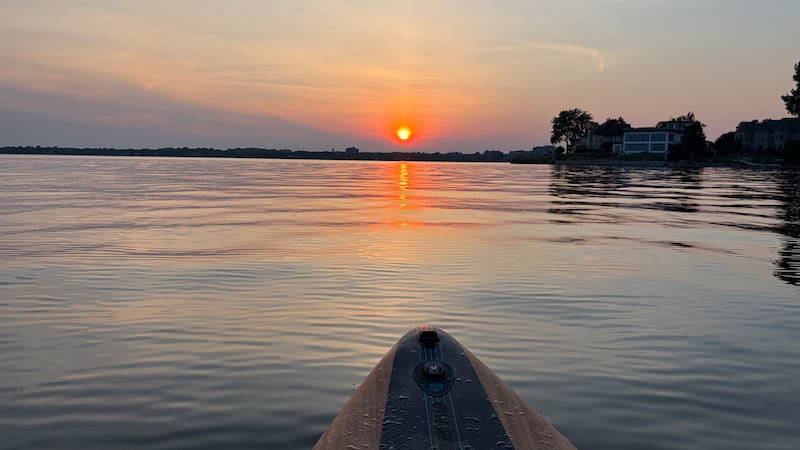
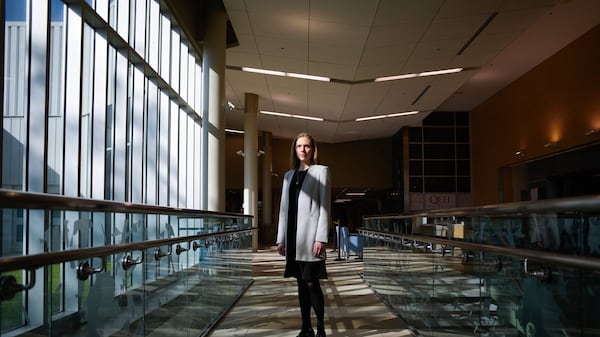
The sky turned orange on Wednesday as smoke from wildfires in northern Ontario drifted south. “Even though we’re thousands of kilometres away from some of these wildfires, we’re being impacted by pretty bad air quality,” said Anabela Bonada, managing director of climate science and the Intact Centre on Climate Adaptation at the University of Waterloo. Environment Canada raised its Air Quality Health Index (AQHI) for Waterloo Region and surrounding communities to 10 plus, which is the top of the scale and considered “very high risk.” IQAir, which tracks global air quality data, ranked Toronto’s air quality the worst in the world on Wednesday morning. Five local cities also made the top 10 most polluted communities in Ontario, based on the organization’s Air Quality Index (AQI). Kitchener came in at number two, followed by Waterloo in third. Guelph and Erin were back-to-back at seven and eight, with Breslau rounding out the list. The determination is based on fine particles in the air, which are invisible to the naked eye and made of various pollutants, including soot, smoke, dust and other elements found in wildfires. “It’s made up of really tiny particles that are measured by 2.5 micrometres [PM2.5] or less,” Bonada explained. “That’s way less than what your hair strand is. Your hair strand is 70 times that size. So, when that enters your body, if you breathe it, it can go to your blood system and into your lungs. It can make you feel kind of sick, dizzy, fatigued.” According to IQAir, Kitchener had an AQI of 291 around noon, or “very unhealthy.” “PM2.5 concentration is currently 43.2 times the World Health Organization annual PM2.5 guideline value,” the organization’s website said. The smoky weather is expected to continue Thursday but improve by Friday morning. How to protect yourself Region of Waterloo Public Health, County of Brant, Grand Erie Public Health, and Huron Perth Public Health all issued air quality alerts on Wednesday. “You may experience mild and common symptoms such as eye, nose and throat irritation, headaches or a mild cough,” Environment Canada said. “More serious but less common symptoms include wheezing, chest pains or severe cough. If you think you are having a medical emergency, seek immediate medical assistance.” Reactions can also vary from person to person. “Some people are at higher risk,” explained Dr. Megan Davis, a resident doctor for Region of Waterloo Public Health. “People aged 65 and older, pregnant people, infants and young children, people with an existing illness or chronic health condition, and people spending extended periods outdoors are more likely to be impacted by the effects of wildfire smoke and should take extra precautions.” They are also urged to limit their time outdoors, reschedule or cancel outdoor sports, activities and events. If that’s not possible, Environment Canada recommended wearing a well-fitted mask, such as a NIOSH-certified N95 or equivalent respirator, to reduce exposure to fine particles in the air. When indoors, keep windows and doors closed as much as possible. Environment Canada acknowledged that it might be difficult as the temperatures climbs. “Both having the heat and the poor air quality can definitely exacerbate the effects of both heat and air quality,” Davis said. In that situation, people should prioritize staying cool. “Closing your windows is imperative,” Bonada said. “Try to have an air filter to help clean the air inside the home so that you can remain safe. If you have a cooler space in your home or in your building, try to sleep there if that’s possible.” Sign of the season Bonada said there has been more wildfires across the country since 2023. While Canada has changed how it manages these events, she thinks more can be done to combat the effects of climate change. “[It is] making our wildfire season longer, it’s making certain areas of the country dry even faster,” she explained. “We actually have drought conditions happening right now, for example, in Newfoundland and Labrador, where it shouldn’t be happening at this time of year. So, we have a higher risk of wildfire occurring [there]. The last thing that climate change does for wildfire risk is there are more hot, dry, windy days. Those days are perfect for spreading the flames, which can lead to more wildfires and lead to more wildfire smoke.” Bonada also warned that it could become the norm during the summer. “We should be worried,” she said. “Unfortunately, for the last few years, we’ve had some of our worst wildfire seasons on record, which have translated into some of the worst air quality for us here in Canada and across the globe. Our wildfires have actually spread the smoke all the way to parts of Europe and the U.S. We should absolutely be worried.” Cancellations and changes A number of cancellations and closures were announced Wednesday as the air quality continued to deteriorate. Here are some of them: Waterloo Cambridge Kitchener Region of Waterloo Woolwich Baden Guelph West Perth Waterloo Region also has designated 56 “clean air” locations across the community, all of which are used as warming centres in the winter and cooling centres in the summer.