ADVERTISEMENT
These are the winning images for Wildlife Photographers of the Year 2026
From thriving fungi to grieving elephants, these are the winners of the 2026 Wildlife Photographer of the Year awards. The photographs are being exhibited at the Natural History Museum in South Kensington, U.K.
Published:
Image 0 of 20
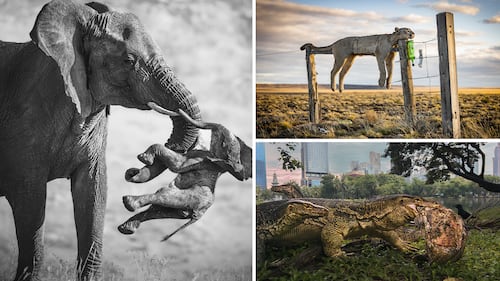
From thriving fungi to grieving elephants, these are the winners of the 2026 Wildlife Photographer of the Year awards. The photographs are being exhibited at the Natural History Museum in South Kensington, U.K.
Winner, Plants and Fungi
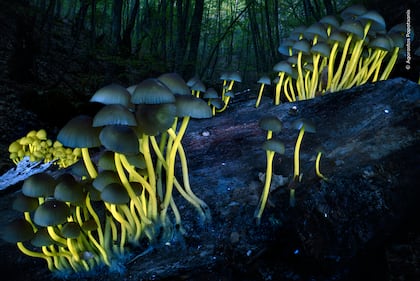
Agorastos Papatsanis (Greece) uses ultraviolet light to reveal the glowing yellow stems of beautiful bonnet mushrooms growing from a decaying log.
On the lower slopes of Greece’s Mount Olympus, Agorastos experimented with ultraviolet (UV) illumination until it revealed the strongest fluorescent response from these mushrooms known as ‘beautiful bonnets’.
While humans cannot see UV light, we can get an inkling of its effect, thanks to the phenomenon of fluorescence. Mycologists are harnessing this phenomenon to distinguish closely related species of fungi by the colours and patterns they reveal under UV.
Location: Litochoro, Pieria, Greece
Technical details: Nikon D810 + Laowa 15mm f4 lens; 8.0 sec at f20; ISO 400; UV light; focus stack of 6 images
Winner, Photojournalist Story Award
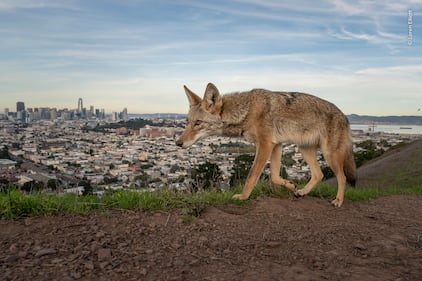
Loren Elliott (USA) opens a window into the lives of the often-misunderstood coyotes living in the environs of San Francisco on the West Coast of the United States.
Around 100 of these urban-adapted wild canines live alongside more than 800,000 human inhabitants, and attitudes towards them are mixed. While coyotes sometimes prey on domestic animals, they also bring benefits such as controlling disease-carrying rodents.
In this portfolio, Loren invites us to reconsider our perceptions of these wild animals and their place in urban environments, living alongside humans.
Technical details: Sony α9 II + 20mm f1.8 lens; 1/800 at f5.6; ISO 250; 2x Pocket Wizard Plus IIIe radio triggers
Winner, Portfolio Award
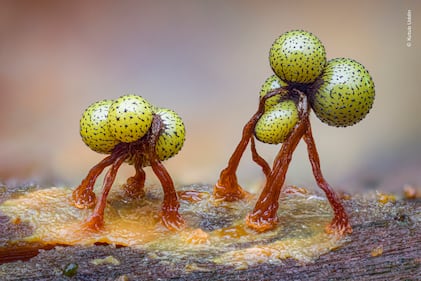
Kutub Uddin (Bangladesh/UK) reveals a magical and often surreal world of slime moulds that can barely be seen with the naked eye.
Kutub became interested in slime moulds in 2024, and as a macro photographer now devotes much of his time to revealing this tiny hidden world. He loves exploring his local woodlands in southeast England, where fallen logs and damp forest floors provide opportunities for discovering these fascinating organisms.
Slime moulds occur throughout the world, mostly growing on dead wood or leaf litter while feeding on other micro-organisms. The structures depicted in this portfolio are just one to two millimetres high (less than 1/12 of an inch).
Location: West Sussex, England, UK
Technical details: Canon EOS R5 + 65mm f2.8 1-5x macro lens; 1/4 at f3.2; ISO 400; diffused flash; Cognisys StackShot macro rail; Benro Bat tripod; focus stack of 124 images
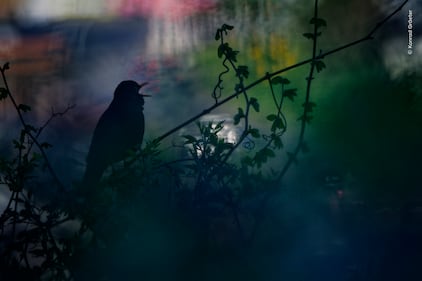
Winner, 15-17 Years
Konrad Gräeter (Germany) highlights a male blackbird singing in a vineyard early one April morning.
Konrad had to crouch down low on the steep slope of the vineyard and point his camera through a gap in the foliage to frame the blackbird within its landscape.
Blackbirds can be heard singing at different times of day, but their songs have the most complex compositions at dawn. During the spring breeding season, the males sing from elevated vantage points to proclaim their territory and to attract a mate. Females respond with a softer sound, known as a subsong, during courtship.
Location: Baden-Württemberg, Germany
Technical details: Fujifilm X-H2S + 150–600mm f5.6–8 lens; 1/800 at f8; ISO 400
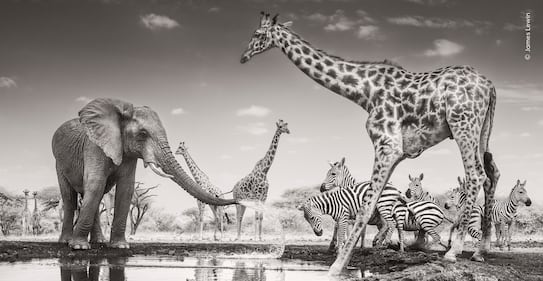
Winner, Animals in their Environment
James Lewin (UK) watches a young bull elephant spray a group of zebra as they congregate in the Kenyan Chyulu Hills.
While there was no shortage of subjects and action around this waterhole, James had to deal with the harsh, unforgiving light. He chose to soften the light using a camera converted to infrared, creating this dream-like scene.
Waterholes can act as vital lifelines during severe droughts. Larger animals, such as elephants, have priority over others for access to waterholes. Herbivores spend more time at these drinking spots when elephants are present, possibly because their size deters predators, although competition for access to water may also prolong herbivores’ stay.
Location: ol Donyo Lodge, Chyulu Hills National Park, Makueni County, Kenya
Technical details: Nikon Z 7II + 28–75mm f2.8 lens; 1/800 at f7.1 (+1 e/v); ISO 800; camera converted to infrared
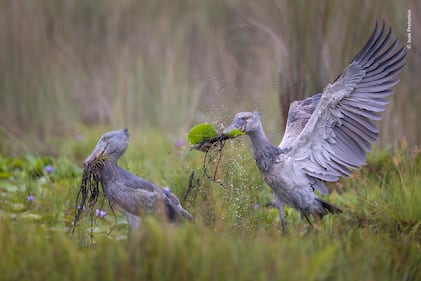
Winner, Behaviour: Birds
Isak Pretorius (South Africa) chances across two elusive shoebill storks among wetland vegetation.
Exploring the swamp in a narrow canoe with a guide, Isak felt exceptionally lucky to see not one but two elusive shoebills. The birds pulled out vegetation, dropped it and then repeated the process several times. It’s likely this is a breeding pair gathering nesting material.
Though often called the shoebill stork, these large birds are more closely related to pelicans, herons and ibises. Fewer than 5,300 mature shoebills survive across their entire range and their numbers are decreasing.
Location: Mabamba Swamp, Wakiso District, Uganda
Technical details: Canon EOS R5 + 500mm f4 lens; 1/2500 at f4; ISO 1250
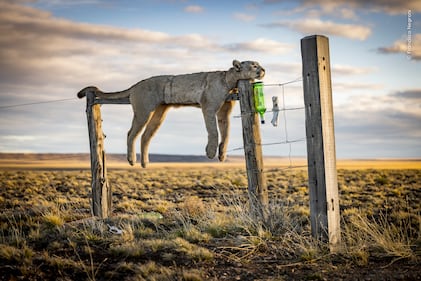
Winner, Photojournalism
Francisco Negroni (Chile) records this scene of a dead puma amid the rugged, windswept beauty of Argentine Patagonia.
Tied to the fence and presented as a hunting trophy, this display was one Francisco had ‘never witnessed or photographed before’. In 2025, Santa Cruz banned the hunting of pumas, but illegal persecution continues.
Livestock predation is one of the major causes of human–puma conflict, and it’s suggested that enclosing sheep at night and using guard dogs can significantly reduce the loss of livestock without resorting to hunting. In southern Chile, some owners have even abandoned sheep farming in favour of puma tourism.
Location: Route 40, Santa Cruz Province, Argentina
Technical details: Canon EOS R5 + 70–200mm f2.8 lens; 1/640 at f3.2; ISO 100
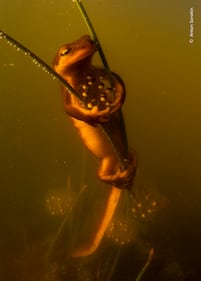
Winner, Behaviour: Amphibians and Reptiles
Anton Sorokin (USA) finds a California newt laying its eggs as it clasps vegetation that already holds another newt’s egg clutch.
Anton hadn’t seen this pose before, despite documenting newt behaviour each winter. The pond was too dirty to swim, so Anton waded along the edge, carefully dipping his camera and lighting beneath the surface to record this remarkable view of parental care.
California newts interlock their back feet to protect the clutch, which are vulnerable to predation by other newts. They will stay like this until the gelatinous mass around the eggs has swollen too large to be eaten and has solidified onto the stem.
Location: Contra Costa County, California, USA
Technical details: Nikon D850 + 8–15mm fisheye lens; 1/100 at f18; ISO 400; Nauticam housing; Seacam 60D strobes
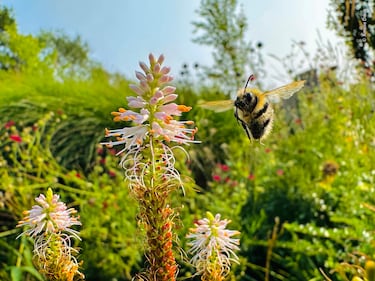
Winner, 10 Years and Under
Amelie Davis (UK) highlights a common carder bee suspended in mid-air as it flies in to land and feast on a flower in southern England.
Amelie had been taking photographs of bees for several months. On this August afternoon the garden was ‘teeming with bees’. Without her camera, Amelie borrowed her dad’s smartphone and was able to record the delicate detail of a single wingbeat.
Bees perceive plants and flowers in many ways. Distinguishing one colour for nectar and another for pollen helps them make rapid decisions when foraging. Their vision is tuned to blue, green and ultraviolet wavelengths, so they can see markings that are invisible to us.
Location: Surrey, England, UK
Technical details: Apple iPhone 14 Pro Max + 13mm built-in ultrawide lens; 1/895 at f2.2; ISO 40
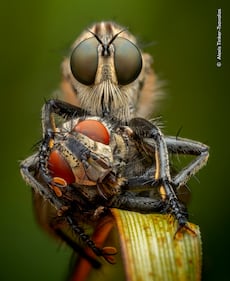
Winner, Rising Star Award
Alexis Tinker-Tsavalas (Germany) reveals the exquisite beauty of the tiniest of animals in the finest of detail.
A previous winner of the Young Wildlife Photographer of the Year award, Alexis got his first camera aged ten. His focus shifted to macro photography during the Covid-19 lockdowns, when he was unable to venture farther than the urban habitats close to home in Berlin, Germany.
By experimenting with focus stacking techniques, which involve combining multiple images with different planes of focus to increase the depth of field, Alexis wants to bring Winner Rising Star Award attention to species that often go unnoticed.
Location: Germany and Northern Ireland, UK
Technical details: Fujifilm X-H2 + Laowa 65mm f2.8 macro lens; 1/200 at f5.6; ISO 200; Godox V860III flash + Cygnustech diffuser; focus stack of 24 images
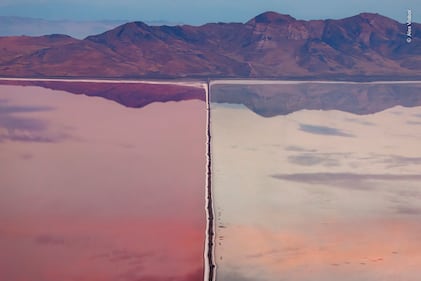
Winner, Wetlands: The Bigger Picture
Alex Visbal (Colombia) documents how a single engineered line can reshape an entire wetland.
This photograph is part of Alex’s long-term project documenting the industrial footprint on bodies of water.
The distinctive pink colour on the left is caused by bright pink microbes that thrive in extremely saline water, which happens when an area is cut off from a supply of fresh water. The ecology of the lake is in sharp decline due to industrial use, upstream diversions and climate change. Since this image was taken, the State of Utah has brought the area under conservation management.
Location: Stansbury Bay, Great Salt Lake, Utah, USA
Technical details: Canon EOS R5 Mark II + 70–200mm f2.8 lens; 1/640 at f3.2 (-0.67 e/v); ISO 1250
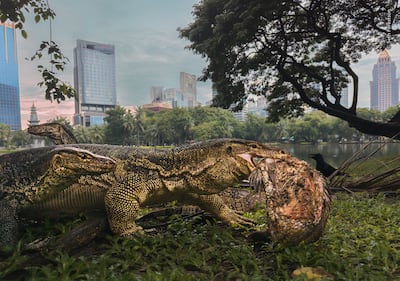
Winner, Urban Wildlife
Seth Forestson (UK) spots a common water monitor carrying its fish supper in a Bangkok park.
The challenge wasn’t finding these lizards, but catching them in action, as they spend most of the day basking in the sun. When Seth spotted this one, he lowered himself down onto the mud to frame this city dragon against the Bangkok skyline.
Common water monitors have successfully adapted to living within cities across South and Southeast Asia. They will take whatever food source is available, such as the plentiful supplies of catfish and koi in the lakes of Bangkok’s Lumphini Park.
Location: Lumphini Park, Bangkok, Thailand
Technical details: Google Pixel 7 Pro smartphone; 1/291 at f1.9; ISO 47
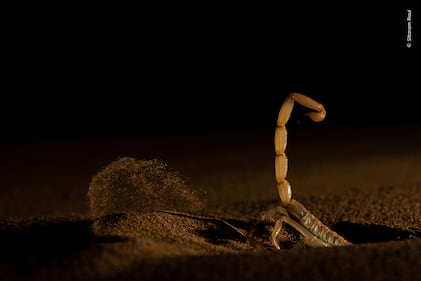
Winner, Behaviour: Invertebrates
Sitaram Raul (India) encounters a scorpion burrowing into one of the shifting dunes of the Thar Desert.
Exploring the dunes at night near the village of Sam, Sitaram saw many scorpions searching for prey. But as sunrise approached, they started burrowing to avoid the intense heat. Sitaram timed the exposure so that the excavated sand was suspended in mid-air.
Just one known species of Buthacus scorpion is from India. It uses its pincers to dig into large piles of sand. Stiff, elongated bristles or ‘sand combs’ are used like snowshoes to stop it from sinking into the dunes.
Location: Thar Desert, Rajasthan, India
Technical details: Nikon D750 + 105mm macro lens; 1/250 at f14; ISO 125; Godox flash
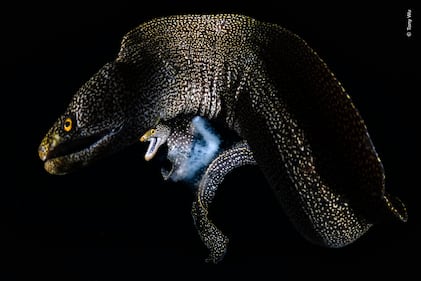
Winner, Under Water
Tony Wu (USA/Japan) provides a first-time glimpse into the mating ritual of Abbott’s moray eels.
Tony has been working with biologists to address a knowledge gap in the social behaviour of this eel species. Guided only by a dim red-light source to minimize disturbance, and using a customized fisheye camera lens, he has studied this male since 2024 as it visits females that dwell in crevices on the reef.
This is likely the first time Abbott’s moray eel courtship and spawning have been documented, and the observations from Tony’s work with biologists are feeding into published scientific studies.
Location: Kagoshima Prefecture, Kyūshū, Japan
Technical details: Sony α1 + customized Nikon fisheye 13mm f2.8 lens; 1/320 at f11; ISO 500; 2x Backscatter Hybrid HF-1 strobes
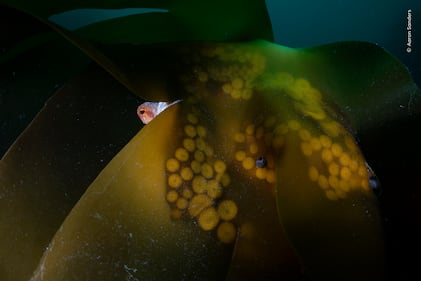
Winner, Animal Portraits
Aaron Sanders (UK) glimpses a common octopus behind a curtain of kelp in the waters off southwest England.
Aaron had been diving off Porthkerris Beach when he noticed the footprints of octopus suckers through a thin blade of kelp, and a single eye slowly emerging. ‘We remained perfectly still, watching one another with a seemingly shared curiosity,’ says Aaron.
In recent years in the waters off southwest England, there has been a dramatic increase in sightings of common octopuses, a species more frequently found in warmer Mediterranean waters. The influx or ‘bloom’ of these cephalopods has been linked to above-average springtime sea temperatures.
Location: Porthkerris Beach, Cornwall, England, UK
Technical details: Nikon Z8 + 24–50mm f4–6.3 lens + Nauticam WWL-C wet lens; 1/40 at f7.1; ISO 125; Inon Z-240 and Z-330 underwater strobes
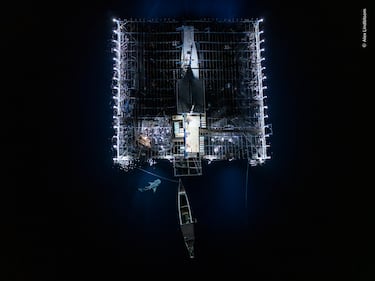
Winner, Oceans: The Bigger Picture
Alex Lindbloom (USA) finds a whale shark investigating the catch of a ‘bagan’, or mobile net-fishing platform, in the inky waters off Papua.
Alex started searching for sharks around dawn when the nets were still in the water. Initially lacking natural light for his drone’s camera, he found these sharks illuminated by the bagan’s bright lights.
Local fishing communities are using the predictable occurrence of whale sharks at bagans to attract tourists. Although contact with bagans can cause some minor injuries to whale sharks, this isn’t a major cause of mortality. The species’ significant decline in the Indo-Pacific region over the past 75 years is primarily driven by ship strikes, entanglements with fishing gear and illegal fishing.
Location: Off Cenderawasih Bay, Papua, Indonesia
Technical details: DJI Air 3 + 24mm f1.7 lens; 1/60 at f1.7; ISO 3200
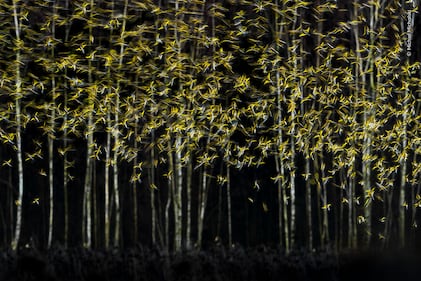
Winner, Natural Artistry
Michał Michalski (Poland) uses a slow shutter speed to create the illusion of trees still swathed in autumn foliage.
Michał was in a field of unharvested sunflowers that had attracted mixed flocks of birds, especially goldfinches and bramblings. As they took to the sky, startled by a sparrowhawk, Michał blurred the movement against a backdrop of leafless birches.
There is evidence that flocks containing multiple species forage more efficiently, partly because each brings different skills to the group. With more eyes on the lookout for predators, individuals can also afford to devote more time to feeding.
Location: Miłochowice, Lower Silesian Township, Poland
Technical details: Nikon D500 + 500mm f5.6 lens; 1/30 at f8; ISO 250
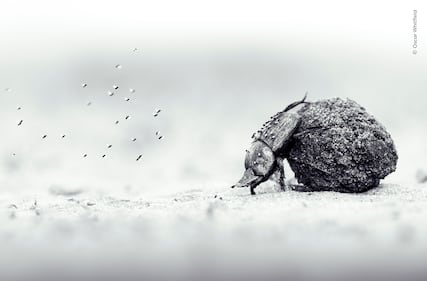
Young Wildlife Photographer of the Year 2026
Winner, 11-14 Years
Oscar Whitfield (Zimbabwe/UK) notices the arduous exertion of this dung beetle pushing its precious cargo.
Using a fast shutter speed and high light sensitivity, Oscar lay flat on the ground to photograph the beetle at eye level, with the sunshine and heat creating dry dust all around him.
There are more than 5,000 species of dung beetle found around the world, and they play a vital role in their environments. Breaking up dung and burying it prevents the conditions required for methane production, reducing the quantity of greenhouse gas emissions. Burying dung also helps it decompose faster, reducing the number of pests affecting livestock and wildlife.
Location: Zambezi National Park, Hwange District, Zimbabwe
Technical details: Canon EOS R6 Mark II + Sigma 150–600mm f5–6.3 lens; 1/1250 at f6.3; ISO 3200
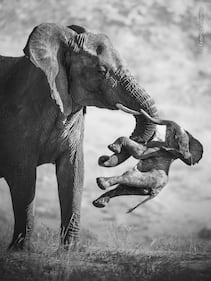
Wildlife Photographer of the Year 2026
Winner, Behaviour: Mammals
Federico Veronesi (Italy) witnesses a powerful moment of an elephant carrying a dead calf, a rare glimpse into complex animal behaviours.
Federico was tracking elephants when he came across an unusual pattern of drag marks in the sand of a dry riverbed. The source became clear when he caught up with a family group. A female emerged with the calf, its leg wedged between her tusk and trunk.
Behaviours centring on death have been observed in both Asian and African elephants, including vocalizations, guarding the dead, inspecting and handling bones, and carrying the deceased. Some researchers suggest these behaviours could indicate an elephant’s journey to understanding death, while others interpret these actions as possible displays of grief.
Location: Huab River Valley, Damaraland, Namibia
Technical details: Nikon Z8 + 400mm f2.8 lens; 1/1000 at f2.8; ISO 72