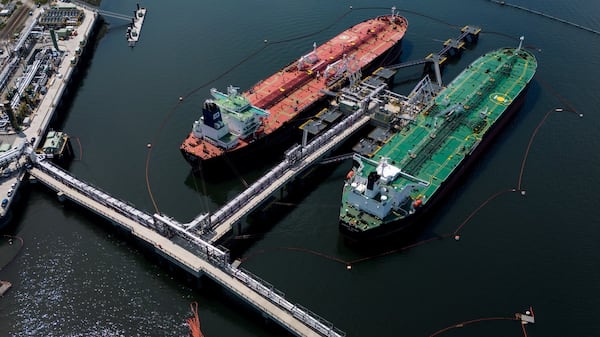
U.S. President Donald Trump on Friday backed Iraq’s efforts to assert control over its oil resources and arms, a move that cements Washington’s alignment with Baghdad as it juggles a showdown with the Kurdish region and the country’s Iran-backed militants. “We support Iraqi Prime Minister Ali al-Zaidi’s efforts to assert state authority throughout Iraq, stop the smuggling of Iraqi oil, end corruption, and bring all weapons under the exclusive control of the state,” Trump said Friday on Truth Social. “We support Prime Minister al-Zaidi’s efforts to build a united, prosperous, and strong Iraq that makes its own political decisions,” he wrote. A 41-year-old Iraqi businessman, al-Zaidi assumed power in May amid the U.S.-Iran war. He immediately launched an aggressive anti-corruption campaign that sought to consolidate both the country’s oil and arms under state control at a time when Iran-backed militias were firing at U.S. interests. The Iraqi leader is supported by U.S. Special Envoy for Iraq, Tom Barrack, who is close to Trump and considered to be influential in regional U.S. policy. “Al-Zaidi has forged a very, very strong relationship with Tom Barrack, who has the president’s ear,” Hamdi Malik, an associate fellow at The Washington Institute think tank and founder of Iraq Monitor, told CNN. In June, al-Zaidi “reaffirmed Iraq’s commitment to deepening trade and investment relations” between Iraq and the U.S., and to allowing U.S. oil companies to resume operations “with full security guarantees,” according to a joint statement. A month later Trump welcomed al-Zaidi at the White House, where he called him “a great fighter” and “a great fan of America.” Trump’s post comes amid escalating tensions with the semi-autonomous Kurdistan Region of Iraq. On Friday, state media reported that Iraq had declared that the export of crude outside the state oil company SOMO will be considered “smuggling” as revenues do not enter the state treasury. Iraqi authorities estimate that oil exported from the Kurdistan Region led to a revenue loss of more than US$100 billion between 2008 and 2025 for Baghdad, Iraqi government spokesman Haider al-Aboudi said. The Kurdistan Region, also known as Iraqi Kurdistan, is rich in oil. It has long aspired to self-determination and has for years been caught in disputes with Baghdad over oil and trade. On Thursday, Baghdad ordered the closure of all “unofficial” border crossings, including those with Syria and Iran, that were administered by the Kurdistan Region’s government. Tensions further escalated between Baghdad and Iraqi Kurdistan after demonstrations broke out Thursday over what Kurdish leaders view as an infringement of the region’s rights by Baghdad. In a rare joint statement, the Kurdish Region’s two competing parties protested Baghdad’s decision to take over oil fields and border crossings, calling it “a red line,” the Erbil-based Kurdish broadcaster Rudaw said. Trump’s post also delivered a blow to Iraq’s Iran-backed militants, who have yet to place their weapons under state control. State forces and the heavily armed Kataib Hezbollah militant group clashed last week after Iraqi forces deployed to the group’s stronghold town of Jurf al-Sakhar – one of Prime Minister al-Zaidi’s focal points in his sweeping anti-corruption campaign. Trump’s post is an unusual way of doing politics, Malik said, where the US makes its position “clear” to the Iraqis and the Kurds.