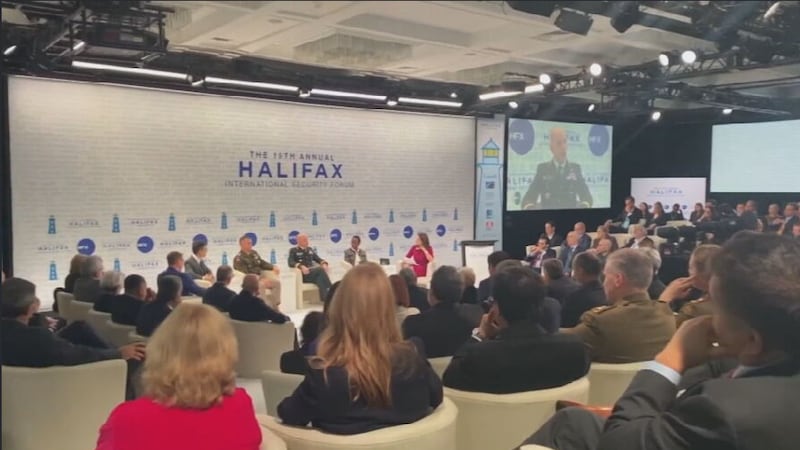
This week is National Addictions Awareness Week, and Calgary is playing host to a three-day conference to discuss addiction and mental health. The Canadian Society of Addiction Medicine’s (CSAM-SMCA) annual scientific conference is taking place in downtown Calgary from Nov. 19 to 21, with the theme being “Words Matter: The Power of Language.” “There’s lots of different ways of looking at addiction. There’s lots of different political leanings and industries involved,” said CSAM-SMCA president-elect Dr. Meera Grover. “To see a scientific committee conference where health care practitioners meet just to learn about the evidence and the medicine and find ways to help people with addiction that are evidence based is such a relief and such a nice thing to have.” One topic addressed by several speakers was involuntary versus voluntary care. Grover said a person voluntarily seeking treatment is a medically important part of recovery since there is “no evidence really supporting involuntary treatment.” Another physician attending the conference called involuntary treatment programs “criminal-based policies rather than disease-based policies.” “They’re not medically based. They’re based on criminalizing the use of substances,” said Dr. Esther Tailfeathers, Assistant-Dean of Indigenous Health at the University of Calgary. Last year, the Alberta government introduced a bill that would force people with severe substance addictions into involuntary treatment. Bill 53 — the Compassionate Intervention Act — received royal assent in May 2025 and is expected to roll out next year. In a statement, the Ministry of Mental Health and Addiction says the government “will not sit back while families across Alberta watch their loved ones suffer and die from the disease of addiction.” “Compassionate intervention is a tool of last resort, intended to treat people with the most severe substance use and addiction and provide them with life-saving treatment and a path to recovery,” the ministry said in a statement. Not everyone is convinced involuntary care is the best approach though, with several conference attendees believing voluntary care and harm reduction is the best approach. “Without adequate harm reduction, people will not survive to enter treatment facilities, and they won’t be able to join recovery peer groups. They can’t attend counseling, they can’t attend their physicians appointments,” said Dr. Spencer Krahn, co-lead of the conference committee and addiction medicine physician. A continuum of care Tailfeathers, who is a physician at the Blood Reserve and the assistant dean of Indigenous health at the University of Calgary, says she saw first-hand how a voluntary, harm-reduction based approach to treating addiction worked in her community. “We found that abstinence-based treatment actually resulted in the mortality of our people, so we looked at treatment centres that allowed opiate replacement therapy,” she said, adding that many people “didn’t survive more than three or four days” when treatment was abstinence-based. Tailfeathers’ community was hit hard by fentanyl in 2014, leading to a community developed continuum of care, she said. This resulted in trauma-based therapy and healing, which she says saw great results in helping people overcome addiction. “Many of the people who had lost their homes, their children, their employment, for the first Christmas ever had food in their cupboards, children in their home, a roof over their heads, and they were happy together,” Tailfeathers said. Destigmatizing substance use For Caitlin Morrison — the sister of Friends star Matthew Perry and executive director of the Matthew Perry House — she knows firsthand how difficult it is to watch a loved one suffer and ultimately pass away. “There’s a hopelessness feeling that comes along for a loved one,” Morrison said. “You know intellectually that the only real way that your loved one is going to find peace and happiness and wellness is if they seek it on their own, if they make a commitment to it.” “You deeply want to shake them and tell them: ‘do it, please. I love you so much. I don’t want to lose you,’” she continued. Morrison believes a major aspect of the addictions crisis is the stigma around it, saying it creates a black-and-white dichotomy that’s difficult for many to overcome. “It creates a challenge, a feeling of either I’m doing the bad thing or I’m not doing the bad thing. It prevents people from thinking about whether or not there’s a way to look at substance use as a sort of a multi-tiered health system,” Morrison said. “If they ask for that support, they feel they’ll be put into a category where they’re now not just part of the problem, but a person who is a problem,” she continued. She strongly believes destigmatizing substance use is a core component of opening the door for recovery options, as there is often a fear of reaching out for support. Youth gambling concerns Gambling addictions was another looming theme at the conference, with lots of attention directed to youth gambling. “We often lose sight of the fact that gambling disorder is a really harmful disease as well, so we need to make sure that we’re addressing those areas that are really prevalent in our in our society,” said CSAM_SMCA president Dr. Erin Knight. The federal government is preparing to cast a final vote on Bill S-211, which could lead to stricter regulations around gambling advertisements. The bill is strongly supported by CSAM-SMCA. “Most addictive disorders begin in adolescence, so focusing on that prevention and early intervention with youth is really critical,” Knight said. Among other things, CSAM-SMCA is calling for the government to include clinical care and lived experience in gambling addiction treatment, saying treatment and recovery support should be paired with prevention.