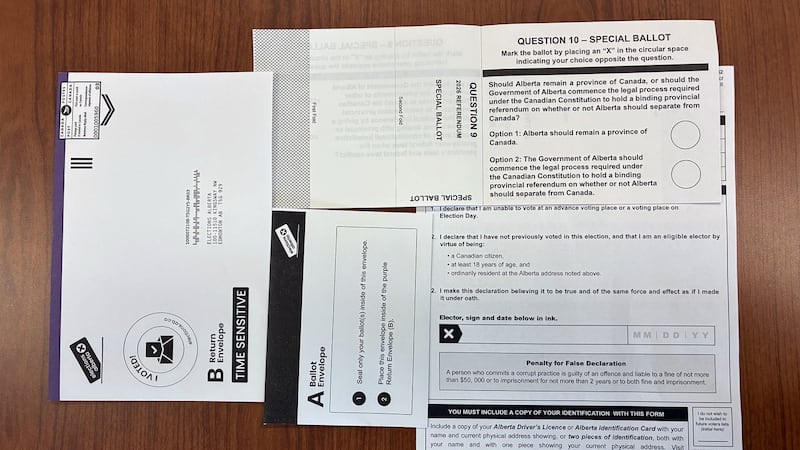
The Business Council of Alberta surveyed CEOs and entrepreneurs about their business expectations and Alberta’s economic outlook. Chief economist with the council Mike Holden joined Alberta Primetime’s Michael Higgins to discuss the results. This interview has been edited for clarity and length. Michael Higgins: What are CEOs saying about Alberta’s economic outlook? Mike Holden: They’re quite optimistic. We asked in our survey about what their business expectations were for the economy, for their own business, their hiring and investment expectations over the next 12 months, and in all cases they were very optimistic. They’re looking forward to growing, looking forward to adding more people, and thinking that better days are ahead. MH: We heard from the federal energy minister and he described the Calgary Stampede as having a palpably different feeling. How does that track with the degree of business confidence you’re seeing with these survey results? Mike Holden: I think they line up quite well. What we’re seeing from our businesses is that in spite of global turmoil, in spite of trade and tariff uncertainty, the policy environment in Canada is improving. There are opportunities that are presenting themselves in spite of all that chaos. The world is seeing Alberta as a good place in which to invest and seeing Canada as a place in which to invest. That combination of us having the goods and the things that the world needs, on top of an improving policy environment, we’re seeing similar levels of optimism to what the minister mentioned. MH: Is this purely the impact of recent announcements around pipelines, data centres, etc.? Mike Holden: It’s actually better still because we conducted this survey in late June before any of those announcements had even been made. I think if anything those kinds of announcements and the positive messages that they send about the investment climate in Alberta and about the opportunities in the province would probably lead to even better results if we were to conduct the survey again today. MH: What should Albertans expect that optimism translates into in terms of numbers being reflected in the survey results? Mike Holden: What we can expect to see is businesses starting to take action. They’re going to be investing more. They’re going to be building new facilities, expanding existing ones, hiring people to do all of that work. Our hope and expectation is that we see even stronger economic growth in the coming years. Alberta is already expected to lead Canada in growth and that could accelerate even further. That means more jobs, more opportunities for Albertans across the province. MH: As an economist, what does that potentially spell for the health of Alberta’s economy? Mike Holden: It’s a positive result. It’s unambiguously positive. I caution to put a specific number on what kind of an increase in GDP that would have, but Alberta is already leading the country in growth. This suggests that that’s a strong expectation, and it could be even better than we currently expect. MH: Are you surprised by any of this, given the ongoing trade tensions with the Trump administration, not to mention the ebb and flow of global uncertainty surrounding the Iran war and the Strait of Hormuz? Mike Holden: A little surprised that those were having as much of a negative effect as they might otherwise have. But at the same time, it also makes sense because we’re seeing higher oil prices which benefits a large chunk of the Alberta economy. It dramatically improves our fiscal situation, and trade and tariff uncertainty. Alberta has been very lucky because most of the targeted tariffs against Canadian goods are in sectors that are in central Canada. We’re seeing weaker growth in expectations in Quebec and Ontario because of the auto sector, steel and aluminium, and those aren’t major industries in Alberta. The effective tariff that Alberta businesses are facing is quite negligible. So we’ve been fortunate in that regard and I think that’s also contributing to the optimism in the province because we’re not seeing that negative impact offset it. MH: Any flip side of the coin here for the CEOs and the entrepreneurs? Are there areas they’re still hung up on or where they’re still looking for changes? Mike Holden: Yeah, there are. One of the questions we asked in the survey is what businesses see as being the biggest barriers to future investment and growth, and it was very clear. And we’ve heard this before, not just in the survey, but from conversations with members, that they’re concerned about the regulatory environment still in Canada. We’ve got over 300,000 regulations that businesses face. The number of regulations has gone up by 37 per cent over the last 15 years. That’s a barrier that they’re concerned about. On the positive side, we are seeing positive language coming from the federal government, attempts to improve the process for major project approvals and permitting, and red tape review exercises federally. We haven’t yet seen results from those things, but those barriers that businesses have identified are barriers that the federal government is targeting and is taking action on. MH: What about the contentious issue of separation and the impending referendum? Does that play a role in the numbers? Mike Holden: It’s obviously the context in which the question was asked. We didn’t ask about separation specifically in the survey. Obviously, that’s in the back of everybody’s mind when they’re answering these questions. But I think in spite of that uncertainty, in spite of not knowing what’s going to happen in October, and the uncertainty that that creates, we’re still seeing optimism. We’re seeing businesses wanting to invest, expand, add new people, and we’re seeing investment announcements that help support that. I’m sure that the businesses were thinking about separation as they answered these questions. But in spite of the uncertainty that I know that they would feel, they’re quite positive about what the future might hold. MH: What do you feel different levels of government should maybe take away from the entirety of this survey? Mike Holden: In all cases they should take away that there’s clearly an improved relationship between the federal and provincial government, both are focused on attracting investment and getting pipelines built, attracting defence spending and other kinds of investment into the province. Focus on growth, the federal and provincial governments are both aligned in that area. On the federal side, it’s about improving investment certainty, sending the message around the world that Canada is open for business,we’re working to improve the areas where we know we need to improve, like project reviews and permitting. From the provincial standpoint, it’s about making sure that we have an investment climate here that is inviting, that we welcome businesses here, and that Alberta continues to be a place where we can invest and grow and prosper.