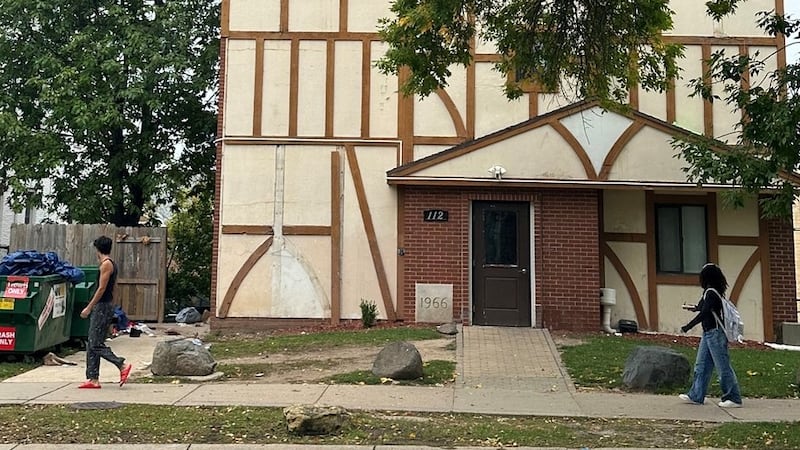
Infill housing is reshaping mature neighbourhoods in Edmonton under the new zoning bylaw as the city aims to grow up rather than out. The current approach is not proving popular on the campaign trail, and each top mayoral candidate has a plan to make changes. The outgoing city council made adjustments to infill rules at the end of the term, such as shrinking the maximum footprint, fewer side entrances and additional design rules to make infills more appealing from the street. But as multi-plexes and other infill homes take shape in mature neighbourhoods, several Edmontonians are pushing back in the form of coordinated groups such as Save YEG and Neighbourhoods United, and the people running for mayor are listening. City council got an earful from residents on infill housing this summer. The city-wide zoning overhaul that took effect in 2024 allows up to eight units on most residential lots. While none of the candidates believe the current rules for infill are correct, their suggested changes range from small tweaks to a complete overhaul. All five candidates say eight units is too many. Andrew Knack and Omar Mohammad support a six-unit maximum. Michael Walters and Tim Cartmell think six units is fine, but only on corner lots. Otherwise, they say infill should cap off at four units. Rahim Jaffer says the whole residential section of the new zoning bylaw needs to be scrapped. Cartmell, Jaffer and Mohammad call for parking requirements on infill projects, though they differ slightly on the proper ratio. Here, we look at what adjustments each of them are suggesting for infill and for housing in general. Tim Cartmell The former city councillor for Ward pihêsiwin is pitching a 40-day infill action plan in his bid to become mayor. In it, he would change the definition of height, redefine setbacks and set the mid-block maximum number of units on a typical city block at four. “We will talk about parking requirements. We will talk about trash requirements. We will talk about the requirement to engage with the community, and in a big, broader way, we will talk about going back and re-engaging on the district plans,” Cartmell said. “Those plans were supposed to describe the distinct nature of each neighbourhood in Edmonton, to talk about why something should be preserved instead of just having this blanket rule where everything should be torn down.” He wants voters to know he’s committed to reining in disruptions to daily life. “We’re going to talk about the cumulative effect on the neighbourhood of construction, of neighbourhood, renewal, of bike lanes, of infill,” he said. “When a neighbourhood has had too many of those things and too short a time, we’re going to stop it for a while.” Rahim Jaffer Jaffer, a restaurateur and former federal member of parliament, says scrapping the residential section of the zoning bylaw is the only choice “given all the bad blood.” He said while the city could tweak the rules, it “almost needs a reset to say, ‘we’ve got to stop and start over because this should have never happened to begin with.’” “The city has a great opportunity to still look at density in so many other areas that are underdeveloped,” he said, mentioning Blatchford, the Exhibition Lands and University of Alberta space. “We have to be engaged and look at these options in a proactive way, not just allow a blanket sort of zoning ability to do anything that doesn’t even make sense in certain neighbourhoods.” Andrew Knack Knack, the former city councillor for Ward Nakota Isga, says infill addresses population loss in mature neighbourhoods, helps with strained city finances and brings down the cost of housing by adding to the supply. “We need to be thoughtful about it, but we also need to make sure we’re not going backwards, because Edmonton is still the most affordable major city in Canada,” Knack said, adding that his infill plan addresses affordability. “There are people, most folks under the age of 40, (for who) housing affordability is a massive concern, and we cannot forget about that when we’re having this constant conversation.” He said his plan would make additional changes, including preserving mature trees in older neighbourhoods, design regulations and the unit count. Omar Mohammad Big shadows and maintaining neighbourhood character are concerns that Mohammad, a pediatric dental surgeon, hears about when he’s talking to residents in central neighbourhoods. Instead of disturbing mature communities with multiplexes, he’d like to see a greater focus on developing Blatchford. “Urban sprawl’s not going to be the answer here,” Mohammad said. “We don’t have the money. We’ve got the land, but we don’t have the money to build that.” He calls infill “a natural result.” “We’ve just got to do it smart, whether it’s on green space, whether it’s on other lots, in our mature neighbourhoods,” Mohammad said. Michael Walters The former city councillor says a city catalogue of approved infill floor plans and designs is worth exploring. In fact, every candidate wants infill to look nicer. “We’ve decided to mostly attempt to solve housing supply shortage by reinventing mature neighbourhoods, which has really broken public trust,” said Walters, who served two terms on Edmonton city council from 2013-21. Walters wants to shift the city’s housing focus to redeveloping areas like the Exhibition Lands, where the Coliseum will soon be demolished. He also wants to speed up building in Blatchford by selling land to developers. “My goal is that at the end of the next four years, people stop rolling their eyes about Blatchford and start to speak proudly about it,” he said. “I’m offering a modified approach which is still progressive, which still provides enormous opportunities to add density to mature neighbourhoods over time, in a way that community members can feel more comfortable.” Walters said he would like to lead the city back to a housing policy put in place when he sat on council, which he called the “most progressive, stable housing policy in Canada.” “It had a regional lens, some of the highest density suburban communities you’ll find anywhere, huge opportunities with large infill sites – namely our downtown – and then the commitment to put thousands and thousands of housing units along the LRT and reasonable infill that was going to help mature neighbourhoods stay sustainable and more affordable over time,” he said. “That all added up to an incredible housing policy, and I think we dismantled that, and we haven’t been focused on the whole picture.”