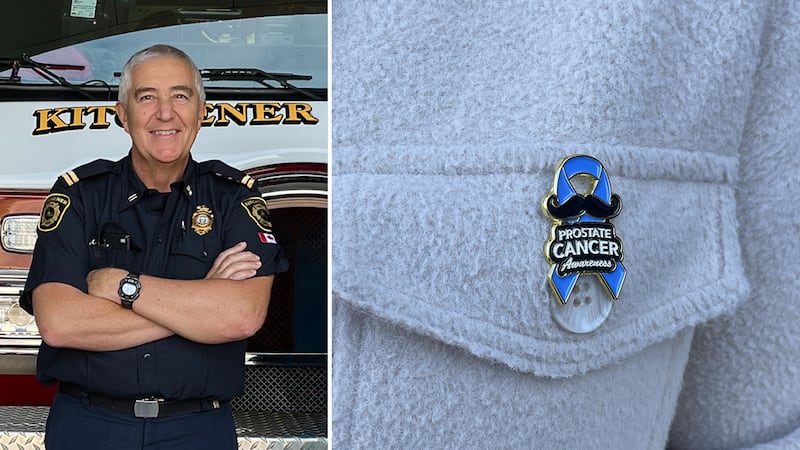
After losing a fellow firefighter to prostate cancer, members of the Kitchener firefighting community are hoping their personal experiences will encourage more men to take their health seriously. Paul Koenig spent 24 years with Kitchener Fire before he was diagnosed with stage four metastatic prostate cancer in September 2023. “He loved his job as a firefighter. He was always wanting to keep everybody safe on the job,” Paul’s wife, Shannon Koenig, said. Paul died on Oct. 10, 2026, in hospice. Before his death, Koenig said her husband wanted to raise awareness about the disease. That mission is now being carried forward by those who knew him. “Paul wanted the awareness about prostate cancer to be known to as many men as he could,” Koenig said. A Prostate Awareness Pin Campaign began with a goal of reaching firefighters in Waterloo Region. The cause was supported by Kitchener Fire management and interest soon spread to other departments. The pin was designed by a fellow firefighter and about 2,000 of them were given to firefighters in Kitchener and beyond. “Prostate cancer doesn’t just affect firefighters. We know lots of other men that are not firefighters and have it too,” Koenig said. “It’s so important to talk to your doctor to get that [prostate-specific antigen] box checked on the lab requisition form, because that is not something that they routinely do.” A disease that can go unnoticed Paul’s diagnosis came after he experienced more frequent urination, a symptom that can be dismissed as a normal part of getting older. “He was going to the bathroom more often. And as men get older, that is a common symptom,” Koenig explained. She said the cancer was already at an advanced stage when it was diagnosed. Paul underwent radiation, chemotherapy and other cancer treatments. But when his last round of chemotherapy stopped working and the cancer spread, his family was left with fewer options. Koenig said Paul’s case was considered by the Workplace Safety and Insurance Board (WSIB), adding to concerns about occupational illness in the fire service. “It was considered a WSIB case because of the type of cancer it was,” she said. “He went through a lot of different treatment - radiation, chemo, cancer pills, bloodwork.” Steve Martin, who retired after 40 years as a firefighter, is also living with prostate cancer. He said his diagnosis came after routine bloodwork with a new family doctor included a prostate-specific antigen (PSA) test. The result was slightly elevated, leading to monitoring by a urologist. Further testing eventually revealed cancer, despite Martin having no noticeable symptoms beyond getting up at night to urinate. “I went and did some tests and lo and behold, I did have prostate cancer, which I would never have thought I had,” he said. He underwent surgery to remove his prostate, but his PSA levels continued to rise. “I did 33 rounds of radiation. I’m on hormone therapy now for two years, and my fingers are crossed,” Martin said. He hopes sharing his experience will encourage other men to have conversations with their doctors rather than assume they are healthy because they feel well. “This is why [Paul] wanted to do this prostate awareness campaign - to bring awareness to as many men as possible.” Understanding occupational cancer risks The campaign also draws attention to broader concerns about cancer among firefighters. “The International Agency for Research on Cancer actually found that occupational exposure as a firefighter is linked to bladder cancer as well as mesothelioma,” Amanda Nagib, an occupational health and safety specialist with the Canadian Centre for Occupational Health and Safety (CCOHS), told CTV News. Research also suggests firefighters may face a higher risk of several other cancers, including prostate cancer, but the evidence is not yet strong enough to confirm those links. Nagib said for firefighters specifically, exposures can vary depending on the materials involved in a fire, making workplace assessments and appropriate safety measures important. “We will focus on decontamination of personal protective equipment, handling of contaminated personal protective equipment, explaining where the risks are to workers and your workplace. Policy and procedures also come in to address those risks as well, because exposure doesn’t always end when the fire goes out,” Nagib said. There is no established evidence that firefighting caused Paul’s or Martin’s individual cancers, however, broader research into some cancer risks among firefighters is still evolving. The Canadian Cancer Society estimates 29,300 men will be diagnosed with prostate cancer in Canada in 2026, and 5,300 will die from the disease. On average, 80 men in Canada will be diagnosed with prostate cancer everyday. The organization estimates 15 men will die from the disease every day. Encouraging men to speak up Koenig and Martin encourage men to learn about possible symptoms, understand their individual risk factors and speak with their doctors about whether PSA testing is appropriate for them. “It makes you appreciate the fact that you’re not bulletproof,” Martin said. “When Paul got diagnosed, it really, really hits home. And you know what? He put up a good fight, and I’m going to do the same thing.”The two hope to make the Prostate Awareness Pin Campaign an annual effort, with plans to begin distributing awareness materials earlier next year.