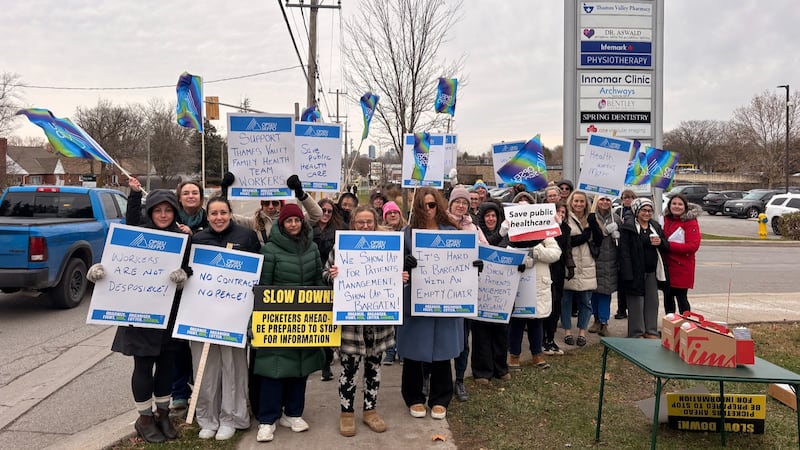
Workers with the Thames Valley Family Health Team (TVFHT) took part in information pickets Thursday, calling for a fair deal as contract negotiations remain stalled. The pickets were held at five locations across the region, including London, Middlesex, Woodstock, St. Thomas, and Strathroy. Represented by OPSEU Local 176, the employees are seeking their first collective agreement with the publicly funded primary-care organization. Negotiations began in the spring, but the two sides have yet to reach a deal. Andrea Hunt, vice-president of OPSEU Local 176, says workers are frustrated with the lack of progress. “We don’t want to do more with less. We’re tired and we’re here for our patients, and we want to serve them as best as we can,” Hunt said during Thursday’s rally. The union says management has proposed a one per cent wage increase over three years. It is also raising concerns about workload, burnout, and proposed changes to breaks and time off. OPSEU says members delivered a strong strike mandate in a vote last week, with 92 per cent participating and 93 per cent of those voting in favour of job action. Although no strike has been called, Hunt says the consequences could be significant for patients who depend on the team’s services. The Thames Valley Family Health Team provides a range of primary care supports, including nursing, dietetics, pharmacy, occupational therapy, and social work. “We are the largest family health organization across Ontario, and we service a lot of patients,” Hunt said. The organization serves more than 162,000 patients through 19 clinical sites across London, Middlesex, Elgin, and Oxford counties. Executive Director Mike McMahon says the organization recognizes the importance of its employees and remains committed to reaching a collective agreement. TVFHT recently received approximately $20 million in provincial funding to help expand access to primary care. The union has questioned why that investment has not translated into a stronger wage offer. McMahon says the funding is specifically intended to connect more people with primary-care providers. “Expansion resources are not available for us to sit down and use those resources to settle a collective agreement. Expansion resources are so that more people across Thames Valley can experience having a primary-care provider,” McMahon said. He says the organization wants employees to feel valued, noting that their working conditions are closely tied to the quality of care patients receive. “Satisfied employees, employees that feel valued are in health care the best service providers for the patients in our communities,” McMahon said. Hunt says workers want to return to the bargaining table and avoid job action, warning that a strike could have far-reaching consequences. “The disruption that this may cause to patients is going to be astronomical,” she said.