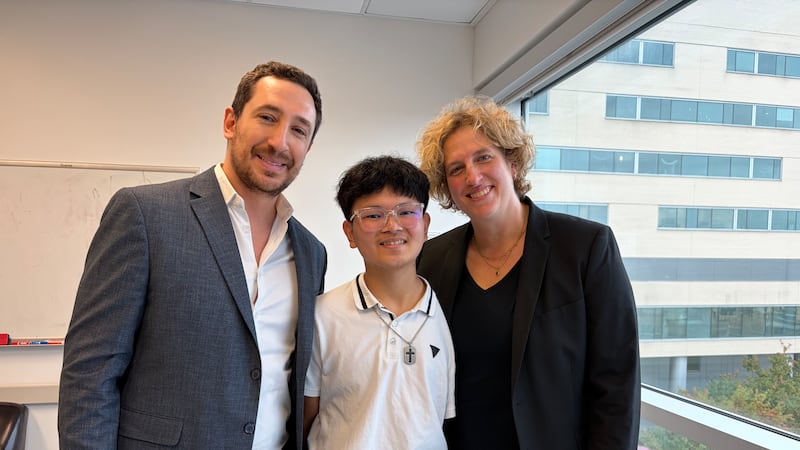
A 16-year-old student from the South Shore of Montreal is helping Ste-Justine’s Hospital make rehabilitation more fun for kids like him by developing a video game. When he was eight years old, doctors found cancer in his left shoulder. Despite rounds of chemotherapy and radiation, the tumour persisted, and his arm had to be amputated. Now, he’s finding a way to give back to the hospital team that helped with his health struggle. With electrodes placed on his neck and upper left shoulder, Angelo plays video games by contracting or flexing specific muscles. The electrodes pick up the signals and he’s leveling up. By playing the video games this way, Angelo is also working the muscles that will help him better control a prosthetic arm. “So once you get your prosthetic, it’ll be easier for you to actually move and do what you want to do with it,” he said. The games were developed with Samory Houzangbe, post-doctorate researcher with a PhD in virtual reality experiences. He created the video game system especially for young amputees to learn how to control their prosthetics. “Patients starting around four or five years old, so we needed a game that was quite simple. Not punishing, still an infinite gameplay loop,” he said. Angelo’s rare sarcoma didn’t respond to treatment and when the cancer in his shoulder kept coming back, orthopedic oncologist Dr. Sophie Mottard said that his amputation was necessary. “When we take the limb off, we take the nerve endings … and we make another use for it. And this is what Angelo had. And that’s why the whole program right now that he’s developing. So it’s really interesting," Mottard said. Those nerve endings are now triggering his gaming muscles in his upper shoulder. “To use the nerve endings in order to enervate these muscles and also detect with the electrodes, function. For example, when the nerve, the muscles contract, you can use it to have a prosthesis, for example, to move the extremity or to play video games for instance,” Orthopedic Oncologist Dr. George Basile explained. Angelo says the games keep him engaged in these preparatory exercises. “Ever since I started playing the game, I’ve been more excited to go to therapy since the other one, it was kind of boring,” the teen said.