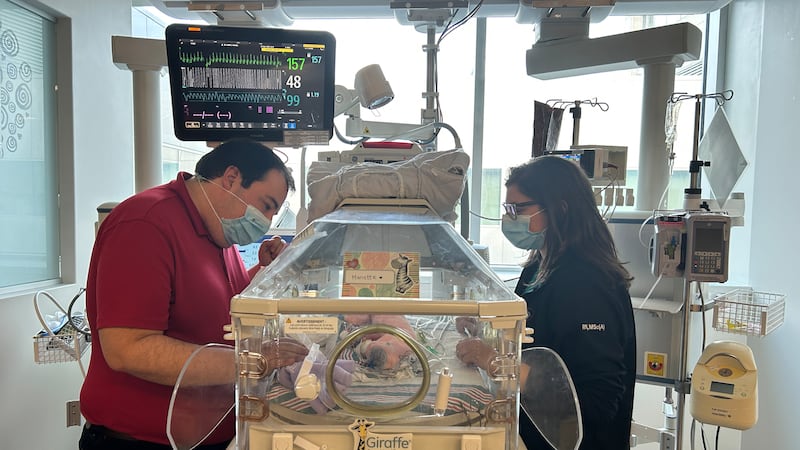
At the Jewish General Hospital in Montreal, Steve Faguy reads to his daughter, Mariette. She cannot see him, but she can hear him. Mariette was born 15 weeks early. An ultrasound showed she was not growing as expected, and doctors recommended a controlled C-section at 25 weeks. Faguy was in the operating room when she was born, and that is where doctors gave him the news. “This baby has maybe a 50-50 chance,” he said. Mariette was rushed to the neonatal intensive care unit (NICU), and her father followed. “I heard her cry for the first time and that was really emotional for me,” he said. Level 3 NICU for highest-risk cases At the Jewish General Hospital, about 550 premature babies and critically ill infants are cared for each year. It is one of six hospitals in Quebec with a level three NICU, which takes in the most high-risk and complex cases from across the province. At delivery, care stations are pre-equipped to provide warmth, oxygen and monitoring, all supported by donations. Remote monitoring across convalescent rooms allows the nurses to watch the infants around the clock. “We wouldn’t be able to achieve the results we have without this technology,” said Dr. Lajos Kovacs, chief of pediatrics and neonatology at the hospital. That is why donations to the hospital’s foundation are needed, says the head nurse. “If we don’t have the tools to be able to support them, it’s difficult,” said Chloé Décarie-Drolet, head nurse of the NICU. ‘We’re very optimistic’ Doctors told Faguy that the first ten days are crucial for a premature baby. Mariette reached that milestone on Monday. His wife is also recovering from surgery. That said, Mariette is expected to remain in the hospital for months to come. “There are a lot of unknowns, but we’re very optimistic now,” said Faguy. Until then, the new dad will keep reading to his baby girl, counting down the days until he finally gets to take her home.