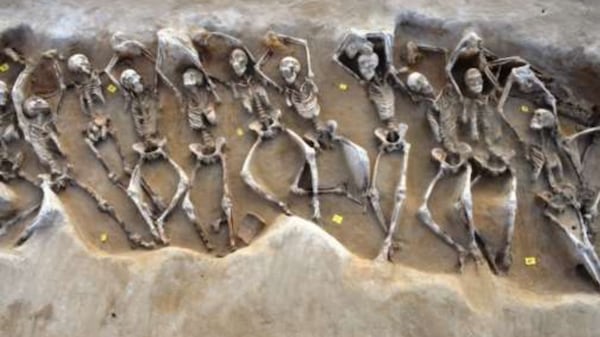
ATHENS, Greece -- The 2,700-year-old remains of dozens of youths put to death in a mass execution in ancient Athens went on display Wednesday in a specially constructed underground chamber south of the Greek capital. The ancient necropolis in Faliro, south of Athens, has been found to contain over 2,000 dead of all ages, in addition to a number of buried horses. In 2016, archeologists found 79 men arranged in three trenches, tied together in groups. Many had corroded iron shackles around their wrists, and most were young adults or juveniles. Experts working on the decade-long project have said the men were in their prime, and had all received a killing blow at the base of the skull with a blunt instrument. Culture Minister Lina Mendoni said the find sheds light on “one of the darkest pages” in Athens’ long history, a time when rival groups fought for control of the city before political reforms gave rise to democracy. The men had met a “violent, tragic death”, Mendoni said. Dubbed the “Captives of Faliro” by the media, the skeletons were subsequently relocated for their protection, until the completion of the new 7.5-billion-euro structure in 2023. The men had lived in the seventh century BCE, a period of turmoil in ancient Athens before the city’s golden age that saw the creation of the Parthenon. Experts believe they were likely supporters of the Cylonian conspiracy -- a failed attempt to seize power in the city -- who were subsequently put to death. According to the Swedish Archeological Institute at Athens, which helped to investigate the finds, it is the earliest known mass burial of executed people in the greater Athens area. Archaeology Magazine had ranked the “Captives” among the top 10 discoveries of 2016. Preserved in sand, the skeletons began to rapidly deteriorate once uncovered, and must be kept under strict temperature and humidity conditions. Most of the ancient cemetery is believed to lie beneath the Stavros Niarchos Foundation Cultural Centre, which was completed a decade ago. It contains scores of other dead who were also likely tortured before being killed. Some were buried face-down in a mark of disrespect, others bound hand and foot like cattle. Separately, the American School of Classical Studies at Athens is studying 1,100 individuals from the site and will publish its findings in 2028.