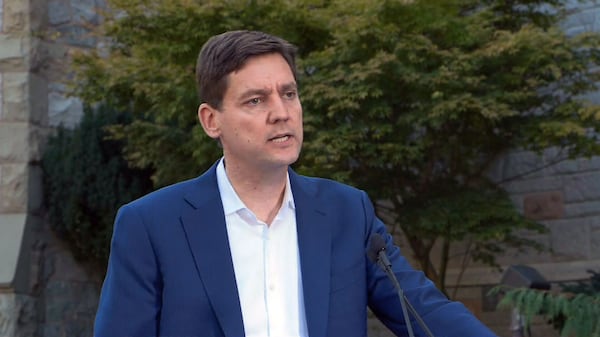
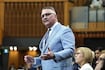
The British Columbia Conservatives moved Wednesday to head off suggestions that interim leader Lorne Doerkson would not remain premier if he wins the Oct. 24 election, as it announced former leader John Rustad would not be among its candidates. A statement from the party said Rustad, who brought the Conservative party to the brink of power in 2024, was not seeking re-election in his northern B.C. riding of Nechako Lakes. He was first elected to the legislature in 2005. Rustad was forced out of the leadership post last December after a period of instability and defections that only intensified under the brief and tumultuous reign of Kerry-Lynne Findlay, who quit on Sunday and was replaced by Doerkson. An interim leader cannot run for the position permanently under the party’s constitution. But the party said its board would “pursue the appropriate means” to keep Doerkson in power after the snap election called by NDP Leader David Eby on Tuesday. “A premier chosen by British Columbians deserves the certainty of leading his party,” the directors said. The constitution would be amended to keep Doerkson in charge, the party said. But changing the constitution requires a two-thirds vote of members present at an annual general meeting or special general meeting. The NDP said that represented a gamble. “What the B.C. Conservatives are saying is that British Columbians should write a blank cheque to the same far-right party members that just picked Kerry-Lynne Findlay as their leader,” Mike Farnworth, a New Democrat candidate and longtime cabinet minister, said in a statement issued by the caucus. “Why would people ever trust them after what we’ve seen?” Doerkson returned from a holiday in Africa over the weekend to take over from Findlay, whose divisive leadership saw 13 legislators exit the Conservative caucus in the final weeks of a reign that tilted the party further right. Doerkson moved swiftly to shore up the party’s ranks, bringing legislators back to the Conservative fold, while describing U.S. President Donald Trump as a bully and declaring that B.C. would never become the 51st state on his watch. Lawyer Tim Thielmann, a former Conservative candidate and former research director for the party’s caucus, said if Doerkson won, it was “extremely unlikely” that enough discontented members would block amendments to keep him in charge. “So, I think the wisest course for people who are angry about the process that led to Doerkson being appointed leader is to vote out the NDP now and … spend the next four years building the party that you want,” he said. “Grassroots Conservatives can’t punish the politicos that put Doerkson into power without rewarding the politicos that put Eby into power,” he added. Eby said Wednesday that his party was the clear choice to stand up to Trump while the Conservatives would turn the province into “America Junior,” complete with health-care privatization. On the first full day of campaigning, Eby touted his government’s success in recruiting American health-care workers and said the NDP would triple the funding for the campaign to $15 million. “When we put forward a $5-million campaign, just $5 million, to recruit these health-care workers, the Conservatives called it irresponsible,” Eby said at a stop in front of the Peace Arch border crossing in Surrey, B.C. The campaign resulted in the hiring of 800 health-care workers from south of the border and ultimately saved the province money, Eby said. Eby said the NDP has set a goal of recruiting 2,400 more health workers from across the border in a renewed campaign that would expand into Republican-controlled states, with laws that restrict the provision of reproductive health care. “If we turn our province into America Junior, we put all of that at risk,” he said. The Conservatives under Rustad had campaigned on a promise to expand private clinics to help fix what he called a system in crisis. Eby also highlighted the prosperity agreement between B.C. and Ottawa, unveiled in July, saying it comes with federal funding to advance major projects, including liquefied natural gas facilities and the expansions of a mine and several ports. Eby said Conservatives running under Doerkson had opposed the deal with Prime Minister Mark Carney’s Liberal government. “Whether it’s any one of the last four leaders of the Conservatives in the last 10 months, the ideas are the same,” he said. A Conservative news release from the time, quoting two of the legislators who flanked Doerkson as he addressed reporters in Vancouver on Tuesday, criticized the agreement for maintaining the tanker ban along B.C.’s North Coast. Rustad isn’t the only high-profile politician to step away from the snap campaign. Former finance minister Brenda Bailey said Wednesday she wouldn’t run for re-election, the fourth cabinet member to make such an announcement. Bailey left the finance portfolio to take on the Jobs Ministry in August as she underwent cancer treatment. In a statement, Bailey said she’d had surgery and she was happy to be cancer free. But she said she wouldn’t run again in her riding of Vancouver-South Granville, calling the decision “incredibly difficult.” Health Minister Ravi Kahlon, Emergency Management Minister Kelly Greene and Agriculture Minister Lana Popham have already said they wouldn’t seek re-election. Asked about Kahlon’s decision on Wednesday, Eby said he was “heartbroken” but understood Kahlon’s need to prioritize his family. Green Leader Emily Lowan, meanwhile, announced she plans to run in the Victoria-area seat of Saanich North and the Islands, held by the Greens’ Rob Botterell — who had been part of a caucus of two with Jeremy Valeriote since the 2024 election. Lowan, who’s never had a seat in the legislature, said both major parties have lost the confidence of B.C. residents but the Greens offer a different vision. “The Greens are ready to serve with conviction, not stoke fears or squabble in division,” she told reporters in Victoria on Wednesday. Lowan said just two Greens have made a difference in the legislature. “In this election, we have a path to grow and hold the balance of power,” she said. “We can hold the government to account and get real results to make our province safer, healthier and more democratic.” Lowan said the Greens were gearing up to field a full slate of candidates, though the majority of their electoral resources would be focused on southern Vancouver Island. B.C.’s chief electoral officer, Shipra Verma, said Elections BC was also planning for the election and needs to hire 17,000 people if it’s to deliver the same services as it did in 2024. This report by Wolfgang Depner, The Canadian Press, was first published Sept. 23, 2026. — With files from Nono Shen and Brenna Owen