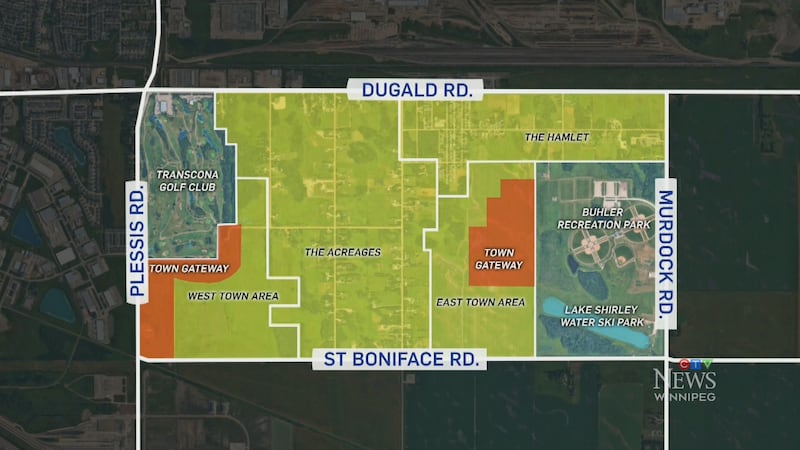
A City of Winnipeg community committee has rejected a development plan for the city’s northeast, turning aside a proposal backed by city planners that would have opened the door to thousands of new housing units. The East Kildonan-Transcona Community Committee voted Thursday to reject the South Transcona secondary plan following a public hearing that lasted several hours. The plan would have set land use, servicing and transportation policies for South Transcona. The area is roughly 1,300-acres and bounded by Dugald Road, St. Boniface Road, Plessis Road and Murdock Road. It includes about 927 acres proposed for new housing and development across four sections — the Acreages, the Hamlet, and the East and West Town areas — along with the Transcona Golf Club and Buhler Recreation Park, which would remain in their current use. Michelle Richard, an applicant representative with MRA Planning + Development, said the area has been designated a “new community” under the city’s development strategy, requiring a secondary plan to guide future growth. She said the proposal was the product of extensive studies and community engagement since 2021. At full build-out over decades, Richard said the plan anticipates roughly 7,500 new residential units to house about 20,000 residents. “This plan is needed right now to assist with resolving the current critical housing shortage and providing a full range of housing options to the city,” Richard told the committee. The plan had the backing of the city’s public service, however Coun. Emma Durand-Wood (Elmwood-East Kildonan) moved against that recommendation. “This is a plan that requires at a minimum nearly $200 million of capital investment, and that is money we don’t have,” said Durand-Wood, who sits on the committee alongside Couns. Russ Wyatt (Transcona) and Jeff Browaty (North Kildonan). “It would be entirely funded by debt, it requires above average tax increases forever not to run at a loss, and it requires subsidization for an entire generation.” Durand-Wood called the plan a “drastic leap” from a rural to a fully urban environment, and said the city should instead focus growth in areas where infrastructure already exists. The proposal called for twinning both Plessis and Dugald roads and building a new fire station — estimated at more than $12 million — to meet Winnipeg Fire Paramedic Service response-time targets. It also outlined other new infrastructure, such as a community centre and transit upgrades. Durand-Wood said any new money spent on fire protection should be used to protect coverage in existing areas, adding the city is already “falling short” of where it should be – and that the current budget doesn’t provide funds for a new fire station. Nick Kasper, president of the United Firefighters of Winnipeg, was among those who spoke against the plan. He said the application’s emergency services memo does not specify a timeline for when the station would need to be built. Browaty said the area is “going to be developed in some way or another over time,” but said there wasn’t enough confidence in what’s being promised for parks and shared infrastructure. “It just feels like it’s too uncertain for residents … with that level of uncertainty, there’s going to be a hit to their property values, because you don’t know what you’re going to have to incur,” he said. “I don’t see enough here that protects them.” According to the city’s financial analysis, existing taxpayers would subsidize upfront infrastructure and servicing costs for up to 25 years. The analysis also found that developing the East and West Town areas would require extending new servicing through the Acreages — including along the frontage of several existing homes — though the report does not specify what those residents could eventually be required to pay to connect to sewer. Wyatt, who chairs the committee, said there is “a lot of stuff up in the air” — including when Plessis and Dugald roads would be twinned and how many affordable units the development would ultimately include. The plan’s fate won’t be final until it goes before council on Sept. 24. Richard said if the plan is approved, construction could begin as early as 2028.