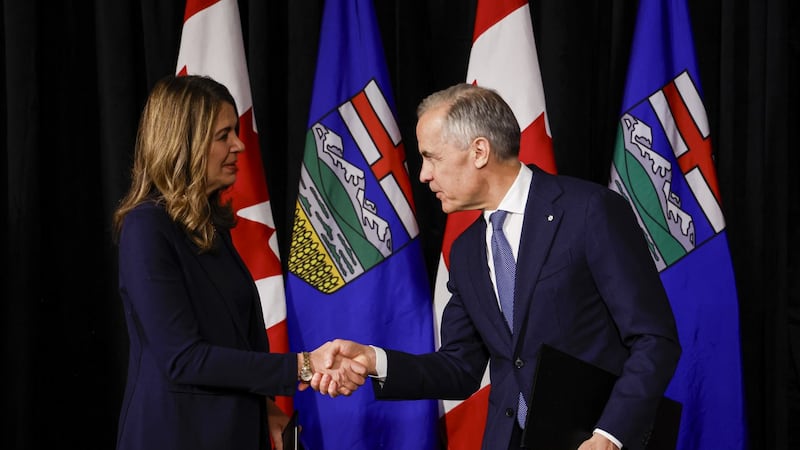
The federal government unveiled nearly $28 billion in new counter-tariffs on U.S. goods on Tuesday, but Canadian energy exports are absent from the retaliatory package — at least for now. Alberta Premier Danielle Smith said Monday that Alberta oil and gas should be off the table for export taxes, saying it’s not a viable option. She has also said she wants Canada to return to the negotiating table. “Alberta’s government remains concerned that tariffs and counter-tariffs increase costs, disrupt supply chains, put pressure on businesses and workers, and ultimately risk escalation to even higher and broader tariffs that will impact even more Canadians. We should do all we can to avoid further escalation,” Smith said in a Tuesday statement. “There is still time before these counter-tariffs take effect on September 8, and I am urging the federal government to use that time to get back to the negotiating table with the United States.” Meanwhile, Alberta NDP Leader Naheed Nenshi says the province should not be limiting its options in the trade fight. “Nobody wants us to turn off the taps to the United States. But I’ll tell you this: when you’re negotiating, especially when you’re negotiating with a bully, you don’t start with one hand tied behind your back,” Nenshi said. “You don’t immediately take things off the table because that weakens your negotiating position.” British Columbia Premier David Eby says he would support leveraging his province’s natural resources, including potential tariffs or restrictions on energy exports. “I don’t put any of the items that are in her (Smith’s) province up in terms of the discussion, I’m just speaking for British Columbia,” Eby said in an interview with BNN Bloomberg. “And what we’re willing to do is part of a coordinated federal effort.” Yet industry experts warn that pulling the energy lever could backfire. Richard Masson, with the University of Calgary’s School of Public Policy, says restricting oil or natural gas could escalate the trade war. “If we try to put export taxes or restrictions on volume on oil or natural gas, I think that could really escalate things quickly,” Masson said. “They’re already feeling pretty bad about paying $5 for diesel. And they could, instead of supporting Canada, generally start to think that we’re playing too hardball.” Federal Finance Minister François-Philippe Champagne sidestepped questions on whether Ottawa considered using a potential revival of the Keystone XL pipeline project during trade talks. “The most sought-after commodity for this trust in Canada, offering the trust that the world needs stability, predictability, and trust,” Champagne told reporters on Tuesday. Smith says she wasn’t part of trade discussions but supports more oil moving to market. “We’ve seen that commitments to increase our energy supply via pipelines to the United States is something that could ultimately help us reach a deal,” Smith’s press secretary Sam Blackett said. “That’s why the premier has told Prime Minister Mark Carney that if he wants to pledge more barrels to close a deal then he has her full support in doing so.” The counter-tariffs go into effect Sep 8.