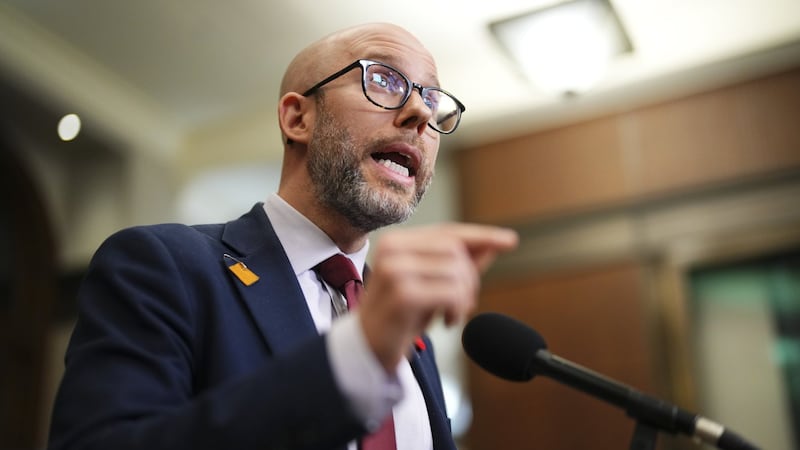
Hundreds of people gathered Friday night at a candlelight vigil remembering two children who were murdered last week. Calgarians from the city’s Eritrean community and beyond gathered at 4500 block of 14 Street N.W. to express their grief and show support after a five-year-old boy and his three-year-old sister were found dead in a vehicle on April 30. Their father, a 37-year-old Calgary man, was taken into custody and charged with two counts of first-degree murder after police said he called them and confessed to killing the children the day before. The identities of both children and the accused are protected by a publication ban. It was a somber and emotional scene Friday evening as grieving community members brought out teddy bears, flowers, handwritten cards and candles. People were also seen hugging each other and shedding tears. The mother of the children was also spotted crying uncontrollably as photos of her children are held up by the crowd. Adanech Sahilie with the Immigrant Outreach Society says the loss of the two children will bring a “lifetime of trauma for the family and the community.” Sahilie said the vigil marks an opportunity for people to process the tragedy. “Everyone can come together and grieve together. Even those kids, in heaven, they will watch us and will love to see the support,” she said. Among the mourners was Ward 5 Coun. Raj Dhaliwal. “(I’m here) just as a father, as a husband, as someone who cares,” Dhaliwal told reporters. “When I heard about this, it was painful. Just these kids who had such beautiful life ahead of them (that) was taken too early, too young. It’s devastating.” He said the deaths of the children forced all citizens to ask “why” and was a reminder that “we need to look at our system.” Alberta NDP Leader Naheed Nenshi also attended the vigil to express condolences. “This is (an) extraordinary and unbearable tragedy,” he said. “I hope that the family and loved ones today understand they live in a community that loves them.” Need to intervene sooner: experts The memorial comes on the heels of calls from advocates to have police intervene in domestic violence cases much earlier. The accused and the children’s mother were in a six-year common law relationship and had been separated for a little under a year. Court records showed the accused had no prior criminal charges or convictions, but police still said he was known to the force and that the couple had “a domestic history” with the Calgary Police Service. They added officers had attended their shared home four times. No charges were ever laid, and there was never a history of violence against the children, police have said. But for University of Calgary Brenda Stafford Chair Lana Wells, the accused’s interactions with police should have been the first signals to authorities that looming violent behaviour needed to be diverted. READ MORE: Death of Calgary children highlights need for earlier domestic violence intervention: experts She says recent research in Calgary has found 73 per cent of men charged with domestic violence had prior police contact through non-criminal domestic incidents. “Often what happens is when police show up and there’s violence, but not enough to charge, they will sit down with the victim and create a safety plan,” Wells said. A larger part of prevention often goes under the radar — namely ensuring the perpetrators of abuse has supports and can regulate himself. She said safety plans “just puts the burden of keeping her and her kids safe on her.“ “We have to flip the burden to those who are causing harm and work with them. Does he have friends? How can he regulate? Where can he get support?” She also added preventing domestic violence requires shifting how communities think about reaching out for help — especially among men. “It is okay. We’re human. It’s part of the human condition. We all need supports and help,” she said. Sahilie added that she has witnessed “a huge lack of support” for people experiencing domestic violence. “I have been advocating for this almost the last 16 years and I haven’t seen any change,” she said. “It feels like, especially these days, it shows clearly our broken system.”