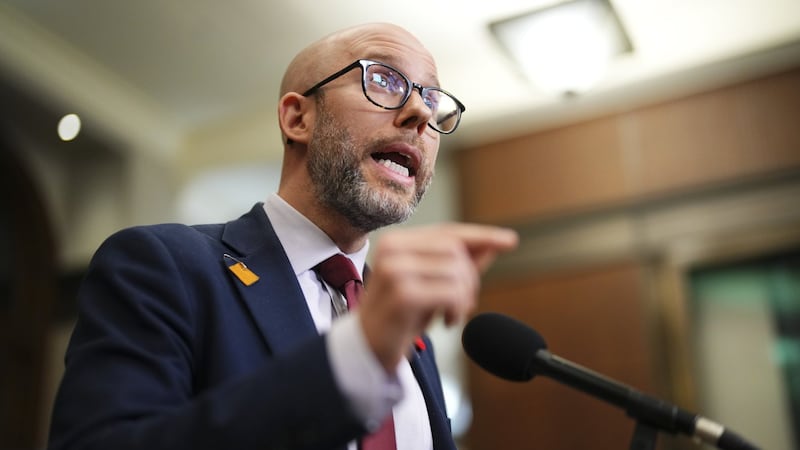
Dozens of people attended a protest hosted by Friends of Medicare outside Calgary-Confederation Liberal MP Corey Hogan’s constituency office on Monday, demanding the federal government step in and delay Alberta’s Bill 11, the Health Statutes Amendment Act. “I believe (the province has) just been intentionally mishandling our money in health care to justify bringing in privatized healthcare,” said Keira Gunn, chair of the Calgary chapter of Friends of Medicare. Bill 11, which was passed last year, would allow doctors to work in both a public and private health-care system. Alberta Premier Danielle Smith says the move would improve capacity. “We’re in the middle of putting the regulations together because of course, we’re going to have very detailed reporting requirements to verify that our doctors are continuing to deliver this exact same amount of service to the public system,” she said. A similar system has also been tested in Quebec. Smith says Alberta won’t copy Quebec’s model, which she says forced doctors to choose between billing to private or public systems. “We don’t want to go down that pathway. We are going to mandate that those who want to do dual practice have to continue providing the exact same service to the public system that they are today,” said Smith. But the United Nurses of Alberta are concerned this is creating a two-tiered approach. “This is nothing new. It’s happened in more places than just Alberta. And what we see happen with that is, in the end, health care gets more expensive for everyone,” said First Vice-President Danielle Larivee. “This is opening the door to insurance companies to come in and make money off of what has previously been, covered through the public health care system.” The protest outside Hogan’s office was one of many across Canada asking Ottawa to challenge the bill and declare it violates the Canada Health Act. Smith disagrees that a two-tiered system runs contrary to Canada’s top medical legislation. Meanwhile, Hogan said he is “unconvinced” a two-tiered health care model would work, but added he hasn’t discussed Bill 11 with Prime Minister Mark Carney. “I do know the prime minister is a strong supporter of a strong, universally accessible public health care system,” Hogan said. Alberta’s United Conservative government believes this bill will emulate similar two-tiered systems offered in Europe, but Gunn says Bill 11 adopts an American-style approach. Gunn acknowledges a two-tiered approach works in European countries, but those success stories exist in nations that have “massively robust health care systems that are fully funded,” she said. “There are just not the concerns that we’ve been having here. I think that we have so much influence from the U.S. coming in to privatize our care and bringing in private insurance.” Smith says the bill will be implemented into law this year. Alberta’s Ministry of Primary and Preventative Health Services says the province is taking a thoughtful and measured approach, with specific guardrails in place. “These may include limits on eligible specialties, the types of services that can be offered, and requirements for physicians to provide a dedicated amount of service in the public system before participating in dual practice, along with strong record-keeping and reporting requirements,” a statement from the ministry said. “In the coming months, we expect to share more details on these guardrails and reporting structures, as well as timelines for when physicians will be able to begin participating in the model to help improve access and reduce wait times for Albertans.” But for protester Janna Klostermann, a two-tiered approach isn’t what Canada signed up for. “I’m really concerned to see this proposal to put forward more for-profit care,” she said, adding that public universal health care is “central to being Canadian.” Protests also took place in Edmonton, Montreal, Vancouver, Winnipeg, and Ontario.