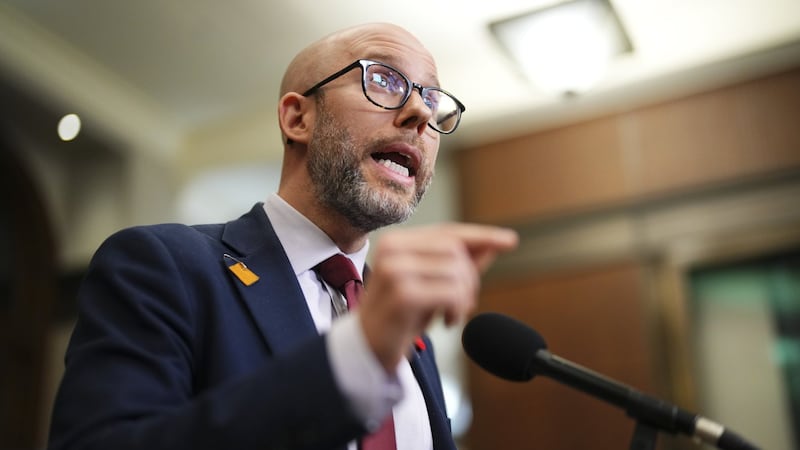
Some residents living on a section of 26 Avenue S.W. targeted for improvements say the project is moving forward without enough consideration for the people who live there. The work on 26 Avenue S.W. stretches from 37 Street S.W. to 14 Street S.W. and includes protected bike lanes and multi-use pathways, intersection upgrades, floating bus stops, improved street lighting and a lower speed limit. A floating bus stop moves the passenger boarding area away from the sidewalk and places it between the vehicle lane and the protected bike lane. On 26 Avenue S.W., buses currently have to cross into the bike lane to reach the curb. Under the new design, buses would remain in the traffic lane while passengers cross the bike lane to reach the boarding area. The city says the design reduces conflicts between buses and cyclists and makes movements around the stop more predictable. However, Bob Berry, a cyclist who uses commutes using 26 Avenue S.W., predicts it will mean more congestion as buses will no longer pull out of the travel lane to pick up and drop off passengers. He worries repeatedly stopping traffic behind buses could create congestion along the corridor. “They’re going to move these bus stops out, so the busses will now stop in the travel lane on the road,” Berry said. “All the traffic will have to stop behind that bus.” Ward 8 Coun. Nathaniel Schmidt says the intent is to improve safety for all users of the corridor, particularly people who may be less comfortable cycling in mixed traffic. “What this does is we have a ton of young families and people getting to the parks and the schools. You could say to your 13-year-old kid, ‘You can travel to school safely’ -- and I think that is where we really need to put our minds, is who is this benefiting? And why are we putting in this benefit?” Schmidt said. It also means the permanent removal of some on-street parking. Parking will be removed from the south side of 26 Avenue S.W. between 37 Street and 25 Street S.W. It will also be removed from the north side between 22 Street and 14A Street S.W. The city says the changes are necessary in some sections to accommodate the new design. “Parking impacts were carefully considered as part of the design, and changes are limited to where they are necessary to improve safety and operations,” the city says on its project website. For some people living along the route, that is a big concern. Brian McKenna, who lives near 26 Avenue and 25 Street S.W., says new homes in the area are predominantly built with single-car garages, forcing residents to rely on street parking for additional vehicles. He says removing on-street parking while the neighbourhood continues to grow and densify will make an already difficult situation worse. Another resident, Leif Undseth, says his objections aren’t to the cycling upgrades themselves, but to how the city arrived at the final design. “We’re not against cycling infrastructure, but the way this has been implemented without properly addressing parking and livability concerns is frustrating,” he said. Undseth says many area residents feel their concerns about parking and the impact on people living along the street have not been adequately addressed. Undseth says people living in the area have attended meetings, submitted feedback and contacted the project team and elected officials, but still have questions about what happens once the parking disappears. Those questions include where displaced vehicles will go and how the changes will affect families with young children, seniors, people with mobility challenges, caregivers, deliveries and moving trucks. Residents also question whether the parking information used by the city reflects current conditions in a neighbourhood that has seen significant redevelopment in recent years. McKenna says he believes the city needs to take another look at how parking is being used now. “I think more consultation – more research is needed,” he said. “From what I understand, the research was done during working hours. Come on a weekend or after rush hour and see how many cars are parked here. You’re displacing a lot of people.” The city says public engagement was conducted in 2021 and 2023, and that feedback from those sessions helped shape the final design. Nathan Stayer, project manager for the 26 Avenue S.W. Mobility Improvements project, says the earlier engagement was when residents had the opportunity to influence the overall design. “That was the key time to put in your input for design and your concerns there,” he said. “And so since then, we’ve engaged with them at some different information sessions in November of 2025 and just recently in July. “We’ve shared the design, heard some feedback, but overall, the larger concept of the design has been finalized, and that was largely informed by our 2021 and 2023 engagement sessions.” The city says there is not enough room along some sections of 26 Avenue S.W. to keep on-street parking while also adding the planned safety improvements. Schmidt says the city has been working with some residents to address specific concerns where possible. He says the city has also been able to preserve some parking near businesses that otherwise would have been lost. The city also says a map showing parking changes and alternative parking options will be provided. Undseth says people in the area have gathered photographs showing current parking use, correspondence with the city and a resident petition. They also want the city to explain why a design that kept at least some of the existing parking was not chosen. The city says the broader project is intended to make 26 Avenue S.W. safer as nearby communities grow and redevelop. Existing painted bike lanes between 37 Street and 22 Street S.W. will be replaced with physically separated lanes, while multi-use pathways will be added farther east. Vehicle travel lanes will remain. Stayer said simply repaving the road and repairing sidewalks would not achieve the safety improvements the city is seeking. “We are doing some road repaving and reconstruction. We are fixing some sidewalks along the way too -- but ultimately, that doesn’t enhance the safety of the road to the level that it’s needed,” he said. “These separated bike lanes, once again, add that additional layer of separation between the bikes and the vehicles.” Berry questions if the redesign will actually make the route safer for cyclists. He maintains experienced cyclists travel quickly along the downhill sections of 26 Avenue, and worries moving them onto shared pathways will create conflicts with pedestrians. “As a cyclist going down that hill, the last thing we want to be doing is dodging people on a sidewalk, a pathway,” Berry said. “Mixed use, okay, but this is a hill -- and people are really flying on it.” Berry expects any experienced cyclists will simply stay on the road rather than use the redesigned cycling infrastructure. “I would almost guarantee that experienced cyclists are going to ignore all this and they’re just going to ride straight down there. They don’t want to be messing around with pedestrians and dog walkers and all that stuff on a pathway.” Schmidt says the project is intended to accommodate people with different levels of comfort using the corridor, including children and less experienced cyclists. The project is also intended to calm traffic along 26 Avenue S.W. Schmidt, who lives in the area and regularly uses the road, says speeds can be inconsistent -- and he has been passed while driving the speed limit. “The real problem is, it’s designed in such a way that you can go really fast at times, but you can also go the speed limit,” he said. “Traffic calming is not just to make you go slower, but to make it more consistent, so that everybody has to follow the flow of traffic because the way the street is designed.” Stayer said the corridor is now carrying more people and more modes of transportation than it was originally designed to handle. “We’re trying to upgrade the corridor to fit in with the increased development in the community, and safety is our primary thought while doing that.” The $21.7-million project is being funded through several sources, including $5.7 million from the city’s Established Area Growth and Change Strategy, $7.5 million from the federal Housing Accelerator Fund and $8.5 million from city operational budgets. Construction will be completed in stages, generally covering two to three blocks at a time. Stayer said crews are expected to spend about six to eight weeks in each phase, depending on the work required. The first phase is expected to begin between 25 Street and 26 Street S.W., with utility work between 17 Street and 18 Street S.W. following. Construction is expected to continue in phases through 2028.