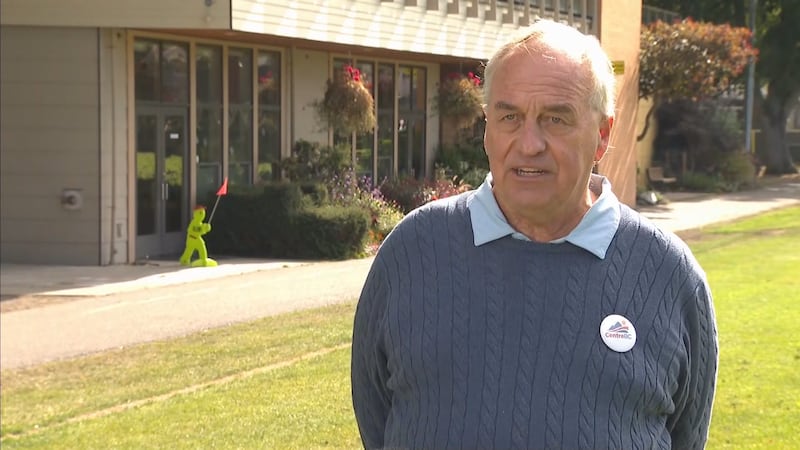
The word “Calgary” stretches across the hull of a red canoe as a team launches into the icy St-Lawrence River, a stone’s throw from the Plains of Abraham in Quebec City. The five paddlers are training for a gruelling and spectacular race taking place on Sunday as part of the city’s renowned yearly Winter Carnival. Around fifty teams will set out to conquer ice floes and fast-moving current as they race from one shore of the river at the Port of Quebec to opposite bank in Levis -- and back again. “Today it’s quite open. So, not bad. But as you can see, it’s moving fairly quick,” says Barney McIlhargey. “You got some big ice chunks. You’ve got to pull the boat over or you get caught under some stuff. So yeah, it can be very grueling physically and mentally for sure.” McIlhargey is in his seventies, and now a 30-year veteran of this extreme sport. “For me, this is all about the challenge,” he says. “I played rugby for years, still, I found that this is something that is very difficult, it is so hard to do. That’s the challenge.” Ice canoes were once a vital mode of transportation, used to ferry merchandise and people across the St-Lawrence River in the 19th century when ice blocked boats from travelling from shore to shore. The first ice canoe race at the Quebec City Winter Carnival took place in 1894. Today, it is staple of the festivities, drawing large crowds as spectators watch teams run, push, and climb over ice along an ever-changing course shaped by the cold and wind. “You are scooting with one foot, all looking forward in unison together, “explains Russ Kueber. “And then you hit the water, you have to transition back to your seat.” The Calgary team has long-standing ties to the Quebec City race. “Calgary and Quebec City, our sister cities. So, there’s a cultural exchange,” says Kueber. “A group from the carnival go down to Calgary during the Stampede. And Bonhomme Carnaval (the mascot) is always there waving his hand to Calgarians. And then during the carnival time here, there’s a group from Calgary that comes.” Teams from provinces where political views don’t always align, paddling alongside one another, and finding common ground in the icy waters. Kueber had a seat in the Calgary boat for years but eventually met someone in Quebec City who was also an ice canoe athlete. Twenty years ago, he moved to the provincial capital and eventually the two were married and had children. “It is such a fun sport,” he says. “The conditions change so often, so it could be a race that lasts 45 minutes, but it could also go over two hours as well.” But there are dangers, and McIlhargey has some wise advice to share. “We do have some rules for ice canoeing,” he says. “The first one is: don’t let go of the boat. The second one is never let go of the boat. The third is never, ever let go of the boat. Because if you let go of the boat, you could be gone.”