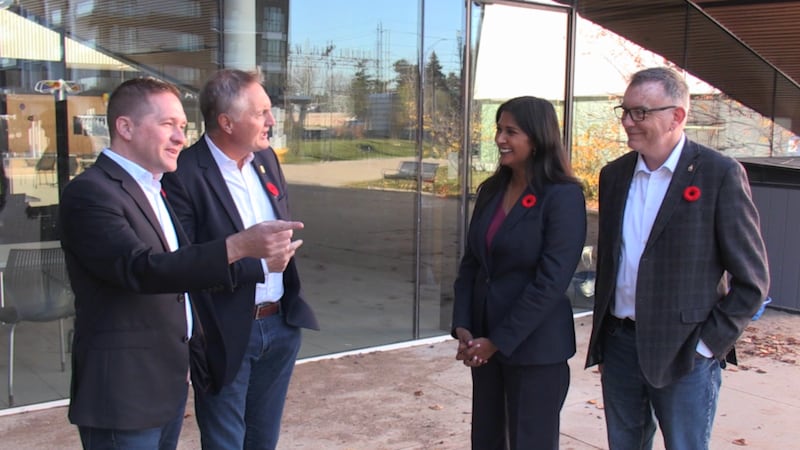
Elements of the recently released federal budget are striking a positive note with Alberta’s premier, a budget that includes more than $150 billion in new spending over five years, while also aiming to incentivize investment and put Canada on a path to end homelessness within a decade. Alberta Primetime’s Michael Higgins is joined by Edmonton MP Eleanor Olszewski to speak on what the federal budget means for Albertans. This interview has been edited for length and clarity. Michael Higgins: Like many of your cabinet colleagues, you’re out selling the details. What is it about this budget that will make the biggest impact here in Alberta? Eleanor Olszewski: I think in terms of Albertans, it’s really about investing in our economy, making sure we’ve set the conditions to enable businesses to grow and to thrive, and that just doesn’t mean in terms of major projects, it means in terms of small and medium-sized businesses too, and so, we want to make those businesses more competitive. There are some strategies, as was already mentioned, in terms of tax exemptions and capital gains and a super deduction. But really, all of this is about people. These budgetary items are basically meant to help Albertans, to help Canadians, to make sure things are affordable for Albertans, that they have opportunity. Because fundamentally, when we invest in businesses, we invest in the people in this province, and making sure we have jobs, high-paying jobs for people, not just in the short term, but for future generations as well. MH: If you listen though to criticism from the opposition, this budget falls short on supporting Canadians. How do you counter that assessment and sell it to Albertans who are maybe struggling with affordability in the here and now? EO: We absolutely understand and are alive to the pressures in terms of affordability on Albertans, and you know, to that end, with our last budget, we introduced so many measures, an entire suite of measures that would improve affordability for Canadians, and that includes everything from the groceries and essentials benefit to pausing the fuel excise tax to making the national school food programme permanent, making sure we had assistance in terms of people who are buying a home, removing the GST for new home buyers. What this budget seeks to do is build on what we were doing in our previous budget, and so, in terms of affordability and additional measures for Albertans and for Canadians, the fuel excise tax will be paused for a longer period of time, people receiving the groceries and essentials benefit will actually receive more money starting in 2027, and of course we are really focused on housing, and we have been over the last year. But this budget adds even more dollars to help us build affordable housing for Albertans and for Canadians, and that includes deeply affordable housing, supportive housing, transitional housing in terms of affordability. MH: What does this budget commit to where the Pacific Link pipeline is concerned? EO: So this budget will help not just this pipeline, but virtually other major projects that are going to be built in Alberta as well. Because of tax items such as the mega super deduction, and also capital gains exemptions, there’s a real focus, as I mentioned earlier, on creating the conditions that will allow major projects to thrive in this province, to get built in in a reasonably short period of time, to make sure that we reduce red tape, and that we focus on what we can do to get projects built and get our resources to market for the benefit of Albertans. And again, the fundamental outcome will be jobs for Canadians, jobs for Albertans, high-paying jobs for Albertans. And one of the other things that the budget does that is especially meaningful for me as the Minister of Emergency Management is our financing that we put in place with respect to de Havilland, and that’s a $2.5 billion investment that will do a number of things, but most certainly it will allow de Havilland to open a second production line that will create thousands of good-paying jobs in this province, not just in terms of de Havilland, but up and down the supply chains as well. And as an additional benefit, it will enable water bombers–because there’s a second assembly line–to be built more quickly, and that means provinces like Alberta that have water bombers on order will be able to get them sooner than they would have otherwise. So that’s just another great benefit that this budget provides in terms of Alberta. MH: Danielle Smith is also expressing concern over what she calls “a whole pile of changes” on immigration without consulting the provinces. How do you address those concerns in the wake of the referendum and the Alberta government’s five questions pertaining to the issue of immigration? EO: Immigration has been something that’s been discussed by the premier and most certainly by our government, with other premiers, provinces, and territories across the country. And as the prime minister has said, we want to make sure that our system provides predictability for provinces and territories, and also sustainability as well. And both the prime minister and our immigration minister have absolutely made their commitment to that. On the other hand, though we know that there are regional differences, that there are parts of the country, including parts of Alberta, that rely on immigration, that rely on temporary foreign workers, and we need to make sure the policies we put in place respect those regional differences. And really, to that end, the immigration minister will be working, has been working over the last number of months, but will continue to work with leadership all across the provinces and territories, so that we can make sure what we’re doing has the broad consensus and the agreement of premiers across the country.