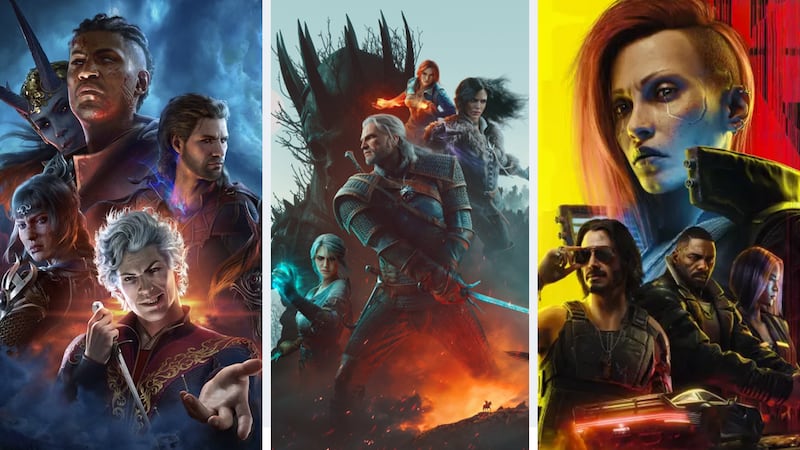
Without BioWare, we wouldn’t have the Mass Effect and Dragon Age games, along with the comics, books, a movie, and everything associated with those franchises, but BioWare’s involvement in the industry didn’t end with their own games. Strong. Stoic. Sullen. These are words you could use to describe Henry Cavill’s portrayal of Geralt of Rivia in the TV adaptation of The Witcher. It’s a show that might never have been made if not for BioWare, though the reasoning behind that isn’t immediately obvious. The Witcher is based on the book series by Polish author Andrzej Sapkowski. The books also served as the base for the The Witcher video game series by CD Projekt Red. Founded in 1994, the Polish company began by distributing games they translated to Polish, including Baldur’s Gate. “CD Projekt Red was great because they originally built a Polish port of Baldur’s Gate without ever talking to BioWare,” said BioWare founder and current Beamdog CEO Trent Oster. “They just went in and essentially reverse engineered how our text was stored, and then just translated it.” That got the two companies talking and led to CD Projekt Red translating Baldur’s Gate II, and the relationship grew from there. “When they were thinking about doing the original The Witcher, they came and they had a look at the Aurora engine from Neverwinter Nights, and said, ‘Hey, this looks great. We’d like to license it.” So The Witcher and The Witcher 2: Assassin of Kings were based off of that technology," Oster said. The Aurora engine was developed by BioWare when making Neverwinter Nights, which was released in 2002. The engine was also used for Star Wars: Knights of the Old Republic and Jade Empire. In addition to the engine, BioWare also offered space to CD Projekt Red at its E3 booth to show off The Witcher. That seemingly little help went a long way, The Witcher games, mainly The Witcher 3: Wild Hunt, have sold more than 90 million copies worldwide. “The first game was decent, the second game was better, and then the third game just hit it out of the park,” said Oster. “We refer to The Witcher, The Witcher 2, and The Witcher 3 as the desired progression. The first game proves you can do it, the second game polishes the craft and the third game knocks it out of the park.” That’s not even mentioning the Keanu Reeves-sized elephant in the room that is CD Projekt Red’s Cyberpunk 2077. The game has sold more than 40 million copies, has a Netflix TV adaptation, a trading card game, comics, a novel, and a reported live-action movie in development. “When I got it, I played it, and I’m thinking, this is the best game I’ve ever played in my life, this is amazing,” Oster said. Another little game that sold more than 23.2 million copies and generated more than $1.2 billion in revenue, according to Alinea Analytics, is Baldur’s Gate 3 from Larian Studios. Oster says without the first two Baldur’s Gate games made by BioWare, the third title “would not have existed.” “All this joy that you got to experience as a player comes from that initial IP being successful and the initial work that BioWare put into Baldur’s Gate 1,” added Travis Gibson, a vice chair with Digital Alberta. As much as BioWare inspired other studios and developers, they were also inspired by games like Final Fantasy VII and Call of Duty: Modern Warfare. “It’s really hard to trace direct lineages on games. In the games industry we play each other’s stuff, and it influences what we build,” Oster said. “Our lead designer James Ohlen played (Final Fantasy VII), and he said, ‘We are children. We do not comprehend how to properly make a great game,’” he added. “So for Baldur’s Gate II, James went very hard on companions and thinking about relationships and how far we could push that, and that really drove forward the next decade, decade and a half of BioWare Games.” Is there a future for Mass Effect? In seven months, the video games industry will descend on Edmonton for Game Con Canada. BioWare’s closure will put a bit of a cloud over the event, but there is a silver lining, according to Meibel Consulting CEO Chris Meilleur. “Everyone is really upset and saddened by the closure, but … the positive that comes from this is that there is now a massive influx of talent to start more small indie studios,” he said. “There’s not enough jobs out there right now, these guys aren’t going to get absorbed into other big publishers. So the option is to create their own games and become an indie developer, and that’s one of the things that we focus on.” Fans have also been vocal about wanting to save the cancelled Mass Effect 5 game that BioWare was working on when it was closed. An online petition advocating for EA to reopen development on the game has garnered more than 336,000 signatures. People have also funded #SaveMassEffect billboards in several cities, including New York’s Times Square, Edmonton and outside EA’s offices in Redwood City, Calif. “It makes you feel good because you’ve had such an impact on so many people over all the years,” Oster said. It would be “very hard” for EA to make a good Mass Effect game, as the company is now, according to Oster, but it’s hard to say if EA would be willing to let go of the IP so someone else could try. “I have spent a lot of time talking to a lot of people, asking that question … still working out what the options are,” he said. Oster has “floated” the idea of buying the IP for Mass Effect to “several people,” he says. “That said, I can’t reach into my back pocket and pull out the dollars involved. If something’s going to happen, funding it is going to be hard. It’s going to be a lot of work,” he adds. Were Mass Effect to be brought back from the grave, not unlike Commander Shepard in the second game, Meilleur thinks it would be “wildly successful.” “I haven’t spoken to Trent about it personally yet, but I can tell you that … if that were to come to fruition, if they’re going to attempt it, we will put every asset and resource we have at our disposal to help that along,” Meilleur added. Digital Alberta also said there are things it could do to support a project, if Mass Effect were revived in the province. “Whether that’s working with the Government of Alberta, whether that’s working with the federal government, or all the other member associations that we’re a part of,” said Gibson. “We’re deeply connected, and we want to make sure that whatever happens is going to be successful again.” The Montréal International Game Summit happened earlier in November and Gibson says BioWare’s closure was an “eye-opening moment” for people there. “If we want good games made in Canada and Alberta, and really showcase Canadian culture and Canadian geniuses … what can we do in the future to … protect ourselves and be in a better position?” Gibson said. “We’re not going to let this happen again. We’re going to be better this time, and that’s my hope moving forward.” In the meantime, most of BioWare’s games are still playable, including: