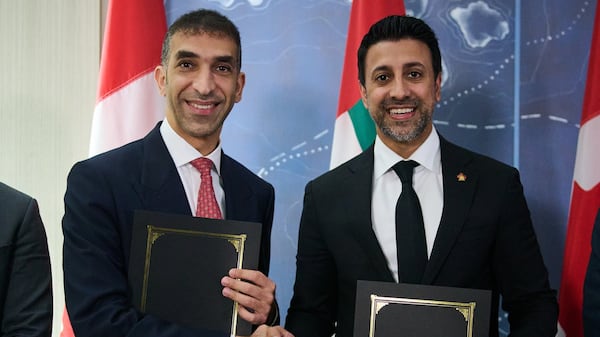
Ontario is going all in on nuclear power, signing a $300 million cost sharing agreement to push along planning for the construction of four more reactors at the Bruce Power nuclear station, near Kincardine. “Today, we are very proud to take the next official step forward on the Bruce C Project, a project that represents 18,900 jobs, a project that will create over 6,000 permanent jobs, a project that will add $230 billion to Canada’s national economy over the next 80 years,” said Ontario’s Minister of Energy and Mines Stephen Lecce. Two years ago, Bruce Power officially started the process to add to their eight-reactor fleet, proposing the construction of Bruce C, Ontario’s first large scale nuclear build in more than three decades. While the proposed project still requires federal approvals that likely won’t come until 2028 at the earliest, Ontario is putting all their weight behind the new nuclear build, willing to share in $300 million worth of pre-development work, such as site planning, community consultation, technology selection and cooling water strategies to get the project approved as soon as possible. “It is a project that needs to come online, a project that is essential. Forty-eight hundred megawatts, that’s power for almost five million homes, and we need the power,” said Lecce at a news conference in Etobicoke Thursday. “Ontario’s long term energy plan for Ontario has estimated almost three more Bruce Power sites will be required between now and mid-century, the 2050s, and we believe the Bruce site is an ideal one for new nuclear,” said James Scongack, Bruce Power’s chief operating officer and executive vice president. Part of the $300 million pre-development funding will be used by the towns and municipalities surrounding Bruce Power to assess the impact the addition of more nuclear reactors and accompanying 6,700 operational jobs will have on the region, known as the Clean Energy Frontier. “This will help all the local governments to assess infrastructure, housing, hospitals, services, workforce needs, when we are bringing this type of large project to the area,” said Bruce Power CEO and President Eric Chassard. “We understand both the opportunity and the responsibility that come with projects of this scale. With the support we are receiving today, our communities can plan with confidence, continuing to meet the needs of our residents while our region helps power Ontario’s future,” said Bruce County Warden and Saugeen Shores Mayor Luke Charbonneau. “On behalf of the Municipality of Kincardine, I want to congratulate the Ontario government for its continued leadership and investment in the nuclear sector. By enabling Bruce Power to move forward with critical early work, the province is strengthening a clean, reliable energy system that benefits all of Ontario, while supporting jobs, innovation and long-term economic stability,” added Municipality of Kincardine Mayor Kenneth Craig. While a recent Ipsos poll found that 91 per cent of Huron, Bruce, and Grey County residents believe the construction of Bruce C would be good for their communities, members of the Saugeen Ojibway Nation are not yet on board. “Bruce Power has proposed building four new reactors at its existing site. However, Canada, Ontario and Bruce Power have not committed to respecting SON’s [Saugeen Ojibway Nation] right to free, prior, and informed consent. This is a serious concern. SON leadership is working to hold Bruce Power accountable for this standard before the project moves forward,” said Conrad Ritchie, Chippewas of Saugeen First Nation Chief and Darren Johnston, acting chief of the Chippewas of Nawash Unceded First Nation, in a joint statement. By the time the federal impact assessment is completed by 2028, and pre-development work on Bruce C is done by 2029 or 2030, Bruce Power certainly hopes to have secured an agreement with the Saugeen Ojibway Nation to let the project proceed. “A central part of this work is ongoing engagement with the Saugeen Ojibway Nation to help shape the project. Also, to minimize the environmental and other impacts, but also maximizing the benefits of the project, and the long-lasting benefits for all the communities,” added Chassard. If approved by 2030, it’s expected Bruce C would require three years of site preparation and up to 14 years to build and commission.