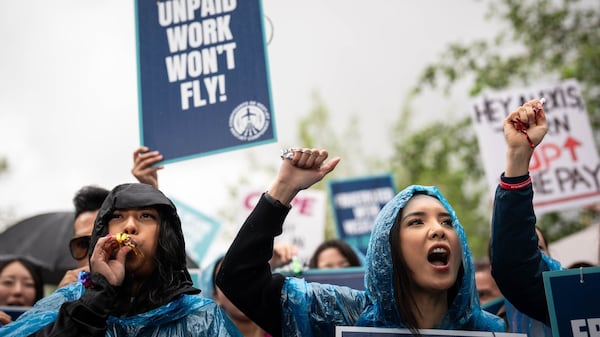
OTTAWA -- As Canadians celebrate the achievements of the labour movement, a major employer group is urging Ottawa to amend the Canada Labour Code in ways that could curb the use of strikes. Federally Regulated Employers – Transportation and Communication (or FETCO) is an employers’ association representing federally regulated companies including airlines, railways and telecommunications firms. And amid a growing number of lost workdays in recent years, the group wants Ottawa to limit workers in critical industries from using strikes as a bargaining tool. Instead, it is calling for the creation of a special mediation office to step in when collective bargaining breaks down. The proposal would send failed negotiations directly to binding arbitration, bypassing a strike altogether. “We think when the national public interest is at risk and Canadians from coast to coast to coast are going to be negatively affected,” says FETCO president Derrick Hynes, “…there has that has to be a situation where it’s reasonable to impose some limits on that right to strike.” The proposal takes on added significance as Ottawa reviews the Canada Labour Code, with a mandate to modernize federal labour relations, employment standards, and workplace rules to reflect current economic challenges. Hynes says Canada has recorded more person-days lost to strikes in the past three years than in the previous decade combined. Work stoppages that have cost the country revenue and, he says, damaged Canada’s reputation as a place to do business. “Let’s look at the strikes along the West Coast ports in British Columbia,” he says. “They took a work stoppage in 2023 and 2024, maybe totalling about 13 days. Nineteen-point-two billion dollars’ worth of cargo was diverted. “That’s an immediate, massive impact on Canadians. And the reality is, some of that business never comes back.” The work stoppages have also hurt small and medium-sized businesses, says Dan Kelly, president of the Canadian Federation of Independent Business. He says some companies have been forced to shut down or lay off workers because of the impact recent strikes have had on supply chains. “These are real on-the-ground effects that don’t just affect those industries. They affect my guys, small and medium-sized companies, and of course all the employees that depend on them.” But labour leaders are pushing back. Earlier this year, as Ottawa began its review of the Canada Labour Code, the Canadian Labour Congress warned the federal government against weakening workers’ bargaining power or their right to strike. CLC president Bea Bruske repeated that message in an interview with CTV News this weekend. “Any infringement on the right to strike,” she says, “is taking away the power that workers have to be treated with respect and dignity, and to get that fair deal.” Bruske says weakening workers’ rights would reduce the pressure on employers to bargain in good faith and put their best offer forward. She says employers looking to avoid strikes should instead do more to address the issues that lead workers to walk off the job. “Wages and benefits are often an issue. But very, very often, the issue of respect and dignity at work, scheduling issues, work-life balance, health and safety on the job, those are primary things that drive people to go out on a picket line.” Still, business leaders worry Canada’s recent history of work stoppages could damage the country’s international reputation as it tries to diversify its trade partners. “I do worry that Canada’s reputation is in the balance here,” Kelly says. The FETCO president echoed that concern. “If we’re looking at trying to grow this economy in Canada, increase east-west trade, non-U.S. trade, we can’t be seen as a place where we are an unreliable place to do business.”