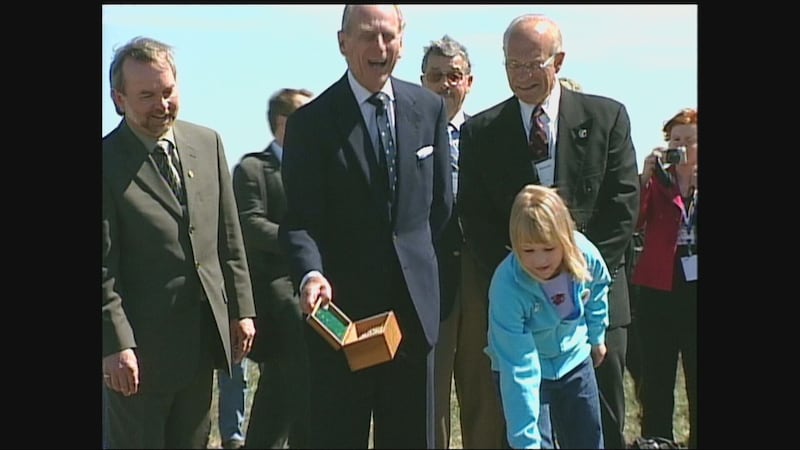
The former Duke of Edinburgh played a visible role in the formation of a conservation area in Regina that’s now at the centre of a legal dispute. While visiting Saskatchewan for its centennial celebrations in 2005, Prince Philip, husband of Queen Elizabeth II and a known environmentalist, helped a group of children plant native grass in a wetland area now known as McKell Wascana Conservation Park. At the time, the surrounding development threatened the natural habitat, which was a major concern for Bob McKell, whose grandfather homesteaded in the area in the 1800’s. “You need land to make a living, but you need some land for the soul,” he said at the time. As he loved the area and wanted to protect it, McKell donated over 150 acres to Ducks Unlimited Canada. Prince Philip unveiled a plaque declaring the site a protected refuge for plants and animals. “To have the Duke come and do this unveiling of a plaque is forever and is something my children and grandchildren will enjoy,” he said. Jack Messer, a former Saskatchewan MLA, spoke on the significance of the donation. “Seventy five acres are within the city limits and another 96 are east of Regina [and] will eternally be untouched by developers,” he said. McKell wasn’t the only one recognized for his love of nature during the visit. Prince Philip also presented five Duke of Edinburgh Habitat Conservation Awards to Canadians who went above and beyond when it came to protecting natural habitats. “This is just the sort of partnership between individuals and organizations that is needed to ensure that future generations will continue to enjoy a rich and diverse natural environment,” Prince Philip said in his remarks. Legal dispute Now, in 2026, the site faces controversy, as conservation groups claim a proposed expansion project will directly encroach on the McKell Wascana Conservation Park – violating an agreement between the two parties. Karin Steuber, executive director of the Saskatchewan Archaeological Society, said the main concern is making sure there is an archaeological assessment done. “So that if there are archaeological sites there or artifacts and belongings, that these are properly recorded,” she said. Last week, Heritage Regina penned a letter to city council and administration voicing their support for the preservation of the park, calling it an important piece of Regina’s living and cultural heritage. “It’s kind of hundreds of acres of untouched, native prairie that that has remained protected for decades. And the goal of the park establishment and easement is to keep it that way in perpetuity so we would really like to see that remain intact,” Nathaniel Hak, vice president of Heritage Regina said. Hak said the conservation easement in place legally protects the area from development of any type, reiterating the importance of keeping it preserved. “It’s one of the only spots in Regina, and certainly the largest spot within the city, where you can still see native prairie,” he said. Hak said Heritage Regina has also echoed concerns raised by the Saskatchewan Archaeological Society on the probability of archeological significance. He also said preserving the site is essential for next generations. “I can’t think of a better way to go and learn about what native prairie ecosystems do, what they look like, why they’re important for humans and for the wildlife that live there than to be able to go out into the McKell area and experience that for yourself.” The park is located at 12001 Wascana Circle. With files from Nelson Bird and Jacob Carr