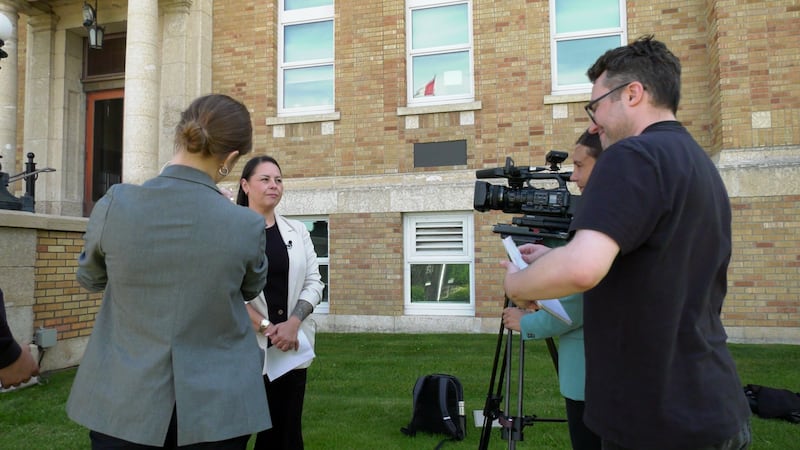
Saskatchewan farmers are dealing with rising fuel prices this seeding season, but they’re also weighing the current cost of fertilizer. “I think the only way we’ve been able to keep ahead with it is by growing more bushels, being more sustainable,” said Gerry Hertz, a farm operator in the rural municipality of Edenwold. “We might spend more on stuff, but if you do it as efficiently as you can, your cost per unit is actually lower.” Hertz owns 1,100 acres of land, about 30 minutes northeast of Regina. Typically, Saskatchewan farmers use four types of fertilizers: nitrogen, phosphorus, sulfur, as well as potash. Hertz said farming operations like his have seen an estimated 30 per cent cost increase in 2026. “There’s way more risk that is attributed to higher costs because you got to somehow make that up,” he said. “You might have to step up your marketing side of things and get out of a comfort zone because of that. We don’t have a glass ball, we just read the markets, and if the markets go sideways or differently, we take the fall.” However, Hertz said every farm is different, not only in Saskatchewan, but across the country. “There is no farm operation that is similar to another one. Every farmer has different problems with human resources, cash flow, the amount of equipment that they have,” he said. “You can’t put a box around agriculture and say, ‘This is where it works’. Do not put boxes around things and pigeonhole us and say, ‘This is how you got a farm.” According to CropLife Canada, parts of Saskatchewan have been dealing with dry and drought-like conditions for the past seven years. Pierre Petelle, CropLife Canada’s president and CEO, said he admires farmers’ ability to adapt with new technology and innovation to maximize efficiency. “Every year there’s new innovations, there’s slightly better genetics in almost every crop,” he said. “Canadian farmers are very quick to adopt those and [are] always looking for the latest technology that will give them that little bit of an edge, [such as] pods that don’t break open and lose the seed as quickly. There’s a ton of innovations that have just been quite transformative.” Petelle said another way to cut costs is for Canada to reduce reliance on other countries, including conflicts like the war in Iran, by using those kinds of agricultural innovations. “There are quite a few inputs like crop protection and seed innovation, seed technology that are heavily regulated,” he said. “Things can be improved here in Canada by looking at how those products are regulated, the speed at which they’re approved and getting into the hands of farmers.” CropLife Canada currently has “almost a singular focus” on creating a regulatory environment for economic growth, with what Petelle describes as a “receptive government” to their message. “What we’re pushing for quite hard here is for the seed regulations and crop protection and that the mandate of those regulators be formally changed to include an economic lens,” he said. “Yes, we still absolutely want health and environment protection to be the ultimate goals, but maybe an additional consideration of the economic factors.”