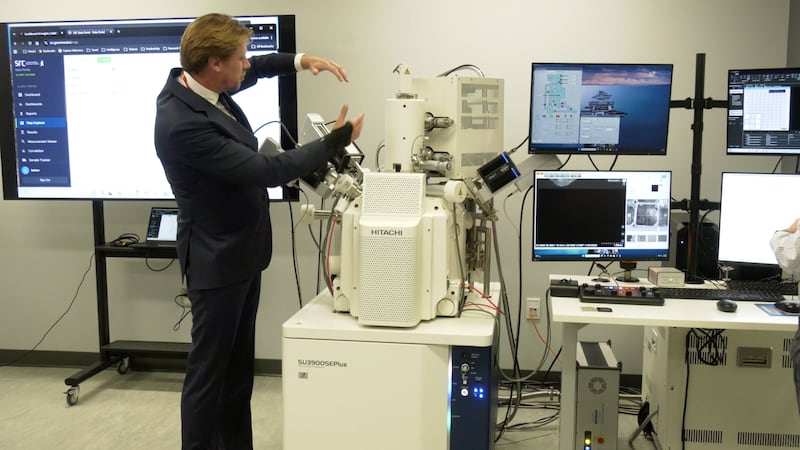
The Saskatchewan Research Council (SRC) has launched what it calls first-of-its-kind technology that could change the way mining companies search for valuable minerals. SRC partnered with Hitachi High-Tech Canada to develop TracePoint Workflow. According to SRC, it’s the world’s first fully automated process for indicator mineral analysis, which examines till samples to help identify areas that may contain valuable minerals. SRC said automation allows it to analyze thousands more samples each year. “SRC, as capable as it is, could do manually probably a few hundred of these samples per year. This fully automated end-to-end solution allows 10,000 a year,” Mike Crabtree, SRC president and CEO, said during a news conference Wednesday. The technology could help mining companies better focus their exploration efforts, according to SRC. “Canada’s a very big country, it’s very rich in minerals, but sometimes finding those minerals is a needle in a haystack. This allows us to focus in on where those needles are,” Crabtree said. The technology includes a first-of-its-kind automated machine that prepares mineral samples and a custom-built instrument that analyzes them. SRC said the system was developed over several years in collaboration with Hitachi. The company designed the sample preparation and analysis instruments and provided the data storage and programming capabilities needed to deliver quick and accurate results. Chad Ostrander, president of Hitachi High-Tech Canada, said the system could be transformative for the mining industry. “You’ve never seen anything like it. You’re talking about orders of magnitude improvement in the overall efficiency and potential cost reduction of the process,” Ostrander said. Warren Kaeding, minister responsible for SRC, said the technology could also help companies determine how much uranium or other critical minerals they have access to. “What we’re going to be able to do with this, I believe, is be able to quantify what that level of uranium or critical minerals that they have under their control and what they’re going to have access to,” Kaeding said. SRC said the system can also be used to reanalyze archived samples, helping companies identify mineral deposits that may have been overlooked. But Crabtree said it’s too soon to put a number on what the technology could mean for Saskatchewan’s economy. “I think it’s going to be really significant. But, you know, an answer that I gave at the moment could seem to be a little extreme,” he said.