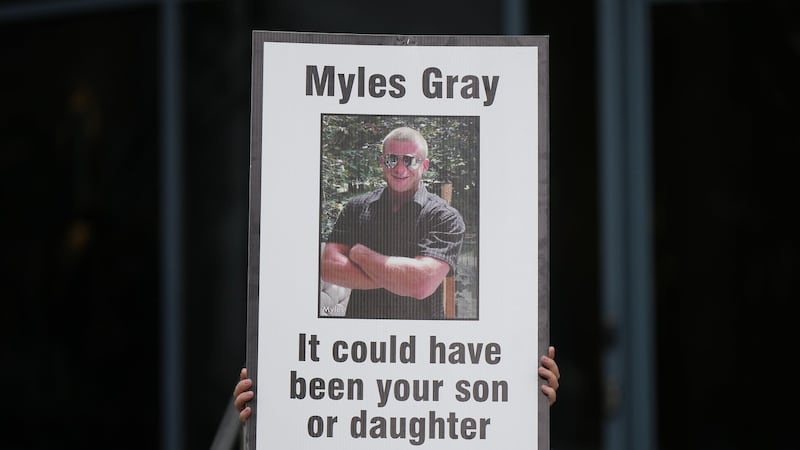
A Vancouver police officer who responded to a call for backup on the day Myles Gray was killed says he arrived at the scene and saw a colleague red in the face and barely conscious after being punched. Const. Nick Thompson was testifying Tuesday about the fatal confrontation between police and Gray at a public hearing where the officer faces allegations of abuse of authority for his use of force, having kicked and hit Gray with a baton multiple times as officers tried to subdue him. Thompson said he arrived at the scene in August 2015 along with Constable Joshua Wong with their lights and sirens on and immediately noticed the smell of pepper spray in the air. There had been an audible “commotion” from the yard, and he said he heard “nonsensical yelling, but more of that primal yelling that we’d heard on the radio that was ongoing.” He told the hearing, called by B.C.’s Police Complaint Commissioner, that a “primal roar” came over the radio while they were on the way to help officers who had encountered Gray. Three officers had been trying to subdue Gray underneath a large shrub, and he saw Const. Kory Folkestad wide-eyed and “barely” conscious as if “there was nobody home,” Thompson testified. A police baton and a can of pepper spray were “scattered” on the grass of the yard, he said. Thompson said he found out later that Gray had knocked Folkestad out and possibly tried to throw him off a retaining wall to the ground, and he worried about “grievous bodily harm or death” from Gray’s “assaultive” actions. He said Const. Hardeep Sahota, who had first encountered Gray, “kept stressing to us like, ‘be careful. He had knocked out Const. Folkestad.” Thompson testified that he’d been concerned upon arrival as he saw Gray trying to “overpower” the three officers, thrashing violently and displaying “brute strength.” “His hips were bucking, he’s trying to, you know, resist with his arms, with all his might. His feet kept thrashing about and kicking and lurching. I recognize that the officers there had some control, but it wasn’t going to last very long,” Thompson said. He described the officers struggling with Gray as the man was trying to stand up, and said Gray was throwing wild punches with a handcuff around one wrist, which could have been “devastating.” “I kicked him as hard as I could. There was no change in behaviour,” Thompson said. “That was like, very unusual. I did not expect that as a response.” Thompson said he had never dealt with a comparable situation to the altercation with Gray. He said other situations in his policing career have always seen officers gain control of suspects, including one who had jumped off a 21st floor balcony and scaled a building like “Spider-Man,” who Thompson subdued with a beanbag shotgun. He’s seen people with significant mental illness, agitated, experiencing mania or catatonia, where they could resolve the situation, Thompson testified. Thompson said Gray “wasn’t responsive to pain” and demonstrated being “physically capable of causing a tremendous amount of destruction.” The officer also told the hearing Tuesday that he didn’t give a statement on the day of the incident after someone from the police union told him to not take notes or write anything down until he had spoken to a lawyer. “I can’t remember who it was, but more than one police officer kind of reaffirm that message from the union, ‘don’t take any handwritten notes,’” Thompson said. Const. Beau Spencer also told the inquiry on Monday that he could not remember which union officials directed him not to take notes. Thompson testified that he was told at a meeting at police headquarters the night of the death to make his statement by creating a document on his home computer, and it was submitted several months after the altercation. He said he remembers “bawling” his eyes out on his drive home that night, and said he dissociated in the weeks afterwards and has little memory of the weeks that followed. He said senior members of the police union told him to be “cognizant” that the Independent Investigations Office, which investigates police actions in such incidents, would try to access his medical records, and it “became very difficult for me to feel comfortable accessing mental health support at that time.” “My mental health has struggled ever since,” he said. He’s since been diagnosed with significant anxiety disorder, depression and post-traumatic stress disorder and he’s taken “substantial” time off work, but he’s been accommodated by the police department. “It is very difficult to have to replay the worst day of my life in a public forum. I just I can’t escape it,” Thompson said. “I would very much like to move forward, get some closure. I think we all would, but the reality is, is that we’ve been stuck.” This report by Darryl Greer, The Canadian Press, was first published Nov. 17, 2026.