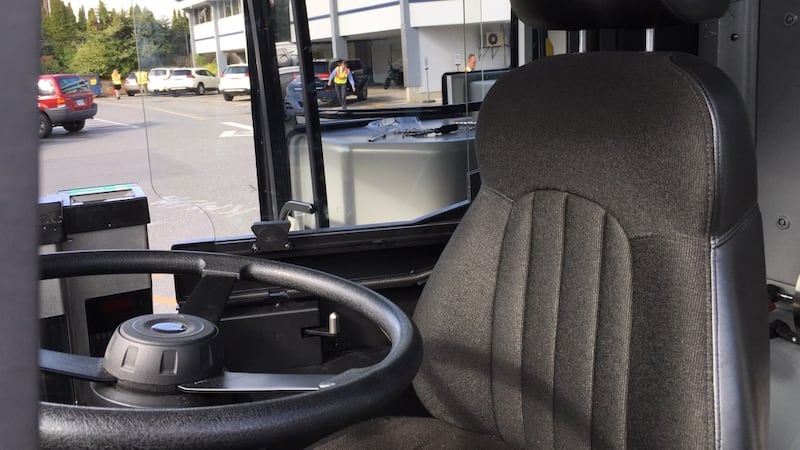
B.C. Transit is warning that rolling strikes could temporarily shut down the entire Victoria Regional Transit System on Nov. 17, adding another layer of uncertainty for thousands of passengers already dealing with widespread bus cancellations. But the president of the union representing Victoria’s transit operators says the current disruptions are not the result of rotating strikes, insisting drivers remain on the job and that cancellations are tied to an ongoing overtime ban. “We have not started any rotating strikes today,” Unifor Local 333 B.C. President Stephen Bains said. Bains says members are reporting for work and performing their regular duties, with the exception of voluntary overtime. He was particularly critical of B.C. Transit’s announcement warning customers that rolling strikes could begin, saying it was misleading and creating unnecessary concern among passengers. “I’m incredibly disheartened to see B.C. Transit deceive its ridership like that,” he said. Bains says the union had committed to giving passengers advance notice before escalating job action and would issue its own public announcement if rolling strikes were introduced. “We would never put our ridership in a situation where we’re just going to start rolling strikes without any advanced notice,” he said. The comments come as commuters face cancellations across the Victoria Regional Transit System, including multiple trips on Route 95 between Langford and downtown Victoria. Other routes have also experienced cancellations, leaving passengers facing uncertainty about getting to work and other daily commitments. Asked why so many buses are not running, Bains pointed to the union’s overtime ban, which has been in place for several weeks. “B.C. Transit has gone to the point where they’re using overtime as a management style. It’s become a business model,” he said. He argues the transit system has become increasingly dependent on employees accepting additional shifts to keep service running. “The Victoria Regional Transit System has, unfortunately, become quite fragile, which is precisely why we have been imploring B.C. Transit and the government to fund the front line and create a true sustainable transit system,” Bains said. He also suggested a combination of employees refusing voluntary overtime and a possible backlog among maintenance staff could be contributing to the cancellations. Transit riders caught in the middle For passengers who depend on public transportation, the uncertainty is already creating challenges. Alice Ross takes transit as many as four times a week. Unable to drive, she relies on the bus to get around Greater Victoria. “It’s convenient,” Ross said, adding that her monthly seniors’ bus pass is more affordable than taking taxis. A potential service shutdown would leave Ross with few alternatives. She says she would have to walk about 25 minutes each way to reach a non-profit organization she visits. Approaching her 80th year, Ross says uneven sidewalks and poor weather can make walking difficult. “When it’s cold, when the wind is blowing at 40 km/h an hour, it’s hard to hold onto my walker,” she said. Ross says she supports the transit operators, recalling instances when drivers went out of their way to help passengers with mobility challenges. “We can have a very large senior population and single people. They don’t have somebody to give them a ride. They depend on the bus,” Ross said. She wants the two sides to find common ground after months of negotiations. “I’m hoping that they are going to sit down and stay sitting down until they have come to an agreement,” she said. Riders’ group calls for resolution Victoria Transit Riders Union chair Liz Cronin says the union has consistently communicated its intention to provide advance notice before major service disruptions. She criticized B.C. Transit’s announcement warning of potential rolling strikes, saying it created unnecessary anxiety among passengers. “I saw people panicking online. A lot of people were really stressed,” Cronin said. While supporting the workers, Cronin acknowledges that rolling strikes would have serious consequences for people who rely on transit to get to work, school, medical appointments and grocery stores. She argues that better working conditions for transit employees are also important for passenger safety and reliable service. “It’s not safe for riders if the workers cannot use the bathroom, if they can’t have a snack, if they can’t be on time, and they’re stressed and rushed all day at their jobs,” she said. The riders’ group is planning another rally in support of transit workers Saturday, Nov. 21, at 1 p.m. outside B.C. Transit’s headquarters at 520 Gorge Road East. Cronin says it will be the group’s 14th weekly rally. “This is not about the riders versus the workers. We are the poor and working people, and we need to stand together to get what we need,” she said. Unifor national president weighs in The dispute is now drawing attention from Unifor’s national leadership. In a statement released Tuesday, Unifor National President Lana Payne accused B.C. Transit of giving passengers inaccurate information about the potential escalation of job action, saying the union has maintained its commitment to providing advance notice of any full-service disruption. “Transit riders in Victoria deserve accurate information, not confusion created by their own transit provider,” Payne said. “Our members made a commitment to the public and they are keeping it. B.C. Transit should put its energy into reaching a fair agreement instead.” Payne’s statement reinforces the union’s position that passengers will receive advance warning before any significant service disruption. Unifor Local 333 B.C. represents approximately 790 transit operators and mechanics at B.C. Transit in Greater Victoria. Their collective agreement expired March 31, 2025. Funding and negotiations at the centre of dispute Bains says the union met with the employer and a mediator last Friday, but the discussions did not produce an agreement. He says B.C. Transit made it clear additional funding for front-line operations would require savings elsewhere. The union presented several proposals it believes could generate those savings. “They had informed us that they’re going to need some time to do the costing, and that they’d get back to us,” Bains said. According to Unifor’s national statement, the union has also proposed interest arbitration to resolve the outstanding issues after mediation failed to produce a deal. The union says B.C. Transit rejected that proposal. Despite the impasse, Bains says the union remains willing to negotiate. “We’ve been prepared to go back to the table at all times,” he said. He also had a message for passengers caught in the middle of the dispute. “After all, without the ridership, there are no transit workers,” Bains said. B.C. Transit warns of possible systemwide shutdowns In its Nov. 16 service advisory, B.C. Transit said rolling strikes could begin in the Victoria Regional Transit System as early as Nov. 17. Unlike a full strike, rolling job action involves disruptions in stages. It could target specific days and locations, with picket lines potentially appearing at different facilities. B.C. Transit warns the entire Victoria conventional transit system could be shut down for periods of time, although not indefinitely. The pattern of disruption could change from day to day or even hour by hour. The agency says it has activated business continuity plans to minimize disruption to passengers and limit impacts on transit systems across the province. The potential job action involves conventional transit operations only. Victoria handyDART service is not affected. Interregional Routes 66, the Cowichan-Victoria Express, and 99, the Shawnigan Lake-Victoria Express, are also continuing to operate as scheduled. However, if local Victoria transit service is suspended, passengers arriving on those routes will not have access to conventional service beyond designated drop-off locations. Buses will also not serve stops located behind picket lines. B.C. Transit also warns its head office at 520 Gorge Road East will close to the public if picket lines are present. Taxi Saver vouchers and handyDART fare products normally available through the office will be temporarily unavailable, and online store purchases may also be affected. The agency says it will provide updates on confirmed strike dates, affected routes and picket line locations as information becomes available. Passengers are encouraged to check the B.C. Transit Victoria service alerts page before travelling, as service information could change throughout the day.