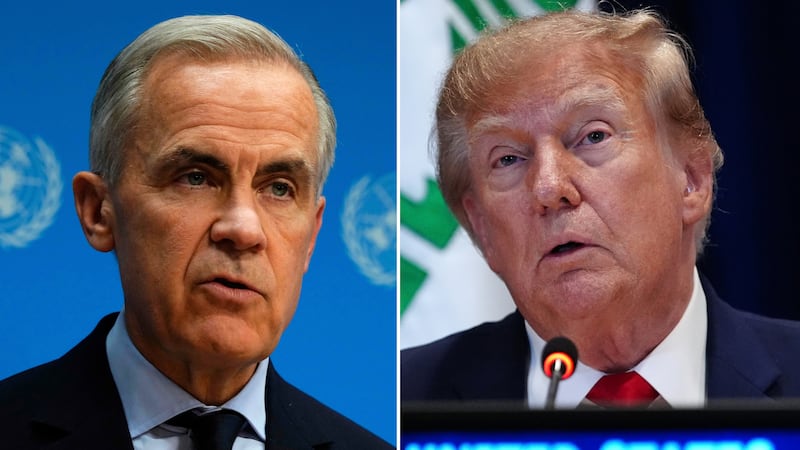
OTTAWA - Just days until new United States’ tariffs could be imposed on Canada, CTV News has learned the Americans’ proposals do not include any significant reduction on softwood lumber tariffs and would require American booze to return to store shelves immediately. In exchange, the Americans are willing to reduce so-called Section 232 tariffs impacting industries like autos, steel and aluminum. But multiple sources briefed on the negotiations tell CTV News the Canadian side does not feel the reductions “go far enough.” CTV News spoke to one American and five Canadian officials on the trade talks. According to the American source, the U.S. believes most softwood lumber tariffs have been a long-standing issue that pre-dates the current trade discussions and does not fall into the purview of these negotiations. That does not mean they aren’t open to further negotiations on the issue, just not right now, the source said. The sources also tell CTV News that once a deal is struck, the U.S. wants to see the immediate return of American alcohol to provincial store shelves, adding the alcohol ban has been “absolute top of mind” for American officials during the trade war. Since early last year, eight of the 10 provinces – excluding Alberta and Saskatchewan – have removed U.S. booze in response to U.S. President Donald Trump’s ongoing trade threats. The ban has been highlighted as one of the largest irritants on the American side, and one of the reasons for Trump’s latest tariff threat. The other irritants for the Americans include supply management on dairy, and certain tariffs and quotas on cars imported to Canada from the U.S. CTV News has also learned that the U.S. wants to see Canadian counter-tariffs removed on American autos, which was done in response to the Section 232 tariffs on Canadian cars and trucks. According to the sources, if an agreement is reached, U.S. Trade Representative Jamieson Greer will put it on Trump’s desk as early as Monday. Greer has communicated to multiple officials that everything will hinge on the mood of the president when the deal is presented to him. The new U.S. tariffs - which would impose 50 per cent levies on a variety of Canadian goods even covered under the Canada-U.S.-Mexico Agreement - are set to come into effect Aug. 19. B.C. Premier David Eby has previously said there is “not a chance in hell” that U.S. alcohol is going back on the shelf in his province. Speaking to reporters on Friday, Eby said his “position is unchanged” and that the “softwood lumber industry is under direct attack.” “The softwood lumber sector is bigger than auto parts and steel combined in terms of the Canadian economy, and it needs to be front and centre at the table,” Eby added. As for Greer, he called discussions with Canadian colleagues as “constructive” while at the Iowa State Fair on Friday. “These tariffs that are coming in, they are a response to Canadian retaliatory measures, like the kind of things that China would do,” Greer said. “And so those are things that would have to be resolved.” Both sides remain ‘far apart’: sources Canada-U.S. Trade Minister Dominic LeBlanc and Chief Trade Negotiator Janice Charette have been in Washington this week and met with Greer twice while there. On Friday, LeBlanc and Charette briefed the Advisory Committee on Canada-U.S. Economic Relations and provincial trade ministers on the state of negotiations. According to two of the sources who spoke to CTV News, both countries “are still quite far apart.” Candace Laing, who is the president and CEO of the Canadian Chamber of Commerce and a member of the prime minister’s advisory committee, also tells CTV News that both sides “are still quite far apart in finding that landing zone to the resolution of each party’s priority grievances.” Laing also says an extension to the Aug. 19 tariff deadline has not “yet been discussed or talked about.” LeBlanc’s office confirms both he and Charette will remain in Washington over the weekend. If the two sides can’t come to an agreement on the new U.S. tariffs, the levies will take effect on an estimated $28 billion worth of Canadian imports. With files from CTV News’ Brennan MacDonald and The Canadian Press