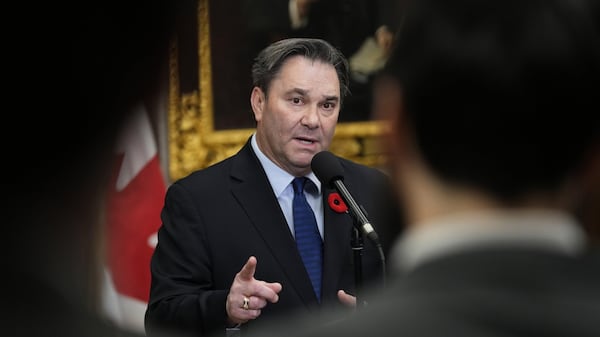
Officials say new rules governing the 2025 civic election led to delays at the ballot box and in posting results, but the province says local authorities were unprepared for Oct. 20. Before voting stations opened on the morning of election day, the returning officer for Elections Calgary asked for voters to be patient, anticipating that the voting process would take longer. “In light of the changes to the legislation, I think the first (change) that Calgarians will notice will be the confirmation if they are on the permanent electoral register. So, election workers will be reviewing the list. I will note that that does take a little bit of time,” said Kate Martin during a media availability. The permanent electors register is new for this election. It’s a record with information requiring a voter’s first and last names, their address, birth date and a signed statement known as Form 13 elector register. This is required by the Local Authorities Election Act, passed in the legislature in spring 2024. Voters told CTV News elections workers handled the extra paperwork before ballots were handed out to be cast, causing fluctuating lineups that kept people waiting up to 90 minutes at several Calgary voting stations. Elections Calgary reported the majority of the 261 voting stations had much shorter lines. Hand counting The new legislation is also being linked to delays with ballot counting. Electronic tabulators are not permitted in favour of hand counting, a process that the returning officer says adds time to the process. “This time around it’s really important to note that our election workers are not just counting one ballot. They will be counting for separate contests,” said Martin. The additional time has also translated to additional costs. According to Elections Calgary, “the emerging costs related to legislative changes” is $3.3 million. The total approved budget for Calgary’s election cycle is $11.94 million. Slow counts around Alberta All Alberta municipalities were affected by the province’s changes, but implementation by local authorities varied. Calgary organized the hand count for mayor’s first, followed the next day by the advance vote count for councillor and school board trustees. Edmonton paused counting until Tuesday morning, withholding results announcements for all categories. Lethbridge officials also did not reveal partial results on election night or early Tuesday morning. Closer to Calgary, the city of Airdrie announced unofficial results Tuesday morning while the town of Cochrane withheld unofficial results until Tuesday afternoon. A statement sent to CTV News by Municipal Affairs Minister Dan Williams on Monday night said municipalities had time to prepare. “Municipalities have known about the new election rules and regulations since the spring of 2024, giving them ample time to prepare and make a plan so election day runs smoothly,” he said. “Voter attestation forms are a normal part of an election process and should not delay a properly staffed voting location. “If a municipality’s election authority was unable to come up with an effective plan, it is up to the local authority to explain to voters and candidates why long waits have developed. “Following every municipal election, we review our legislation and regulations to identify if any improvements need to be made.” Politics at play in electoral process Political science experts say the province is not taking accountability for the issues with the recent civic election. “The province, imposes these requirements on the cities without providing any support for them in administering them,” said Lisa Young, political science professor from the University of Calgary. She later added, “it’s only the province that can address some of the fundamental underlying questions and so I think there will be a lot of pressure on them to take another look (at the Local Authorities Elections Act.)” Regarding the process of hand-counting over electronic tabulators, she says there’s evidence of political motivations for the change. “This is not a call that we saw (from) across the political spectrum, and it’s not grounded in any real experience in Canada that would cause us to move away from those tabulators,” said Young.