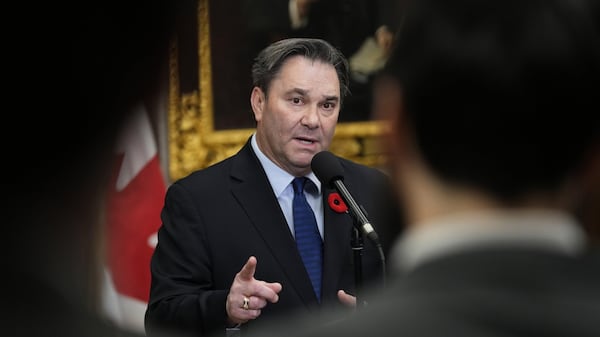
Alberta’s premier is defending her government’s use of the notwithstanding clause to end a weeks-long teachers’ strike and says Peter Lougheed would have done the same. On Oct. 28, legislators passed Bill 2, also known as the Back to School Act, invoking the notwithstanding clause. The inclusion of the notwithstanding clause in the Charter negotiations of the early 1980s was proposed by Lougheed—then Alberta’s premier—as a way for governments to temporarily pause rights in special circumstances. “I think he would have,” Danielle Smith told reporters on Friday morning. “We didn’t stop anyone from striking, but we did get to a point where we had to look at the balance of rights of students and how that was being impacted.” The comments were made during a press conference announcing more details of the Class Size and Complexity Cabinet Committee. “We hope this is a show of good faith that we were serious about finding a different way to address the complexity issue, and we will see how the court process plays out,” Smith said. On Thursday, the Alberta Teachers’ Association (ATA) announced it had filed for an interlocutory injunction asking the court to pause Bill 2. The second part of the action asks a judge to declare use of the notwithstanding clause to pass the bill as improper and invalid and ultimately as a violation of the Charter-protected freedoms of assembly and expression. Smith said invoking the notwithstanding clause was for the sake of Alberta’s kids—and for democracy. “Democracy is when the elected officials make decisions. Democracy is not when unelected judges unilaterally make decisions. So, let’s be clear about what democracy is, and that is the reason why we are asking the courts to be a little more constrained, because there are areas that fall very clearly into the realm of elected officials.” A law professor emeritus at the University of Calgary Faculty of Law says the judiciary is the check and balance for the legislative body. “The courts are supposed to be the guardian of our rights and freedoms. Our human rights are protected by the courts. By pre-emptively pushing them out of the picture, that takes away their role, their jurisdiction,” said Kathleen Mahoney. Mahoney agreed Lougheed was a strong proponent of the notwithstanding clause but believes it was meant as a reactive tool and would not have been applied in the same way. Its application in a labour relations context is concerning, says another academic. “When the government imposed the final resolution of a conflict, that undermined collective bargaining,” said Jason Foster, director of the Parkland Institute and human resources professor at Athabasca University. “Now that the government has used it once, history has told us they are more likely to use it again.” An Edmonton courtroom will hear the ATA’s filing on Nov. 20.