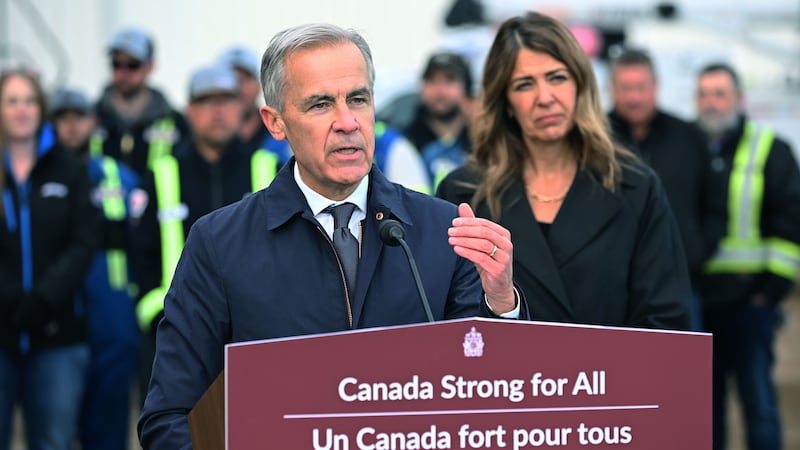
OTTAWA - The recently dubbed “Pacific Link” pipeline is expected to carry up to one million barrels of oil a day to the Pacific Coast once it is built. But the project is also carrying political significance, as Albertans prepare to vote on their province’s future in Canada in little more than two weeks’ time. On Thursday, the pipeline was designated by the federal government as its first project of national interest — a move intended to streamline the approval process and speed up construction. In an interview with CTV’s Vassy Kapelos for “Question Period,” Energy Minister Tim Hodgson touted the project’s potential to open new markets for Canadian oil. “We’re in a world where people are looking for new alternatives, new suppliers. They’re looking for trusted partners,” he said. “We don’t sign our contracts in pencil. We don’t use our energy for coercion ... Most of the countries in the world are looking for new sources of supply, and they see Canada as an ideal provider of that oil.” Pipeline takes on political significance But beyond the economic arguments, there is a political dimension to the pipeline as well, particularly because of its implications for national unity as an Alberta referendum on the province’s place in Canada fast approaches. During Thursday’s announcement, both Prime Minister Mark Carney and Alberta Premier Danielle Smith pointed to the co-operation between the two levels of government that made the project possible. “I think the demonstration of today’s announcement is Canada is working. We came together, we looked at an opportunity, and this opportunity is unlocked by Canada as a whole,” Carney said. Carney added that it was not just Ottawa and Alberta, but British Columbia, Indigenous rights holders and unionized labour that helped make the potential pipeline to the Pacific Coast possible. “That’s the country as a whole coming together and helping support it, and it is a demonstration of the power of Canada.” the prime minister said. For her part, Smith said the project demonstrated that federal and provincial governments can work together. “This is one example, along with the work we’ve done over the last year, I think of demonstrating that co-operative federalism can work in action,” she said. Separation vote at heart of Alberta referendum But the question remains: what impact will the pipeline’s designation have on the Alberta referendum? On Oct. 19, Albertans will be asked to vote on 10 referendum questions. Four deal with constitutional issues, while five are non-constitutional. But it is the 10th question that is getting the most attention. It asks: “Should Alberta remain a province of Canada, or should the government of Alberta commence the legal process required under the Canadian Constitution to hold a binding provincial referendum on whether or not Alberta should separate from Canada?” Recent polling suggests most Albertans would vote to remain in Canada. But a substantial minority would choose the second option. Smith acknowledged that support for separation remains higher than she would like. “I think in the latest poll it was about 22 per cent. Still too high for my liking,” she said. “I don’t like the fact that that many of our fellow citizens have given up on Canada.” Pipeline could sway ‘voters on the fence’ Polls suggest many Albertans have already made up their minds. But there remains a group of voters — estimated by some pollsters at between five and 10 per cent — who are either undecided or uncertain about how they will vote. It is those voters who could be most affected by Thursday’s announcement, according to Lori Williams, a political science professor at Calgary’s Mount Royal University. “Where it might make a bit of a difference is in those folks that are sitting on the fence, perhaps undecided, or what we call frustrated federalists or soft separatists,” Williams said. “And those folks potentially could be persuaded not only to change their mind on the referendum question but be motivated enough to come out and vote accordingly.” Turnout could shape Alberta referendum result Voter turnout could also play a significant role. Federalists in Alberta are seeking a strong result on Oct. 19 as they try to blunt separatist sentiment in the province. But if polls pointing to a strong federalist majority lead some voters who support remaining in Canada to stay home, the separatist side could account for a larger share of the final vote. That could give separatists a result they could point to as evidence of continued support for their cause, potentially sustaining the issue beyond the referendum. Nik Nanos, head of Nanos Research, agrees that the pipeline announcement could have an impact on voters who are undecided or less firmly committed. He believes Thursday’s announcement could help galvanize voters who are looking for a reason to support the federalist side. But Nanos cautions that it may not be enough to prevent separatists from posting a significant result. “The big wild card in this referendum is who will decide to vote, and how motivated are the different factions that are battling on this referendum,” he said.