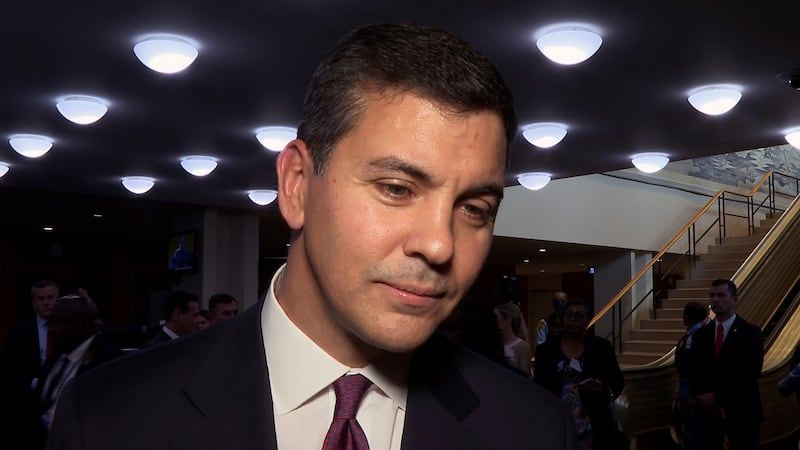
RIGA, Latvia - The prime minister of Latvia has two words to share with Canadians: “Thank you.” He also said much more during a wide-ranging one-on-one interview with CTV National News this week in Riga. Prime Minister Andris Kulbergs said Canada’s role in leading NATO’s multinational brigade in Latvia has been crucial to the safety of Europe. He noted that it has also deterred any thought of an attack by Russia in the Baltic region. “It’s substantial, (Canada’s contribution) is substantial, and we appreciate it very much,” Kulbergs said. This week, NATO’s Canadian-led, multinational brigade has been conducting a historic “military rehearsal” in Eastern Latvia, which borders both Russia and Belarus. Roughly 3,000 soldiers and 600 military vehicles have mobilized from the Adazi military base near the capital of Riga. They have deployed eastward in separate units that have spread out across hundreds of kilometres of forest and countryside with some operating just kilometres from the border. Kulbergs believes the operation is an important show of force and military readiness in the region. He said Moscow is continuing to push the envelope in Europe. “They’re taking the next step, escalating a little bit, then escalating a bit more,”Kulbergs said. “The only way to push a bully, as you know how it is at school -- you have to show force.” That is what NATO’s Canadian-led brigade has been showing this week, during its largest exercise ever deployed along Latvia’s border with Russia and Belarus. NATO soldiers have been conducting multiple exercises, ranging from close-quarters combat to trench and drone warfare drills.NATO’s multinational brigade includes soldiers from 14 different allied countries, all of whom took part in this week’s deployment. Latvia’s own military, along with Estonia and Lithuania, have been working to build a roughly 950-kilometre “Baltic Defence Line.” The line includes anti-tank roadblocks, trenches, and more than 1,000 bunkers near their eastern border. CTV News was granted permission by Latvia’s border guard to visit a portion of the defence line that used to be a land border crossing shared by Belarus and Latvia until it was completely closed in 2023. Now shuttered, the Latvian military has installed concrete and barbed-wire barricades at the crossing. Hundreds of ironclad roadblocks, called hedgehogs, have also been brought to the border. Following Russia’s full-scale invasion of Ukraine, Kulbergs said Latvia has learned from its Ukrainian counterparts. “We’re replicating what Ukraine has done with their border patrols, he added. “We’re digging the trenches, putting in the barbed wire, putting in the surveillance technology.” Latvia’s border guard has also installed fencing that stretches 145 kilometres along the border of Belarus and an additional 280 kilometres along the Russian border. Standing at the eerily quiet, militarized crossing, State Border Guard Inspector, Vladimirs Sersts pointed toward the barricade now in place. “Belarus is just two metres away,” he said.“Russia has been conducting a form of hybrid warfare, sending waves of migrants into Latvia through Belarus, using our resources and testing our capabilities.” The now-closed crossing is not just the external border of Latvia, it is one of the eastern borders of the entire European Union. Lining the road into Latvia from the border of Belarus, hundreds of metal barricades, known as hedgehogs, are piled high and ready to be deployed. “We should be ready (at the border). We’re being poked every day, every day we’re being poked, and they’re testing our response times,” said Kulbergs, who noted that he takes the potential threat very seriously. “As I say, prepare for the worst and have peace. That’s the only way,” he said. Sovereignty, security, and the growing economic relations between the two countries are a few things that Kulbergs said he and Prime Minister Mark Carney discussed on the sidelines during July’s NATO summit in Ankara. “We spoke about the energy sector, AI, data centres, and the military defence industry,” Kulbergs said. When it comes to the current threat Russia poses to NATO nations, Kulbergs believes the Kremlin is already overstretched in Ukraine and does not currently have the manpower to strike any other nation. However, the Latvian prime minister is adamant that Ukraine’s success is vital to safety across the entire region as well. “It is for our common good . Good has to win over evil,” Kulbergs said.