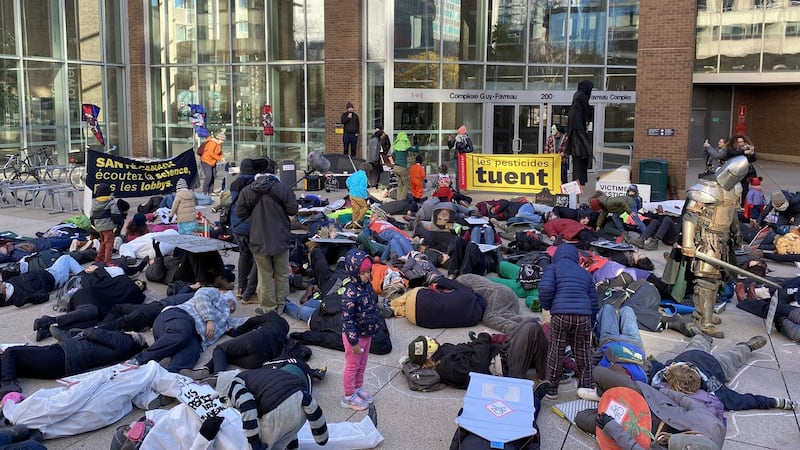
More than a hundred people, many of whom were in fancy dress on Halloween, sought to highlight the message that “pesticides kill” by staging a “die-in” on Saturday outside Health Canada’s offices in Montreal. The participants lay down on the ground in front of the Guy-Favreau complex in the city centre, whilst people dressed in white overalls moved through the crowd, pretending to spray pesticides on the protesters. Children taking part in the event were invited to trace the outlines of the people on the ground with chalk, to leave a record of the protest. The organizers had placed a coffin and cardboard gravestones in front of the building, bearing the names of various diseases, to create a “cemetery.” A person dressed as Death itself, standing on stilts, also moved through the crowd, clad in a long black robe and brandishing a scythe. Thibault Rehn, chief executive of Vigilance OGM, one of the organisations behind the demonstration, stated that the action was intended to “denounce the historic setbacks that the Carney government is currently implementing on the issue of pesticides.” “Pesticides are chemicals that are fundamentally designed to kill – to kill insects, to kill weeds – but they also have a huge impact on humans, as scientific evidence is gradually showing,” he argued, noting that the “die-in” was intended to draw on the symbolism of Halloween to get this message across. The organisers deplore the passing of Bill C-30 last June, which allows for the reauthorization of pesticides that had been banned by Health Canada. They are also concerned about section 13 of the wide-ranging Bill C-31, currently under consideration, which would amend certain provisions of the budget. Section 13 would amend the Pest Control Products Act to end the requirement to re-evaluate registered pesticides every 15 years. “For us, it’s like giving pesticides a lifetime licence, and so we oppose this bill,’ argued Rehn. “The question is: what needs do Bill C-30 and Bill C-31 address? Which citizen has signed up to eat more pesticides, to drink more of them?,” said Maude-Hélène Desroches, from the Family Farmers’ Network—which brings together farms producing organic vegetables and was one of the organisers of the protest—speaking into the microphone. “The real needs are, rather, to equip ourselves with the means to regulate good agricultural practices, to protect biodiversity, our soil, the environment and our waterways,” she added. Geneviève Dussault, a participant in the demonstration, her face painted green, was dressed as a “sick pumpkin” and held a placard reading “Carney is slowly killing us.” “We can no longer afford to do nothing and then remain silent,” she said, urging citizens to voice their opposition. Rébecca Pétrin, chief executive of the organisation Eau secours, took part in the protest with her family. She was there as a citizen and a “Mother on the Front Line,” wearing the organisation’s green heart badge, to call for a reduction in pesticides at source. “It’s absurd: whilst we should be reducing the amount of chemicals sprayed on our food – given that there is growing evidence that they harm human health – the Canadian government is moving in the opposite direction. It really makes no sense,” she said. “We think it’s a shame that our health is being sidelined for the sake of greater profits,” said Sarah Mollier. Following the Canada–European Union Summit held this week in Montreal, Ms Mollier criticised “a serious lack of common sense when it comes to forming partnerships, particularly with the European Union.” “Why not align ourselves with their agricultural standards, if we want to export and trade with them?” she asked. Alexandre Bergeron, spokesperson for Federal Health Minister Marjorie Michel, stated in an email sent to The Canadian Press on Saturday that Bill C-31 is still under consideration by the Standing Committee on Finance and that they are awaiting its conclusions with interest. “Health Canada will continue to apply rigorous scientific standards, monitor pesticides throughout their life cycle and take regulatory action whenever the evidence indicates that a product may pose increased risks, whilst prioritising re-evaluations that need to be undertaken more quickly,” wrote Mr Bergeron. With regard to Bill C-30, Mr Bergeron emphasised that “the health and safety of Canadians will always be (their) priority.” “Rising food prices are a major concern for Canadians and continue to place significant pressure on households. That is why our new government has amended the mandates set out in the Pest Control Products Act and the Canadian Food Inspection Agency Act,” he stated. “As for situations where economic security might be prioritised, these powers are intended to be used only in exceptional circumstances and are not exercised lightly.” A petition calling for the repeal of the amendments to the Pest Control Products Act introduced by Bill C-30, as well as the withdrawal of the provisions amending that same Act in Bill C-31, is available on the House of Commons website and has so far gathered more than 19,000 signatures. The petition is being spearheaded by a Bloc Québécois MP, Maxime Blanchette-Joncas. Rallies against pesticides took place simultaneously on Saturday in Québec City, Ottawa, Sherbrooke, Saguenay, Terrebonne, Blainville and Val-David. Victims of Pesticides in Quebec, the Union paysanne, Les Greniers agricoles and Mères au front also helped organise these demonstrations. This article by The Canadian Press was first published in French on Oct. 31, 2026.