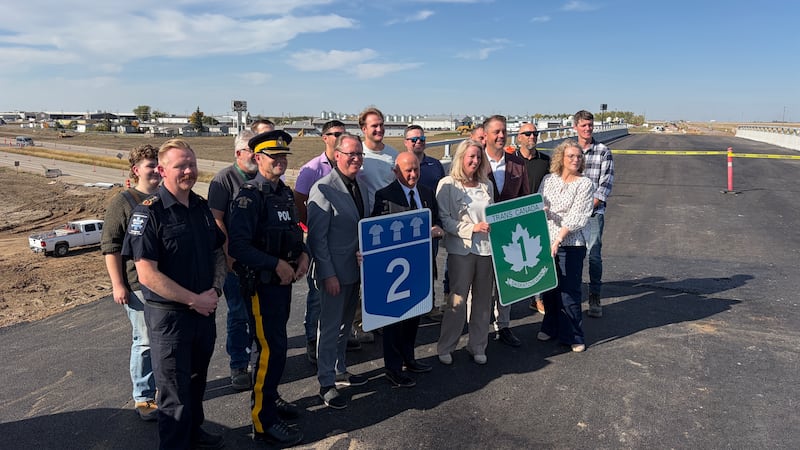
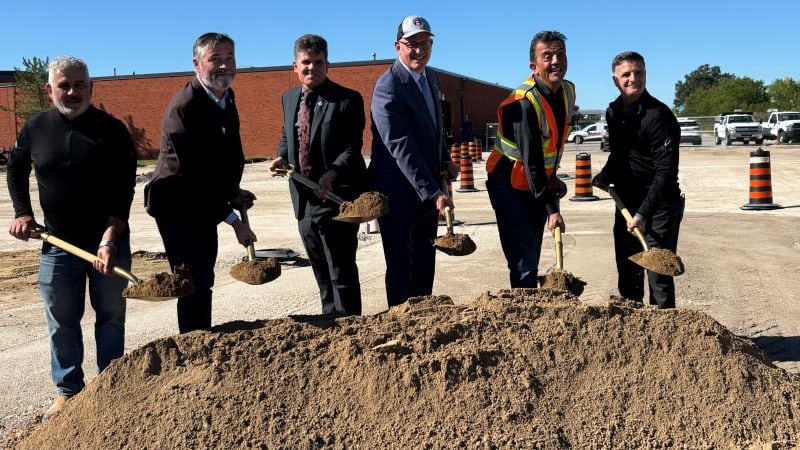
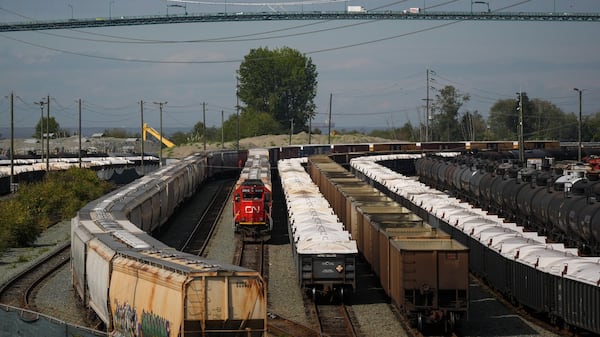
The largest employer in the northern Ontario community of Bruce Mines is working on a project to make shipping trap rock more environmentally friendly, with the help of the federal government. Canada’s Minister of Transportation was in the Algoma district Friday to announce up to $6.4 million for the initiative at the R.W. Tomlinson Ltd.’s Ontario Trap Rock quarry. The funding comes from the federal Green Shipping Corridors Program and will go toward the construction of an electrified conveyor system. “What this is allowing us to do is build a two-kilometre-long conveyor system to move the stone from the quarry down to the dock, which is on the other side of Highway 17,” said Rob Pierce, Senior Vice President of Planning and Development at R.W. Tomlinson Ltd. “Then it’ll allow us to do live loading of ships, the Great Lakes freighters, as they come in, as opposed to now where we have to stockpile material on the dock and then ship it out.” Environmental, safety benefits The environmental advantages of the project are twofold. Not only will the conveyor eliminate the need for diesel trucks travelling back and forth from quarry to port, but it also makes use of marine shipping – a system where one vessel can move the same amount of aggregate as 301 railcars or 964 trucks. The electrified system is expected to significantly reduce greenhouse gas emissions while also cutting truck traffic crossing Highway 17, a change believed to bring added safety benefits for the local community. “There are people that speed through town, they’re not going the speed limit and they could very easily come up on a truck that is just starting to pull out,” said Bruce Mines Mayor Lory Patteri. “So, by going underneath the highway, definite improvement.” Aggregates from Ontario Trap Rock are typically used for railway ballast, asphalt and concrete – materials that align with broader government infrastructure plans. Federal Transport Minister Steven MacKinnon highlighted the connection between the local project and national priorities. “Think of all the highways, think of all the transit that we’re building, think of all the rail that we’re building right across this country from east to west,” MacKinnon said. Economic impact The quarry is the largest employer in Bruce Mines, with approximately 50 full-time workers, and has decades of reserves remaining. Officials expect the new system, along with a planned dock expansion, will increase annual output volumes by 25 per cent and lead to additional hiring. “As a proudly Canadian-owned, family-run company that has operated for more than 70 years, R.W. Tomlinson is committed to investing in innovative and sustainable solutions for the future,” said CEO Ron Tomlinson, in a news release. “This project at Ontario Trap Rock will help reduce emissions, improve efficiency, and strengthen the movement of essential construction materials throughout the Great Lakes region.” Sault Ste. Marie-Algoma MP Terry Sheehan noted the project’s potential to expand the quarry’s reach beyond Canadian borders. “If we use boats and we use our geographical location, which we are the hub of the Great Lakes, the markets that Bruce Mines can access are unlimited,” Sheehan said. “Because not only in Canada, they can also access the American market.” The conveyor system is expected to be operational by the summer.