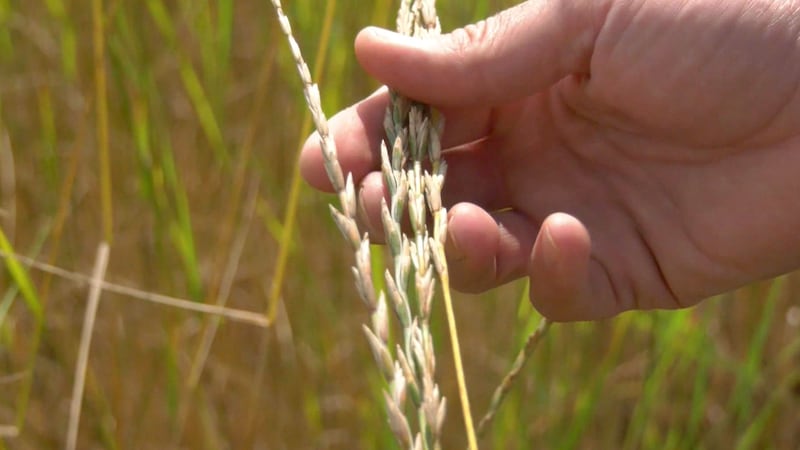
HARRINGTON, P.E.I. - On a federal farm in Prince Edward Island, researchers are testing a little-known grain that could cut some costs for growers while lowering greenhouse gas emissions. Scientists with Agriculture and Agri-Food Canada and Dalhousie University have trialed Kernza in the Maritimes for the first time. Unlike wheat or barley, the perennial grain grows back each year, meaning farmers don’t have to start from seed every spring. Researchers say that could lower expenses associated with planting crops, including seed, fertilizer and fuel. “Normally, there’s a lot of costs associated with planting a crop,” said Agriculture and Agri-Food Canada research scientist Aaron Mills. “So if you can get away with planting it once every three-to-five years, then you save those inputs.” Mills said wheat can cost anywhere from $500 to $800 per acre to grow. By comparison, he estimates Kernza at closer to $100 per acre. It can also do double duty, producing both grain and forage for livestock in the same growing season. ‘It’s not for everybody’: scientist While those differences are dramatic, there are trade-offs. With wheat, growers can make about $1,000 per acre, Mills said. Kernza doesn’t bring returns that high. It has lower yields and, at this point, a much smaller market. “It’s not for everybody,” Mills said. “What we try to do is try to add more tools in the toolbox for farmers.” He added Kernza could be a good rotational crop for some growers. On P.E.I., for example, potato farmers who aren’t set up for grain production could use it more like a cover crop, planted between main crops to keep fields covered and help maintain the soil. Not only can Kernza grow in Maritime conditions, but it can successfully withstand western winters, said Doug Cattani, an associate professor and head of the University of Manitoba’s Department of Plant Science. “I’m out west, where this was Prairie, and the great soils that we had were the result of having the permanent ground cover,” Cattani said. “So there are some maybe long-term benefits for all of us.” Those benefits include less soil erosion and nutrient leaching, along with better long-term water use, trapping snow and more organic matter deeper in the soil than with annual crops. Its potential advantages also extend below ground. Kernza’s roots remain in the soil year-round, pulling carbon from the atmosphere and storing it there. Researchers say the crop also needs less fertilizer and uses less fuel, which can help lower its greenhouse gas footprint. Cattani started working on perennial grains about 15 years ago. He said Kernza itself is still relatively new, with researchers only working to develop it for about two decades. It is already being used by artisan bakeries to make bread and by breweries to make beer, though it remains a niche product. “I think it’s got a lot of potential,” Cattani said. “Maybe it will catch on. I sure hope it does.