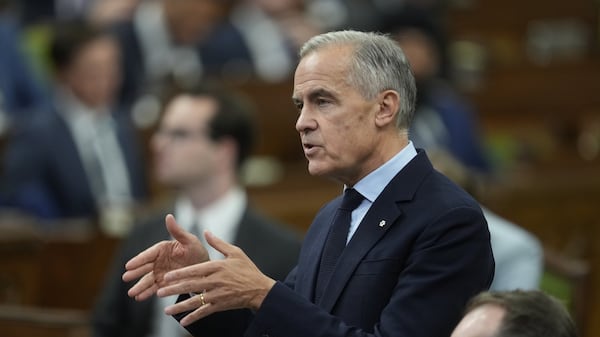
After an unprecedented flurry of floor crossings to the governing Liberals, could Windsor-Essex be further from Ottawa’s focus following Monday’s byelection results and the region’s Blue Wave last election? Not likely. At least, that’s how political analyst Lydia Miljan at the University of Windsor sees it. “What people in Windsor could be comforted by is that we are a strategic area,” said Miljan, in an interview with CTV News. “We certainly are front and centre in terms of the trade battles and that’s still ongoing regardless of who’s the MP, that still has to be a focus for whichever government is in power.” The Carney government added another Conservative floor crosser to its ranks in the form of Sarnia-area MP Marilyn Gladu last week, who described the move as one that would benefit her constituents. “It’s a critical moment for Canada,” said Gladu, at the opening of the Liberal party convention in Montreal over the weekend. “I know how to look past the usual politics to step up for the constituents who elected me, as part of this strong new team in government.” The Carney Liberals have announced five new caucus members since re-forming government, four from the Conservatives and one from the NDP. With Windsor-Essex going Blue in the last election, electing Conservative MPs in each of the area’s ridings, voters could be forgiven for wondering if the region was missing out by being in opposition instead of in the government’s ranks. For the area’s MPs, a Gladu-style switch comes with its own risks for a region that has most recently been dominated by New Democrats and Conservatives. “The advantage to maybe switching parties here is that there’s not a lot of people that you’re up against, right?” said Jamey Essex, a professor of political science at the University of Windsor. “It’s kind of a clearer field to move into, right? Sort of make your name if you switch over. The other question is whether people want to reward you after the fact the next time they go to vote.” And it’s not just voter wrath that enters the math for area MPs considering a switch to best secure government support for their ridings. Essex says these kinds of cross-party deals often centre on internal polling and perk promises. “The question is, what would they want? Right? There’s already concern about the future of the [Gordie Howe] bridge, about its economic impact, about the continued cross-border relationship with the free trade agreement being renegotiated,” said Essex. Cynical calculus The economic and trade turbulence caused by U.S. President Donald Trump’s foreign and tariff policies is a key backdrop to the shuffling in Ottawa, with Gladu specifically mentioning tariffs as a reason to rally together and unite. “It’s such a cynical ploy,” said Miljan. “Marilyn Gladu said it was good for her constituents, and it was good for her. Personally, I think it’s more of the latter than the former because it really puts a lie to the statement that somehow government will work with all Canadians, and they’ll be the government for everyone.” But Miljan doesn’t see Windsor-area MPs as missing the boat by not jumping ship to the Liberals. “They are the ones typically that say, ‘It doesn’t matter which riding you’re in, we’re still going to deliver for all Canadians,’” said Miljan. “And now they’re saying, ‘Well, nudge, nudge, wink, wink. If you vote for us or if we can get your MP to cross the floor, there’s extra goodies at hand for your riding.’ And I think that’s a terrible message.” While Miljan doesn’t dispute the legitimacy of floor crossings within Canada’s Westminster Parliamentary system, noting the constitution only enshrines the Prime Minister must command the “confidence” of the House, she suggests the current trend is warping the democratic direction offered by voters in the last general election. “It almost feels like a one-party state,” said Miljan. “I guess the question I would put to the Prime Minister was like, why doesn’t everybody cross the floor? I mean, what’s the point of having elections anyway? What’s the point of having political parties if you’re willing to accept anyone and everyone who will join the fray?” Whether or not the consternation the recent run of floor crossings has caused will spark new rules around party switching or a renewed push away from a winner-takes-all system to a proportional one, remains to be seen.