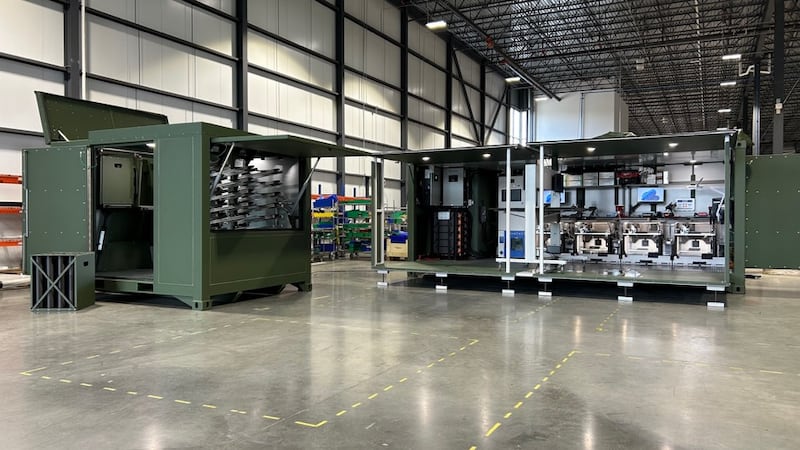
A Canadian defence technology company is developing a mobile drone factory that could allow military forces to manufacture, repair and deploy uncrewed vehicles in remote locations, including the Arctic. Sentinel Advanced Military Solutions unveiled its modular StarForge system at this year’s CANSEC arms trade show in Ottawa, amid growing demand for surveillance and reconnaissance drone technology across the defence industry. The company, which is a subsidiary of the Quebec-based CMP Advanced Mechanical Solutions, has been pitching its technology to senior Canadian defence officials but has yet to secure a contract from the Department of National Defence. Nonetheless, Sentinel has benefited from a $10-million spinoff investment from Lockheed Martin as part of the Canadian Army’s acquisition of the HIMARS rocket artillery system through Ottawa’s Industrial and Technological Benefits program. The company says its mission has been shaped in part by the evolution of warfare in Ukraine, where drone technology is developing rapidly as operators on both sides of the front line adapt to increasingly sophisticated countermeasures. “Maintaining readiness to participate in that type of conflict is exceptionally difficult,” said Ed Zimmerman, Sentinel’s chief technology officer and vice-president of product development, in a recent interview. “We’ve really made it our mission to ensure that Canadian and allied forces are able to be prepared and have that readiness at hand through the use of this type of capability.” Shipping container factories Traditional military supply chains can be long and inflexible, while procurement timelines for new equipment can stretch for years or even decades. Sentinel aims to address those logistical challenges by deploying small-scale drone factories and command-and-control centres wherever and whenever they are needed. “Imagine arriving at a remote Arctic outpost or a forward operating base where traditional supply chains no longer exist,” Sentinel chief executive John Soares said in a statement. “Within hours, you have command and control, secure communications, autonomous surveillance, deployable power and the ability to manufacture mission critical components on site. That’s the future we’re building.” The StarForge system is housed in shipping containers that can be delivered pre-loaded with the latest drone and counter-drone designs, as well as the materials needed to produce them. Designed to fit inside military cargo aircraft, the containers are equipped with 3D printers from Vancouver-based Pantheon Design. The printers produce drone and counter-drone airframes, which are then fitted with third-party motors, batteries and guidance systems and launched from the same location. The company says each StarForge container can ship with enough onboard material to produce between 300 and 400 drones, depending on their size and type. “You could also produce perhaps 100 quadcopters and 50 long-range surveillance platforms, and then still have plenty of material left over for ongoing maintenance of those platforms over the course of weeks or even months,” Zimmerman said. University of Alberta research Researchers at the University of Alberta have partnered with Sentinel to develop the technology as the university positions itself as a larger player in Canadian defence and security initiatives, particularly in the Far North. “As Canada’s northernmost research-intensive university, we have a long history of using world-class research to address challenges facing northern and Arctic communities, including energy security, climate resilience, and sovereignty,” a university spokesperson said in a statement to CTV News. The university says the partnership could also have applications in civilian sectors, including emergency response, communications and health care. “By combining research and manufacturing expertise in areas like communications systems and remote sensing, we can build better tools for Arctic operations,” it said. “That supports both Canadian sovereignty, security and community safety in the north, while creating jobs and economic growth at home,” it said. The StarForge system has recently undergone testing with the U.S. Marine Corps at a facility in the western United States, where troops printed, assembled and flew the drones during simulated missions. “That’s the type of opportunity that that we’re seeking to have more and more of and getting a lot of really great feedback from forces in Canada, as well as in Western Europe, asking us if we can participate in different activities with them and help them understand how the system can be used to support their missions,” Zimmerman said. National Defence has invited 22 companies from six countries to demonstrate emerging drone and counter-drone technologies as part of a “sandbox” field text at Canadian Forces Base Suffield in Alberta on Oct. 6. While Sentinel was not invited to the demonstration, the military has earmarked billions of dollars for drone and counter-drone research, development and acquisition across a range of projects in the coming years. “No contracts yet but we have had the opportunity to brief some senior members of the forces, sort of show them what we’re up to,” Zimmerman said. “There’s definitely a significant degree of interest.”