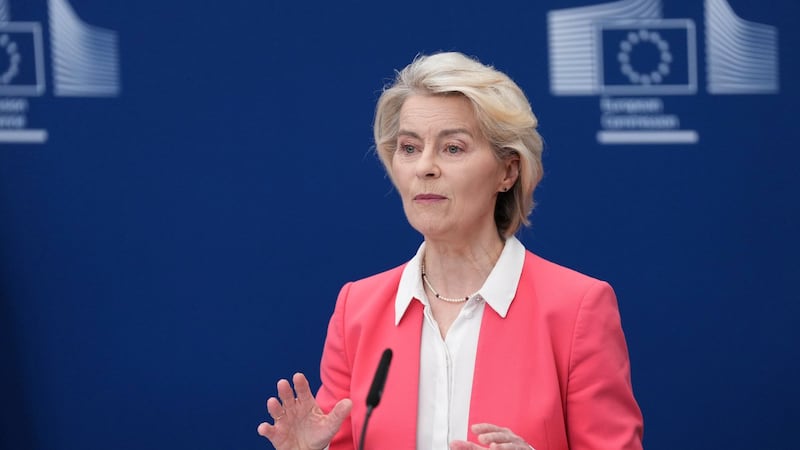
EU chief Ursula von der Leyen arrived in Greenland on Sunday for a two-day visit aimed at reaffirming the bloc’s support for the Arctic island coveted by U.S. President Donald Trump. Throughout her two-day visit, von der Leyen will be sending the message that the Danish autonomous territory belongs with Europe rather than the US. Her agenda includes a boat outing amid the icebergs, meetings with top Greenlandic and Danish officials and signing a joint statement between Greenland and the European Union. “We are family,” von der Leyen said on arrival in the island’s capital, Nuuk, where she was welcomed by Greenland’s Prime Minister Jens-Frederik Nielsen and Denmark’s Prime Minister Mette Frederiksen. Trump insisted earlier this year that Washington needed to control Greenland for national security reasons, though he ultimately ruled out annexing it by force. A Danish-Greenlandic-U.S. working group has since met regularly to find a way of cooperating in the future. Following Trump’s threats, European countries backed Denmark and Greenland, and in January von der Leyen vowed “massive” EU investment in Greenland to step up security in the Arctic. Brussels has proposed doubling direct EU aid to Greenland to 530 million euros (US$616 million) under the bloc’s next budget for the 2028–2034 period. According to the Financial Times, von der Leyen is expected to propose an additional 200 million euros in support during her visit on Sunday and Monday. “Europe is delivering,” she said. “We are expanding our cooperation to new areas, from better, faster connectivity and clean energy to critical raw materials.” Her visit coincides with the start of NATO’s Arctic Shield military exercise, bringing together soldiers from 10 countries. Mikaa Blugeon-Mered, a geopolitics researcher at the University of Quebec, called the timing a “not insignificant coincidence”. The Trump administration has repeatedly accused Denmark of neglecting Greenland and Arctic security. Copenhagen has since reinvested in the region, as has NATO, which launched its Arctic Sentry mission at the start of the year. “Greenland is becoming increasingly important to the EU as a gateway to the Arctic and because of its geopolitical location, critical raw materials and role in Arctic security,” Marc Jacobsen, a researcher at the Royal Danish Defence College, told AFP ahead of the visit. ‘Postcards’ from Trump The message is all the more important as the U.S. has kept up pressure on Greenland -- though Trump has been less vocal since a May visit by his special envoy Jeff Landry. “We’ve been getting ‘postcards’ from Trump or those close to him about Greenland every month, showing that they haven’t forgotten,” noted Blugeon-Mered. One such image Trump posted on Truth Social in May showed him peering over the island, with the headline: “Hello, Greenland!” In August, media reports of an American oil company’s preparatory operations in a remote region of eastern Greenland rekindled concerns on the island. The project, run by a Texas-based company with licences granted before a 2021 moratorium on oil and gas exploration and extraction, has left locals and authorities uneasy. Authorities have yet to grant the company approval for exploratory drilling, citing procedural reasons. Greenland, home to 57,000 inhabitants, is also struggling to develop its mining industry, which could help it fund its independence from Denmark. But turning Greenland’s geological potential into reality is proving more difficult than expected. Around 135 mining permits are held by more than 60 companies, but only two mines are currently in operation.