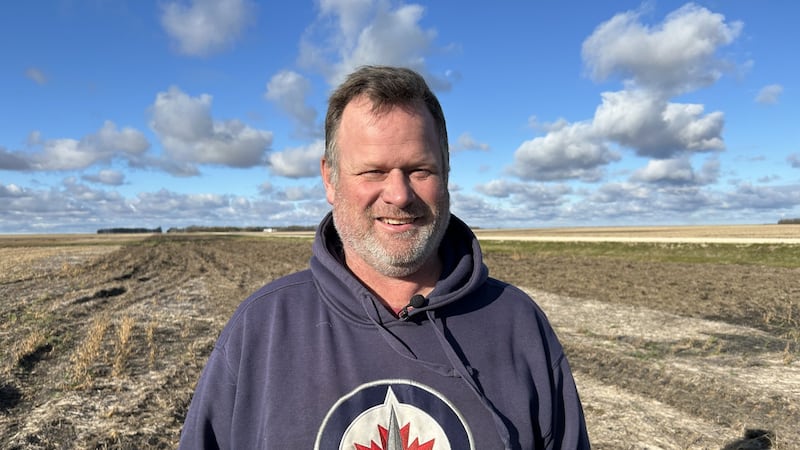
CLANDEBOYE, Man. – This year’s farming season has been nothing short of challenging for Curtis McRae. Heavy rains and severe storms flooded nearly half, around 800 hectares, of his farmland near Clandeboye, Man., approximately 41 kilometres north of Winnipeg. Although he managed to salvage some of the damaged crops, he still lost approximately 200 hectares, making this one of the most challenging years he’s faced as a farmer. “It’s right up there, absolutely,” he said. “Definitely not fun.” A two-day storm in June dumped dozens, and in some areas, hundreds of millimetres of rain. About 255 millimetres of rain fell in Stonewall, Man., and surrounding communities in just a few hours, flooding fields and causing significant crop losses. Some of McRae’s fields had nearly a metre of water, which remained there for several weeks. He says the heavy rains and flooding in June left his farmland completely saturated all season long. With excess moisture still a concern, he worries the effects of this year’s flooding could carry over into next year’s crops. “I can’t leave acres like this unattended, but they’re still wet from the June 9 storm,” he said. “The soil is still very, very saturated. Any little precipitation we get doesn’t seem to go anywhere. It just sits.” McRae isn’t alone. Farmers across Manitoba are facing similar conditions as they try to salvage what they can from a difficult growing season, while hoping to get relief through crop insurance. “Certainly, a lot of claims probably are in the process right now with some of those hard-hit areas,” said Jill Verwey, who is a producer and president of the Keystone Agricultural Producers (KAP) in Manitoba. “So, a lot of producers will be struggling with below-average yields.” The latest crop report from the Manitoba government shows some producers are still working to complete the harvest. Ninety-four per cent of the harvest is complete province-wide, but with more precipitation in the forecast, Verwey is concerned some producers may not have the conditions needed to prepare their fields for next year. “We saw that back when we had the flood of 2011 and 2014, and those hangovers lasted two to three years,” she said. “A lot of guys are just choosing to park their equipment and have a good start for 2027.” “We’ve had summers where November brings us some really favourable weather, so we still have that to look forward to in the next little while and hoping that producers have the ability to get the work done if they can,” she said. For McRae, recovering from this season’s damage is only part of the challenge. He’s calling on local and provincial governments to provide better mitigation measures, including improved culvert maintenance and clearer drainage channels. He says better drainage and flood mitigation will be key to protecting his land and preventing future losses. “A lot of work to be done, a lot of repairs on infrastructure that has been broken for years, and hopefully it gets repaired,” he said. “This is long-term, society making decisions and not knowing what the repercussions are. When you restrict farmers, you restrict your food, and guess what? Your food price goes up.”