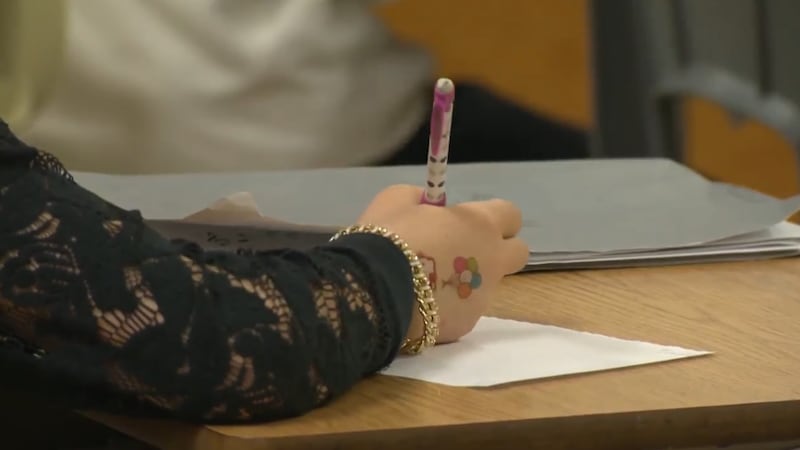
For the last decade, Geraldine Shingoose has been sharing her residential school stories with Manitoba students. On Monday, she was speaking to students at Westwood Collegiate, in Winnipeg’s west end. She says it’s important for her as a survivor to share her story with the younger generation. “I want them to know the impact it had on me as a child when I was going to a residential school,” she said. “That was really hard, like being there.” Shingoose, known to many as “Gramma Shingoose,” attended Muscowequan Indian Residential School near Lestock, Sask., from 1962 to 1971. She said her experience there was not a good one. “We were not allowed to speak our language, so that was taken from me,” she said. “They took me away from my family, my parents and my community.” Shingoose speaks at events, including at schools, throughout the year but says it really gets busy around this time. Orange Shirt Day marked in Canada The federal government recognized Sept. 30 as National Day for Truth and Reconciliation (NDTR) in June 2021, following the discovery of 215 unmarked graves at the grounds of a former residential school in Kamloops, B.C. Shingoose says Sept. 30 is an extremely important day for her. “It’s a day where we acknowledge our truth, our stories, and our history about residential schools,” she said. “It’s a day to honour the families of residential school survivors and the communities. It’s also a day to honour the little children that didn’t make it home from residential school.” However, Shingoose says recognition for survivors like herself on National Day for Truth and Reconciliation, should not just be limited to one day. “Us survivors, we carry that every day and to remember us every day,” she said. “That history is so important for Canada.” Vivian Ketchum shares the same feeling as Shingoose. Also a survivor, she attended the Cecilia Jeffrey Residential School just outside of Kenora, Ont. She was five years old when she was taken from her family. “The homesickness that still haunts me today. The bad food and the lack of connection. My siblings were there. I remember they were on another floor. I couldn’t connect with them either. It was just horrible,” she said. For Ketchum, this National Day for Truth and Reconciliation is a little more meaningful and emotional than previous years. Her eldest brother, who also attended the same residential school as a child, died a few days ago. She says she wants to honour him the best way she can. “I want to walk for him this year,” Ketchum said. “I want to walk for him, other survivors that didn’t make it and the little ones that didn’t make it home. I want their stories to be heard.” But there is also another issue that is bothering Ketchum – denialism of residential schools. “We have to fight a little harder this year,” she said. Controversial speaker prompts university protests Frances Widdowson, a former professor at Mount Royal University who was fired in 2021 after an investigation into harassment claims, was at the University of Manitoba last Thursday to discuss her claims the discovery of mass graves at a residential school was a hoax. The Assembly of Manitoba Chiefs condemned the event, saying it was outraged Widdowson was allowed to speak on campus. “Allowing someone who denies the violence, deaths, and systemic abuse of our little ones in residential schools to speak at Manitoba’s largest university is irresponsible and harmful,” Grand Chief Kyra Wilson said in a news release. “First Nations Survivors and families continue to live with the trauma of these institutions. To deny these truths is an act of violence in itself.” Ketchum herself was at the protest. “It got ugly, I got hurt and I am going to keep fighting to keep our stories out there and our memories alive,” she said. Denialism is ‘on the rise’: AFN chief Cindy Woodhouse-Nepinak said there is a lot more work to be done to address the misinformation being shared about residential schools. “The Truth and Reconciliation Commission: I encourage all Canadians to look through those 94 Calls to Action and how far have we come? How do we grade ourselves this December, 10 years after the signing of that?” she said. Woodhouse-Nepinak said she would like to see universities and colleges across the country mandate an Indigenous course for students. “Making sure there is a First Nations course in every single university and college across this country, so when professionals are graduating, they remember and know the true history of what happened to First Nations people in this country,” she said. “I think it’s doable from coast, to coast, to coast.” Ahead of the federal budget this fall, she is also calling for Indigenous basic services and programs to not be cut and is pushing for a one-time, generational investment into language and culture. “Let’s make a better life for our kids,” she said. As Canadians mark National Day for Truth and Reconciliation, Shingoose says she never wants the history of residential schools to disappear. “There’s not too many of us left. We are not going to be here anymore,” she said. “We are still here (now) and to acknowledge us and just take care of us. It means a lot to us.”