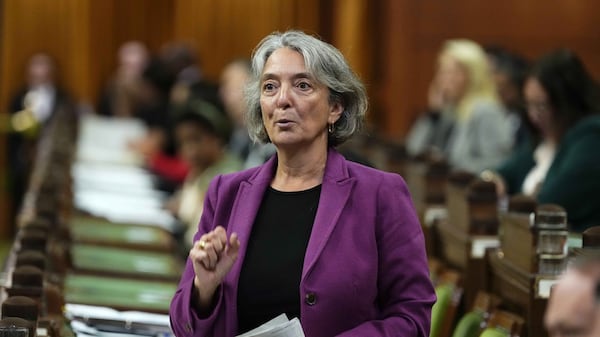
A much-anticipated report on Alberta ridings is expected to be made public Monday afternoon amid mounting accusations and concerns regarding next October’s provincial election. The report was authored by a United-Conservative-Party (UCP)-majority panel that was directed to go back to the drawing board on electoral boundaries after a bipartisan public boundaries commission’s report was rejected in the spring. It will be the second set of recommendations since new boundaries were first approved in 2024, though two UCP boundary commission members authored their own set of recommendations suggesting merging urban and rural ridings to create four new seats for a total of 91. The Alberta NDP said the new report’s boundaries are “cheating” and would give the UCP an edge in close races in Lethbridge and Calgary. “The maps that are going to be tabled today are bad for Alberta’s next election because it does not respect urban voters. It does not respect rural voters,” Christina Gray, Alberta NDP House Leader, said Monday. The Alberta NDP holds the vast majority of its seats in Edmonton and Calgary, while the UCP is the party of preference in smaller cities and rural communities. The opposition is accusing the UCP of U.S.-style gerrymandering through reconfiguring urban ridings to include more rural voters, which could give the ruling party an advantage come October. For example, Lethbridge – currently represented by one NDP MLA and one UCP MLA – would be split from two to four seats, pulling in voters from surrounding UCP strongholds. Gray said the original bipartisan majority report was created in consultation with thousands of Albertans and would ensure rural and urban Albertans are represented by MLAs that understand their different needs. “It is still an option to pass the majority maps that consulted thousands of Albertans, that struck a balance between growth and representational rights,” she said. The official opposition said it will be challenging any unfair map in court. Alberta’s election administrator also has serious concerns, saying either the new boundaries or the election should be postponed, but Justice Minister Mickey Amery shot down the possibility of any delay. “Alberta’s government has no intention of changing the legislated date of the next provincial general election,” Amery said in a letter to chief electoral officer Gordon McClure. “The final electoral boundaries enacted by the Legislative Assembly will constitute the law of Alberta and Elections Alberta is expected to prepare accordingly.” Amery said the new boundaries are expected to be approved by the end of the fall sitting, giving Elections Alberta 11 months to prepare. He said that is enough time with the new maps and that other provinces have been able to work under even shorter timelines. The last time the electoral boundaries were adjusted was in 2017. With files from CTV News Edmonton’s Hannah Kavanagh and The Canadian Press