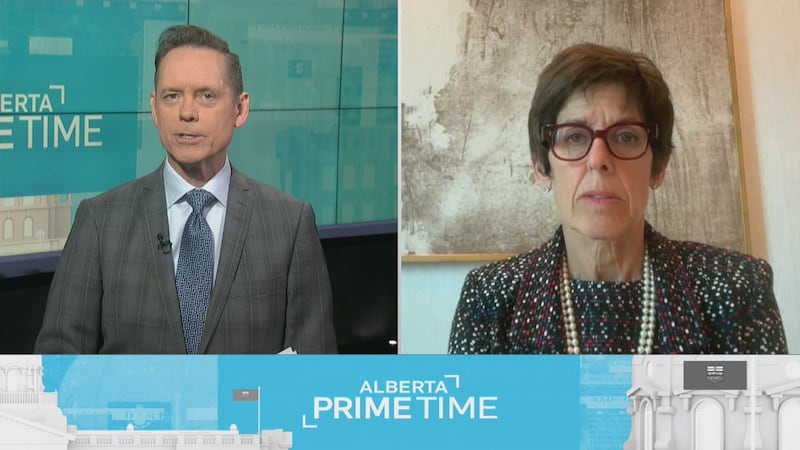
With just over a month until a provincewide referendum, a new independent report released Wednesday suggests it could cost Alberta between $50 billion and $170 billion to separate from Canada. Deborah Yedlin, the CEO of the Calgary Chamber of Commerce, discusses what this could mean for Canadian business and investment – especially on the heels of an investment summit in Toronto – with Alberta Primetime’s Michael Higgins. This interview has been edited for length and clarity. Michael Higgins: The findings of this report, which looks at both smooth and difficult scenarios in negotiating separation with Canada, show significant economic disruption and costs for Albertans. How does that align with your chamber’s perspective? Deborah Yedlin: We’ve also had some analysis done and are awaiting a final report from (University of Calgary economics professor) Trevor Tombe, and the numbers that we’ve also seen really are aligned with what’s been released today. There’s a lot of uncertainty that would be created if this was a decision to go in that direction, and certainly from a cost perspective, from a GDP perspective, employment, wages, all of that would significantly decrease alongside a very high debt level for the province, and that’s not exactly something that would be helpful. Your borrowing costs go up; that means it costs you more to deliver services, and that would affect every Albertan. MH: What degree of clarity do you see this bringing to the questions being asked by those in the business community? DY: If anybody in the business community knows how to run a business, the one thing they don’t want to do is run up their debt unnecessarily because they know that that’s going to compromise their access to capital, and it’ll cost them more to get access to that capital. They’re going to look at ways to make sure that they’re competitive, that they can access both capital and labour. This would be an own goal kind of scenario. What you want to do is make sure that you’re as strong as you can be, and that you don’t make decisions that compromise your ability to succeed. MH: How do you see this particular report, and yours, changing dialogue, political or otherwise, with the referendum now just over a month away? DY: I think people were sort of wondering and waiting for these numbers to be released, and now that they’re out in the public domain, it gives a different perspective and will change the shape of the conversations for anybody who thinks this is a good idea. To hobble the province significantly is something that really doesn’t make sense, and I say this as you know, having being in Toronto at the moment, having listened to the conversations around the investment summit, the importance of stability and certainty, and also the fact that people are coming here with an appetite to invest, but if we compromise that in any way, that doesn’t happen, and it’s not just Alberta that hurts, but it’s the country that hurts. MH: We were initially meant to discuss this week’s Canada Investment Summit with you, including the expansion of the so-called mega deduction, which allows companies to write off total costs of new investments. This is part of Ottawa’s drive to attract a trillion dollars in new investments over the next five years. How far do you see that going in moving the Canadian economy beyond the trade tensions with the Trump administration? DY: When you think about what’s been discussed, the capital that was in that room – and why they see Canada as being a sleeping giant in terms of its resources, our ability to build, to be able to develop our resources and export them to new markets. This is a country that’s seen as one that has significant economic potential from a growth perspective, and I think when you see what was announced in terms of the tax deduction, that puts us well below the U.S. rate by 6.4 per cent versus 13 per cent. We have a very low cost of capital attraction now, and that is something that is definitely essential as we seek to attract investment, to build infrastructure, to grow our economy, to make, develop our resources that we know the world needs. MH: What kind of attention do you see this generating in Alberta’s business community with members of your Calgary chamber? DY: Anything that helps our economy is good for all of our members because there are direct jobs and indirect jobs created when you have increased investment. That’s something we’re looking to be seeking, too. We’ll be seeing unlocked as we go, from an energy perspective, increased development. MH: How much of a ticket is this to unlock private sector investment in Alberta’s proposed West Coast pipeline? Would it save taxpayers maybe from having to foot that multi-billion-dollar bill? DY: We know that companies around the world and investors around the world are looking to diversify their exposure to various regions, and that includes the United States. Certainly, the West Coast pipeline is something that is on the agenda. It’s on the radar. Everybody knows now exactly what it represents, and we’ll look forward to seeing that those investment dollars come forward, and not just for energy, but for other areas, whether it’s critical minerals, technology, quantum. I think there’s a wide array of opportunities. There’s a big opportunity suite that we have that was basically showcased to the world’s biggest investors these last couple of days, and I think it’s going to be a really interesting fourth quarter and 2027 as we see those dollars start to flow into the country and support our economic growth. MH: To what degree do you see this offsetting any uncertainty that may yet exist around separation in Alberta? DY: When you listen to people at the sidelines and who have been attending the various events in the city, what they are asking for is stability and certainty. At a time when we have a generational opportunity to attract investment to develop our resources, and that includes Alberta’s energy sector, we don’t want to do anything that compromises our ability to do that. That would increase the cost of capital because the risks would go up. I think there’s a very prudent lens through the view of what we face as a province, and that means we don’t want to compromise our own economic future by looking at the referendum as a fast ticket to something that really doesn’t exist.