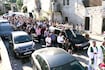
An overflow crowd of Palestinians on Wednesday laid to rest visionary artist Sliman Mansour, whose landmark painting “Camel of Hardships” has become an emblem of Palestinian identity. Mourners including senior officials followed his hearse from the family home in Birzeit near Ramallah in the Israeli-occupied West Bank to an Anglican church, led by uniformed scouts playing bagpipes. Olive branches were draped over his coffin, a symbolic reference to the olive trees he depicted in many of his paintings. “Many knew his paintings, his colours and his symbols. Many saw Palestine through his eyes and his brush,” Imad Haddad, bishop of the Evangelical Lutheran Church in Jordan and the Holy Land, said at the service. “He portrayed man with his pain, his sorrow, his joy, his culture, his heritage and his memory.” The small church could not accommodate the large number of mourners, with many people standing on the steps and in its courtyard, and a loudspeaker set up outside to broadcast the funeral service. “From the moment the news of his death spread, it was as if all of Palestine was in mourning,” artist Khaled Hourani told AFP, adding that his passing was “a great loss for Palestinian culture, and it truly feels as though an entire era has ended”. Mansour, who died Monday at age 79, is best known for 1973’s “Camel of Hardships”, which depicts an elderly Palestinian porter carrying the city of Jerusalem on his back. The Palestinian culture ministry said that the painting showed “the story of a people carrying their homeland, their history, and their memory”. Mansour was buried in Birzeit’s cemetery, where wreaths were laid on his grave including one in the name of Palestinian president Mahmoud Abbas.