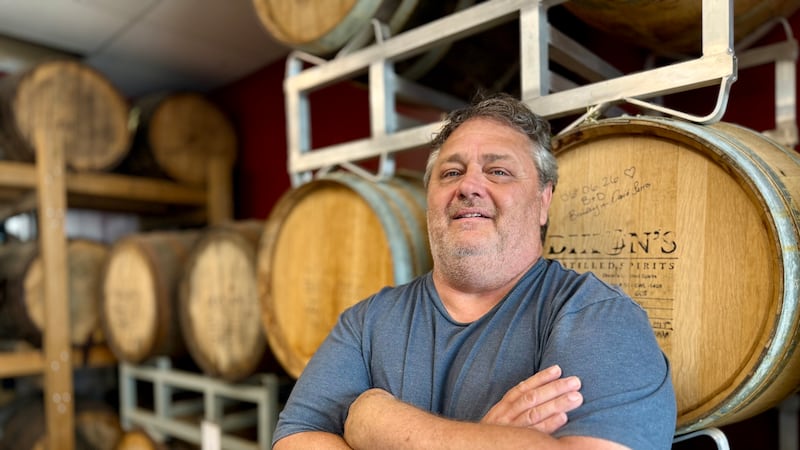
With news of the impending ban on certain liquors to the U.S. later this month, a distiller based in Guelph, Ont. is considering their options. Dixon’s Distilled Spirits said their efforts spent making sales south of the border up until now feels like a waste of time. “I think that’s really the big issue is that, all the money I’ve spent and all the branding, even though it might be small, all that branding and energy and time [was] for nothing,” Jeremie Dixon, owner of Dixon’s Distilled Spirits, said. He said his company has already scaled back deals with customers in California and New Jersey throughout the trade war. But, it’s been difficult to keep tabs on which tariffs will directly affect his business. “It’s exhausting. I think we’re getting burnt out from the Canadian version. When I flip on American news, we’re hardly even getting a headline,” said Dixon. After learning he won’t be able to sell products to the United States as of Sept. 29, Dixon said the ban has effectively ruined any inroads they’ve made for their products going down south. “You take us out of the market for a month or two months, three months, six months. It’s going to be like starting from square one again,” he said. Distiller considers destroying products already in U.S. Dixon added that he will likely destroy 400 cases of his products that are already in the U.S., as it’s cheaper to dispose of the cases instead of shipping them back to Canada. “I was limiting the shipments down anyways, so I didn’t have a ton of stuff,” said Dixon, who hopes to eventually be able to sell his product in other liquor stores across Canada. “Let’s say British Columbia opened up one or two SKUs to me specifically, [that] probably would cover all of that,” he explained. Hopes for Canada-wide distribution Despite the loss of the U.S. market, Dixon has seen growth in local support. “It’s very nice to see new faces coming in, and their comments are very much to support Canadian products,” Dixon said. He is hoping to get his products out across the whole country. He does sell in Saskatchewan and Manitoba, but is pushing for more of a national distribution. “We are working on a couple of possible submissions out east – New Brunswick and Newfoundland,” Dixon said. “If I had the opportunity to get into B.C. tomorrow and then land a couple of things out east, I’m going to be honest, I’d probably just put my energy there. Then I wouldn’t have to worry about crossing borders, different tax rates,” Dixon said. While trade between provinces has opened up on paper, Dixon said getting his products into other liquor stores is still a struggle. “Doug Ford and the B.C. Premier should be talking and saying, ‘Hey, we’ll put in B.C. wine in all the LCBO stores if you put in whatever into your stores,’ and that will truly be breaking some of those barriers down in cross-province trades,” he said. “But nothing has changed really from my aspect on that front. I still have to go through the process. The buyer still has to like us. They still have to approve us. If they don’t, then I’m not in B.C. And that’s the reality.”