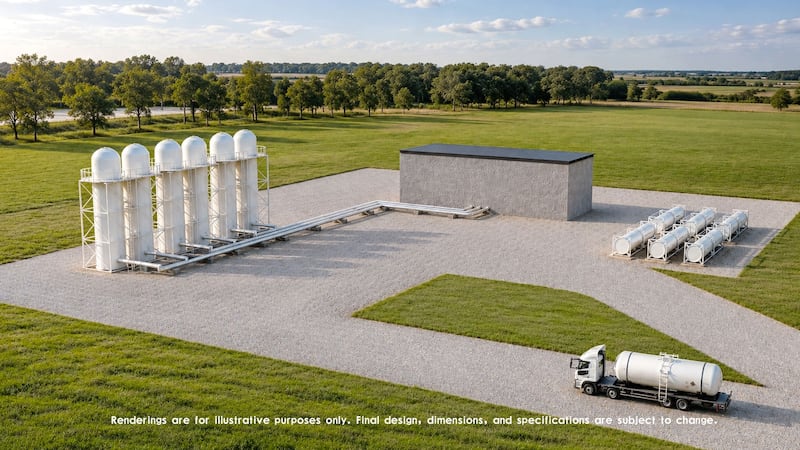
It’s a big step for science, but a giant leap for London’s entry into the rocket building business. The Canada Rocket Company (CRC) on Thursday announced plans for a $30 million rocket engine test facility at the London International Airport. It means Canada may no longer have to rely on other countries’ rockets to get satellites into space. Vic Fidelli, Ontario’s Minister of Economic Development remarked, “We’re in the middle of a trade war.” Fideli was on hand as ground was broken on Canada’s first such facility. “Companies opening. Companies expanding. Companies digging in the middle of the field of dreams here. All at a time when our sovereignty continues to be challenged,” Fideli continued. Named after London born astronaut Jeremy Hansen, the $30 million facility will allow the company to conduct static testing of rocket engines for its reusable, medium-lift rocket, explained CRC co-founder and CEO, Hugh Kolias. “We’re building what we’re calling the R2. It can take up to 12,500 kilograms to low-earth orbit. Similar in size to SpaceX Falcon9. So, there’ll be nine engines on the first stage, one engine on the second stage, so 10 engines in total. And we’re looking to launch up to once a week, once we get the full cadence,” he said. According to CRC, almost every satellite in the world gets to space on a rocket. And currently, most of them are transported by SpaceX’s Falcon9. And those satellites run everything, from GPS to weather forecasts, from communications to emergency response. And right now, Canada is entirely dependent on other countries’ rockets. CRC says it expects to create about 40 skilled jobs at the London facility in the next 18 months, with a broader rocket development program projected to create 1,000 jobs, and more than $1 billion in new investment over the next decade. CRC is also developing training partnerships with Western University and Fanshawe College. “We already have some amazing space scientists. So, we have engineers, astrophysicists, planetary scientists. So, we already have a really great space community. And adding in the rocket science, definitely very exciting,” exclaimed Sarah Gallagher, Director of the Institute of Earth and Space Exploration. The CRC facility is funded in part by $8.3 million from the Department of National Defence’s IDEaS Program. There are currently more than 40 defence and aerospace companies already operating in the London region. “This is certainly a sector that is poised for significant growth going forward,” said Kapil Lakhotia, President and CEO of the London Economic Development Corporation. “Especially when we take our cues from the federal government, that’s investing more in defence and aviation projects as well,” he said. The facility is expected to be fully operational in 2028.