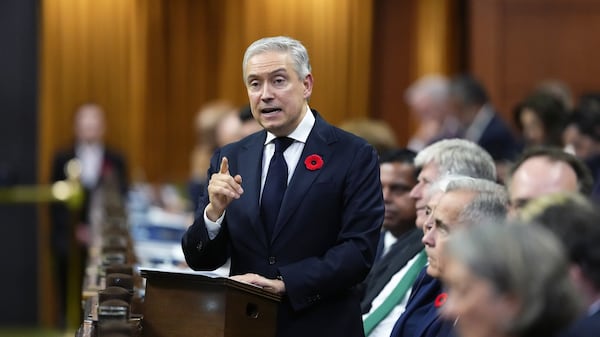
OTTAWA - Finance Minister François-Philippe Champagne says criticisms of his government’s fiscal positioning are not based in fact. “What you’re seeing in the federal budget, first of all, is that deficits are down,” Champagne told CTV News Chief Political Correspondent Vassy Kapelos in an interview on CTV Question Period airing Sunday. “Last year, this year and projected into the future, they’re lower.” Champagne was referring to last year’s deficit, which in the spring economic update last April was projected to be $27.5 billion higher than what this week’s budget showed. Significantly higher-than-expected revenues allowed the federal government to revise down the deficit for last year. The deficit for next year, however, jumps to more than $62 billion and stays above $50 billion through 2030. The vast majority of any new incoming revenue, meanwhile, has already been either earmarked or spent. Those consistent deficits and higher interest rates mean the cost of paying down the interest on the government’s debt is increasing — and significantly so — projected to reach more than $85 billion by 2030. Next year alone, the cost of servicing the debt load will exceed health-care transfers to the provinces. The budget projects it will cost $60.2 billion to pay down the interest on Canada’s debt next year, compared to $57.4 billion the federal government has earmarked for health care. “Deficits are lower, that’s a fact,” he also said. “It’s in the budget, so that’s a fact.” The minister brushed off concerns about those interest payments, arguing the elevated spending is necessary to spur economic growth. “What we’re saying is that you’re not going to borrow for groceries,” Champagne told Kapelos. “If you’re borrowing, you’re going to take that money and invest it to grow the economy.” “People understand the difference between expenses and investment,” he added. Conservatives, NDP criticize budget The opposition Conservatives contend it doesn’t matter what the money is being spent on, it’s the level of spending that is a concern. “Debt interest is the fastest-growing item on this government’s budget,” the party’s leader Pierre Poillievre said in the House of Commons on Thursday. “It does not buy a single doctor, a single soldier or a single protection at our border.” According to Champagne, about two-thirds of the $146 billion in additional budget measures are intended to grow the economy, while the remaining third is directed toward supporting Canadians through initiatives addressing affordability, housing and homelessness. The weighting toward growth initiatives doesn’t sit well with New Democrats, who argue there’s no guarantee capital investments will “trickle down” from large corporations to Canadians. “[The] budget is Christmas-come-early for CEOs, foreign investors and arms dealers,” NDP Leader Avi Lewis told Kapelos in a separate interview on Thursday. Ultimately, Champagne insisted the government’s objective is to use Canada’s existing fiscal capacity to support Canadians while making the investments needed to expand the economy. “You need to grow the pie,” he said. You can watch Finance Minister François-Philippe Champagne’s full interview on CTV Question Period Sunday at 11 a.m. ET.