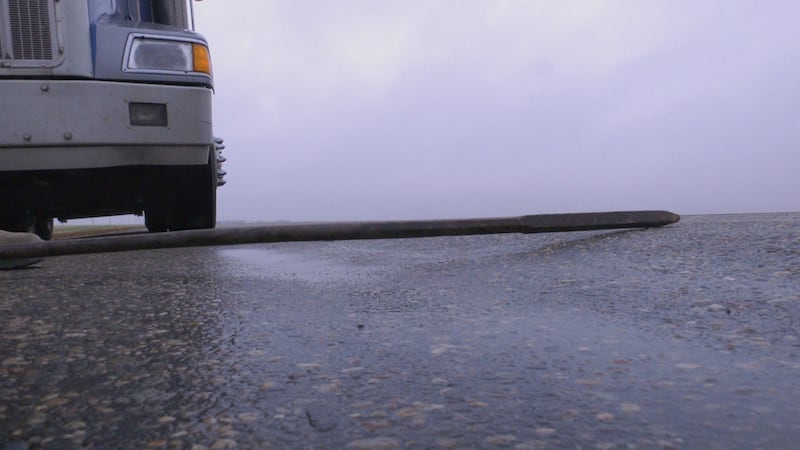
As calls for a deteriorating highway southeast of Moose Jaw, the provincial government says it is working to find a solution. Residents and farmers who live near Highway 339 travelled to the legislative building on Wednesday to express their concerns. “It’s sinkholes, it’s the ruts from the trucks, it’s a very thin membrane highway. There’s very little to no base underneath it,” farmer Nick Cornea said. Cornea said the highway has become dangerous to drive on, creating challenges for residents. “We can’t get emergency services out to our communities fast enough … They have to stop once they’re in the ambulance. They have to stop to do vitals because they’re bouncing so much,” he said. “It’s a violently dangerous piece of asphalt that we’re trying to use daily.” Cornea had been voicing his concerns with the condition of the asphalt for some time now, referencing a fatal collision on the highway in August. “[I] pulled someone out of a car accident this summer in August that eventually didn’t actually make it. The junction isn’t safe. The Highway 39 is on an angle to to 339, so you have to turn and get squared up to it. That needs to be fixed,” he emphasized. Area residents say they have damaged their vehicles travelling the highway. Truckers hauling grain say they are forced to avoid Highway 339 and travel the grids, adding to their costs. “We can not use our highway for commerce. We have to use our grid roads and that puts strain on our municipalities,” farmer Mike Schick said. NDP MLA Darcy Warrington said he travelled the highway just this week, noting there was water pooling everywhere. “There’s going to be some icy, dangerous highways for those folks to travel around for the next several days and into the winter,” he said. “Highway 339 serves as an economic lifeline for the people in and around Briercrest. We have folks whose axles and tires and all of the components of their tandems and their semis are in disrepair on a regular basis as a result of this absolutely atrocious highway.” Minister of Highways Kim Gartner travelled the highway twice this summer and said he understands the problem. “The highway itself needs some love. It is part of a system that was built in the 1970s, maybe even back into the 60s,” he said. “The extent of the life of that road, we’re trying to extend it as best we can.” “The road, when it was constructed, wasn’t constructed to carry what’s being asked of it now, so what we haul, where we haul and what we’re hauling it with has certainly changed over time, so we need to address that somehow to try and extend that life until we can get into a construction mode.” Gartner said the highway has been through and will continue to go through continual assessments. “Up until now, we’ve had a more robust maintenance program on there and we’ll look see what more we can do to improve that.” The rural residents had an opportunity to meet with the highways minister to express their concerns about the highway, with a current assessment to determine the extent of repairs needed. A decision will be made on whether repairs can be made in next year’s road building budget. With files from Ardenn Lloyd