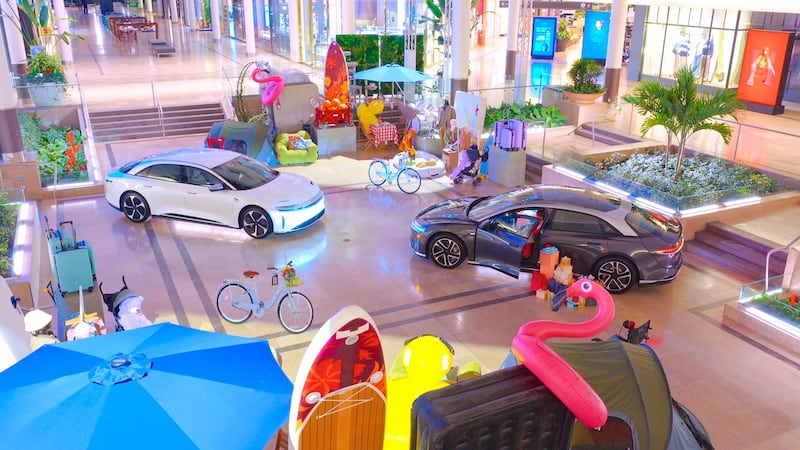
TORONTO — When Charles Wachter signed on as a showrunner for Netflix, he was tasked with a shopaholic’s dream: visiting innumerable malls across North America to find the perfect set for his new reality competition show. “Win the Mall” is high-concept: 10 teams of two move into a shopping mall and compete in a series of challenges to win “ownership” of different stores. Each store comes with its own benefits (a luxury bedding boutique includes the most comfortable place to sleep; a fried chicken franchise features endless snacks during filming) and associated prizes ($40,000 worth of bling from a jewelry store; a year’s worth of makeup from a cosmetics store). At the end of the season, the team that owns all the stores wins a million dollars. It’s a “fantasy mall,” Wachter said on a recent video call. “It’s this sort of hyper-surreal experience.” “Win the Mall” ups the ante on shows like “The Price is Right” and “Supermarket Sweep,” gamifying consumerism while glamorizing the shopping mall as a commercial oasis where dreams come true. Bringing that concept to life required a very specific set of criteria and a lot of work, Wachter said. “With a show like this — no one’s ever done it: a 400,000-square-foot set, 200 retailers. We had to do deals with everybody. So it was really complicated.” Find the mall They considered building a set in an abandoned mall, but “it quickly became apparent that wasn’t a good idea because the amount of dressing and money to bring a mall to life is tens of millions of dollars,” he said. “But at the same time, we couldn’t shoot in a mall all day because it’s full of people. We couldn’t shoot in a mall just at night because it’s a game about real people and real people get tired, just like producers get tired.” What they needed was a unicorn — and they found it in Toronto. “The irony of ironies is the perfect mall was the mall I actually grew up going to, because I’m from Toronto and I went to Sherway Gardens — it’s where my dentist was when I was a kid,” Wachter said. The proverbial horn that set Sherway Gardens apart from all the horses was, as it happens, also one of the biggest changes to Canada’s retail landscape in recent memory: the closure of the Hudson’s Bay Company. The 355-year-old company’s collapse left a gaping hole in one three-storey wing of the mall. Prep the mall, film the mall The team turned the former Hudson’s Bay location into “a cover set,” Wachter said. The ground floor was the production hub; the second floor included a fabricated food court and several faux stores (including the bedding store that served as sleeping quarters for some of the contestants); the third floor is where they conducted interviews with contestants. They’d start filming in that set at about 4 p.m., Wachter said, and they’d stay there “more or less until the mall closed. “And then we’d rush out (into) the mall with all our cameras and people and shoot challenges.” But filming in a real mall — even when closed — came with its own set of challenges. There are roughly 200 stores in Sherway Gardens, which is owned and operated by Cadillac Fairview, and Wachter said his producers had to work out contracts with each of them. That’s because brand deals are a massive part of the show. “We had hundreds of brands to deal with — thousands, millions of dollars worth of retail and logos,” Wachter said. The amount each brand paid for placement differed — more money meant more exposure, which affected how much of each storefront they could show. “It was a huge department and a big part of the show and very complicated, honestly — the speed at which we had to close these deals and then figure out where to shoot.” In some cases, they built whole storefronts for brand partners that don’t have a presence north of the border, such as an American guitar retailer. In other cases, they convinced storefronts to keep their doors open and lights on after hours in case they showed up in the background of a shot. They created a sort of war room to keep track of it all, Wachter said, pulling out a large, laminated map of the mall. As they closed deals, he said, they’d change the colour of the store on the map. It was unlike anything the veteran producer — who was also showrunner of the first season of “Beast Games,” the Mr. Beast-helmed Prime Video series, and Netflix’s “Million Dollar Secret” — had done before. “We’d be like, ‘OK, we can’t go there, but we can go here. We could shoot this; we have to do a (brand) integration here; we’ve gotta show logos there; we can’t show those logos but we can show the storefront; we can show storefront but we can’t use the product,’” he said. “So we had this huge matrix of what we can and can’t do and a whole bunch of very organized people making sure that when we were filming, it was all making sense to what we had promised people.” Ideally, he said, all of this will go unnoticed by the general viewing public. “I think hopefully my producer friends are going to be like, ‘Wow.’” Consider the mall Wachter is a defender of the mall as an institution. While there may have been too much “build-out” in the 1980s and 1990s and some of the smaller malls didn’t survive, Wachter said scouting locations showed him that the shopping centre is alive and well. “They’re going through a resurgence,” he said. “I think Gen Alpha and Gen Z have rediscovered how much fun it is to go to a place that’s full of life and full of people and products. And a lot of these malls are actually seeing a rebound.” Likewise, he said, the closure of Hudson’s Bay isn’t representative of the fate of the mall as a whole. “I would argue the Hudson’s Bay piece of it is a little bit more of that big private equity one-stop shop type of approach to shopping that’s gone away,” he said. “But the malls that do it right ... I think are finding that the crowds are showing up.” This report by The Canadian Press was first published Nov. 19, 2026. Nicole Thompson, The Canadian Press