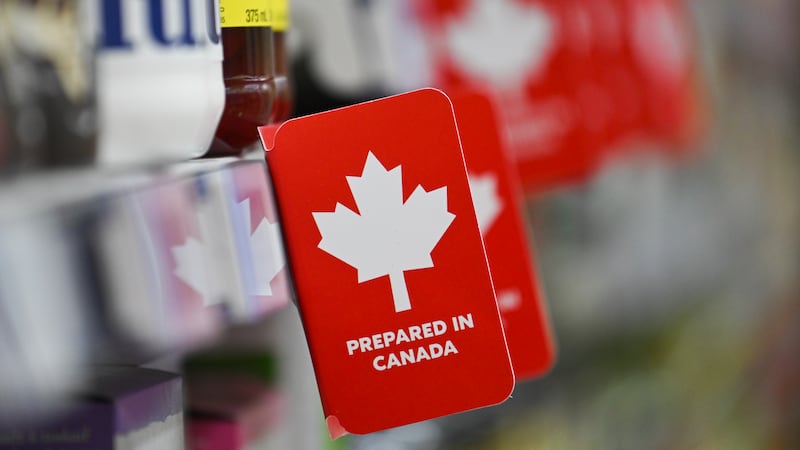
Toronto resident Josh Balon was shopping for meat at his local grocery store when he decided it may be a good time to look at supporting a local butcher shop. “I think if anyone has the means to support local… those small businesses, I think those are really important because they’re going to hurt,” he told CP24.com. “They (grocery chains) have a lot more room to weather the storm compared to a local butcher.” Balon is one of a number of Torontonians who have set their sights on buying more local products as the trade war between Canada and the United States heats up. New U.S. tariffs on billions of dollars of Canadian goods were implemented on Aug. 22, prompting the Canadian government to announce dollar-for-dollar retaliatory tariffs. Those counter-tariffs on hundreds of U.S. products range from 15 to 50 per cent and come into effect after Labour Day. Trade talks broke down last weekend after Prime Minister Mark Carney said the U.S. offered Canada a “bad deal.” A war of words between Trump and Ontario Premier Doug Ford led Trump to sign an executive order to change the name of Lake Ontario to Lake America. The trade dispute has dominated headlines in the country in recent days and retail expert Bruce Winder said it is top of mind for Canadians, who are assessing the ways in which they can support businesses in the country. “(They) are talking about it at the water cooler, they’re talking about it at the dinner table,” he said. He noted that Loblaw has recently re-introduced ‘T’ labels on products to indicate what products are impacted by tariffs, as well as a maple leaf symbol to identify Canadian products. “That’ll sort of help guide the consumer for (those) who really want to buy Canadian and who really want to maybe avoid some of the products that have been impacted because of the tariffs,” he said. He said Canadians have also shifted toward supporting other Canadian retailers outside the grocery segment, opting to shop at Canadian Tire, Rona, or Dollarama over other U.S. or multinational businesses. ‘Do what we can within our means’ Winder said that not everyone is affluent enough to go all in on the buy Canadian movement. “I think that’s probably the biggest impact a consumer can make is to shop at a Canadian grocer and also try to look on the labels and buy Canadian where possible,” he said. Balon said over the past year, he has made sure to shift his grocery purchases to Canadian producers when possible. One U.S. product he has switched out for a Canadian alternative is ice cream. “I’ve completely shifted away and stopped buying those U.S. brands and gone fully into Chapman’s,” he said. He noted that he also makes a point to shop at Canadian grocery chains. “Different people are going be able to go different lengths to supporting Canadian businesses,” he said. “I think we should all do what we can within our means.” Speaking to CTV News last week, Brydon Parker, who founded the website MadeInCanada.dev, said he has seen a “surge in traffic” over the past few days. According to Parker, the site gets anywhere from 10 to 100 visitors on the average day. This week, that jumped to around 1,000 at peak traffic. “There are a lot of great Canadian companies that Canadians do not even know about,” Parker told CTV News. “If they did know about them, they would be excited to be shopping for those rather than other alternatives.” He said he thinks the patriotic purchasing will likely stick around. “We all want to band together in times of challenge, try to support each other and figure out how we prosper through it all,” he said. ‘Not a perfect science’ While Balon told CP24 that he sees a lot of opportunity to support local, he isn’t boycotting U.S. companies who employ thousands of Canadian workers. “Those companies, you know, they have head offices, they have employees here in Canada,” he said. Winder noted that globalism has made it much more complicated to simply buy 100 per cent Canadian products. “You don’t want to sort of throw the baby out with the bathwater. It’s a nuanced discussion, and it’s a nuanced way of thinking about it,” he said. “What I try to do, and I think what a lot of Torontonians try to do, is just try to support Canadian as much as possible, knowing it’s not a perfect science.” With files from CTV News Video Journalist Allison Bamford